Strategic National Floor Care Programs: The 2026 Facility Manager’s Guide
The cleaning industry faces a staggering 42% labor turnover rate, yet by the fourth quarter of 2026, OSHA will require strict annual slip-resistance testing and documentation. For facility managers overseeing multiple locations, relying on a fragmented network of local vendors is no longer a viable strategy. It’s a significant risk to your operational consistency. Strategic national floor care programs offer the only path to maintaining high-standard environments while insulating your brand from these rising regulatory and labor pressures.
You’ve likely dealt with the headache of managing twenty different invoices and the visible disparity in floor quality between cities. It’s exhausting to police night-shift crews from a distance without reliable quality assurance. This guide outlines how to consolidate your maintenance into a single, strategic framework that reduces lifecycle costs and ensures ISO-compliant results across every branch. We’ll examine the shift toward data-driven performance metrics, the impact of new EPA chemical limits, and the steps to securing a single point of contact for your entire portfolio.
Key Takeaways
- Shift from reactive cleaning to a proactive asset preservation strategy to significantly extend the lifecycle of your flooring materials.
- Discover how national floor care programs eliminate administrative friction by replacing multiple local vendor invoices with a single, consolidated billing system.
- Master the balance between daily preventive maintenance and scheduled interim care to ensure consistent quality across every geographic location.
- Learn the step-by-step process of harmonizing your Scope of Work (SOW) through professional site audits and standardized cleaning protocols.
- Gain insights into managing high-compliance environments, such as labs and banks, using ISO-compliant protocols and centralized quality assurance.
What Defines an Effective National Floor Care Program in 2026?
An effective national floor care program is a centralized management framework that replaces fragmented local cleaning contracts with a unified, data-driven strategy. It’s no longer sufficient to hire a local janitorial crew and hope for the best. In 2026, the complexity of regulatory compliance and the rising cost of flooring materials demand a more sophisticated approach. These national floor care programs act as a strategic management layer, ensuring that every square foot of your portfolio meets specific safety and aesthetic benchmarks regardless of its zip code.
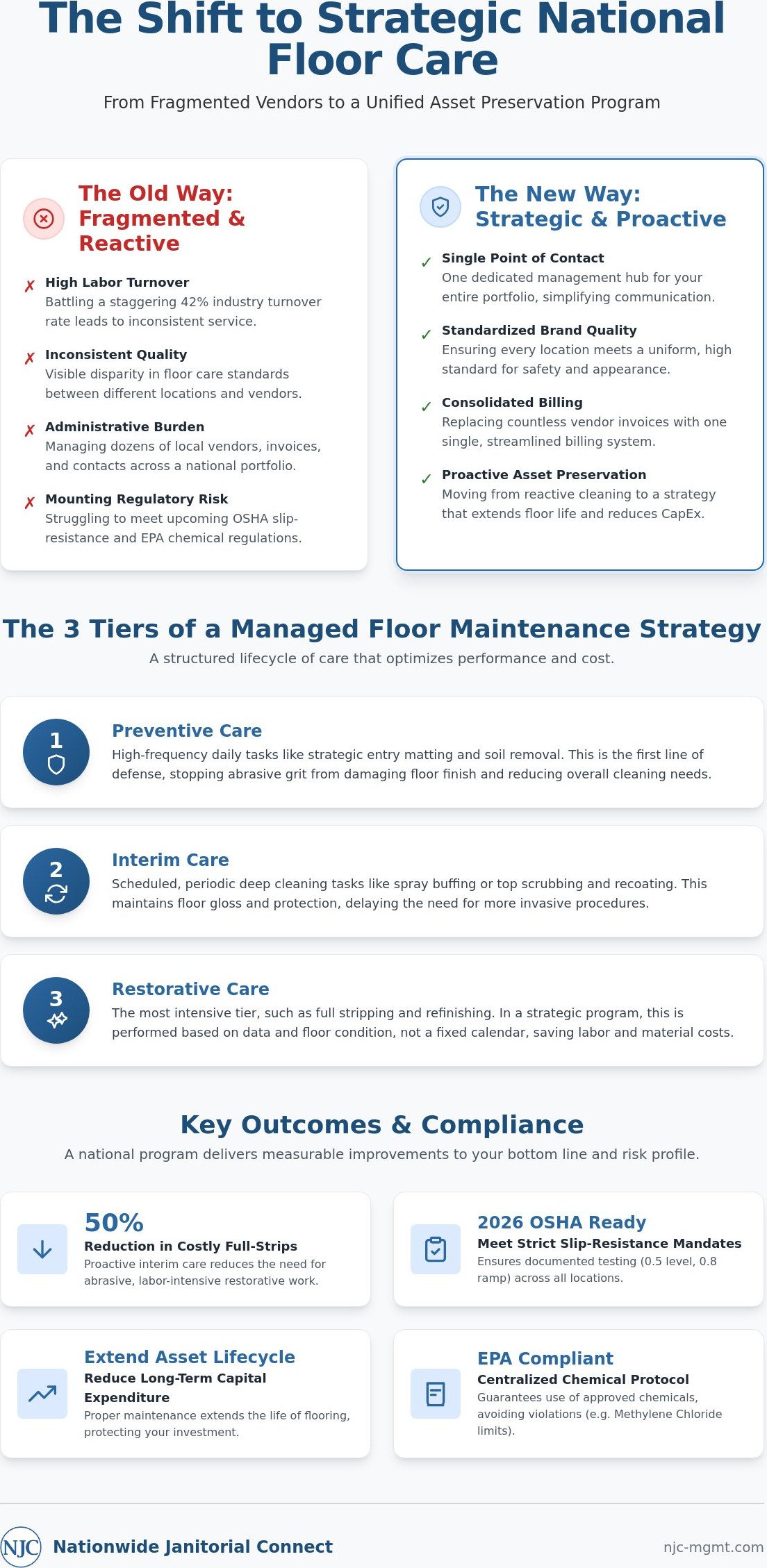
The industry has moved decisively away from reactive cleaning. Waiting for a floor to look dull or damaged before intervening is a financial mistake. Modern facility management prioritizes proactive asset preservation. This shift is driven by new 2026 OSHA standards that mandate quantitative slip resistance testing, requiring a minimum coefficient of friction of 0.5 on level floors and 0.8 on ramps. A managed national program ensures these measurements are taken, recorded, and maintained across 20 or 200 locations with absolute precision.
Standardization vs. Local Adaptation
Success starts with a defined Brand Standard. This is a non-negotiable benchmark for floor appearance and safety that applies to all sites. By centralizing Floor cleaning methods and equipment protocols, you eliminate the risk of a local vendor using an unapproved, high-VOC chemical that violates 2026 EPA exposure limits. For example, the EPA now restricts Methylene Chloride to 2 ppm; a national program ensures that stripping agents used in your facilities are strictly compliant.
While the standard is uniform, the execution must be flexible. A branch in a snowy climate requires aggressive salt-neutralization and high-frequency entry matting programs that a desert-based location doesn’t need. A strategic partner like NJC manages these local nuances through a single Houston-based hub, providing one point of contact while adapting frequencies to local foot traffic and weather patterns.
Asset Preservation: Extending Floor Life via Strategy
Strategic national floor care programs are designed to reduce long-term capital expenditures (CapEx). When floors are maintained through a managed cycle of preventive and interim care, the need for costly, abrasive full-strips is reduced by up to 50%. This is particularly critical for VCT and natural stone in high-traffic zones, where the science of polymer bonding and diamond-pad polishing can extend the material’s life by years.
The Life Cycle Cost of commercial flooring is the total sum of the initial acquisition and installation price plus all cumulative operational and maintenance expenditures incurred throughout the asset’s functional lifespan. By optimizing this cost, facility managers can reallocate budgets toward other critical infrastructure needs, such as the structural outdoor construction and deck restoration provided by Cascade Outdoor Services to enhance property value. High-compliance sectors, such as laboratories and financial institutions, benefit most from this rigor, as it ensures ISO-compliant environments remain pristine without the constant need for floor replacement.
The Core Components of a Managed Floor Maintenance Strategy
A sophisticated floor maintenance strategy is not a single recurring task. It’s a structured lifecycle. National floor care programs provide the necessary oversight to coordinate three distinct tiers of care: preventive, interim, and restorative. Without this centralized management, local crews often fall into the trap of over-stripping floors. This aggressive approach damages the substrate and inflates costs. Conversely, neglecting daily maintenance leads to premature wear and expensive replacements.
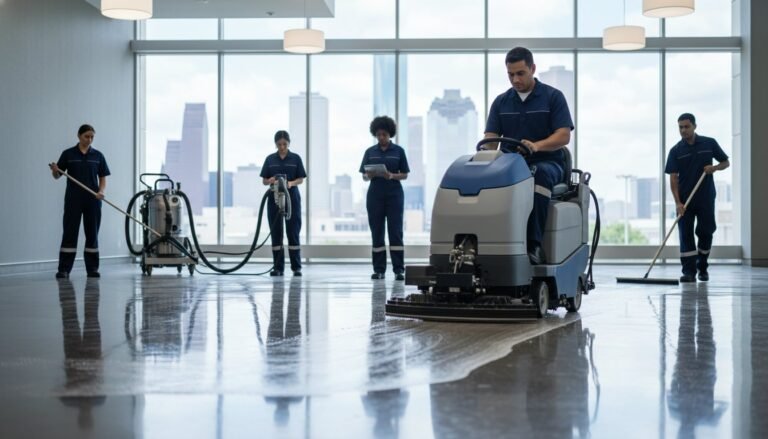
Preventive maintenance focuses on high-frequency tasks like entry matting and daily soil removal. These actions stop abrasive grit from acting like sandpaper on your floor finish. Interim care involves scheduled deep cleaning and buffing to maintain gloss and protection. Restorative care, such as stripping and waxing, is the most invasive tier. In a strategic program, restorative work is timed based on actual surface condition rather than an arbitrary calendar. This data-driven timing saves significant resources in labor and chemicals.
Quality assurance acts as the final pillar of this strategy. Relying on a cleaning crew to grade their own performance is a conflict of interest. Effective programs utilize third-party inspections to verify that all protocols align with Green Seal environmental standards and your internal brand requirements.
Frequency Modeling for Multi-Location Facilities
Facility managers should avoid “one-size-fits-all” scheduling. A quiet bank branch doesn’t require the same maintenance cadence as a 24-hour retail flagship. We utilize foot-traffic data to build custom frequency models for every site in your portfolio. This precision balances aesthetic requirements with budget constraints. It ensures you aren’t over-servicing low-traffic zones while preventing high-traffic locations from reaching a state of failure. By implementing national floor care programs, you gain the ability to scale these custom cadences across hundreds of locations without losing control. Developing a robust vendor management strategy is the first step toward this level of operational maturity.
Compliance and Safety Standards
Floor care is a primary tool for risk mitigation. Slip-and-fall incidents represent a massive liability for multi-location operations. Maintaining a consistent coefficient of friction is a legal and ethical necessity. For specialized environments like clean rooms or laboratories, the requirements are even more rigorous. You must meet specific ISO standards to prevent contamination and maintain certification. If your portfolio includes high-compliance facilities, our industrial cleaning services in Houston offer the technical precision required for these sensitive environments. Partnering with a specialist ensures your floors remain safe, compliant, and visually consistent across your entire national footprint.
Vendor Consolidation: Solving the Multi-Location Management Gap
Managing a multi-state facility portfolio often results in a fragmented administrative nightmare. When you juggle twenty different local vendors, you aren’t just managing floors. You’re managing twenty different insurance certificates, twenty sets of invoicing quirks, and twenty varying levels of quality. This management gap is where brand consistency dies. Transitioning to national floor care programs isn’t merely an operational shift. It’s a strategic move to reclaim your most valuable resource: time.
The hidden costs of a decentralized approach are staggering. Facility managers often suffer from contractor fatigue, spending hours chasing down night-shift crews or clarifying why a floor in Phoenix looks nothing like the one in Chicago. A single point of contact eliminates this friction. You gain a partner who understands your specific brand standards and enforces them across the board. If a sub-par result occurs at any location, you don’t have to navigate a maze of local contacts. You have one strategic partner held accountable for the entire portfolio.
A common objection to consolidation is the fear of losing local responsiveness. This is a misconception. Centralized management doesn’t mean removing the local presence; it means professionalizing it. By applying Floor Maintenance Best Practices through a managed network, you ensure that local crews have the direction and oversight they need to succeed. Our Houston-based management team vets every vendor in the network, ensuring they have the technical capability to meet your standards before they ever step foot in your facility.
Eliminating Administrative Friction
Centralization transforms your daily workflow. Instead of managing a chaotic inbox of local updates, you move toward consolidated billing and unified communication. Implementing facility vendor management solutions allows you to focus on high-level asset strategy rather than chasing invoices. This shift reduces the administrative burden on your team, allowing for more predictable budgeting and resource allocation across your entire national footprint.
Centralized Quality Assurance (QA)
Quality control must be independent. Relying on a technician’s self-reported job complete status is a risk you can’t afford in high-compliance sectors like banking or laboratory management. NJC acts as your eyes on the ground. We use standardized reporting and project management tools to verify that every stripping, waxing, or buffing job meets your exact specifications. You see the health of your entire portfolio from a single dashboard. This level of transparency ensures that night-shift crews remain disciplined and that your facilities always reflect the professional image your brand demands.
Implementing a National Program: Site Audits to Consolidated Billing
Transitioning from a fragmented vendor network to a unified management structure requires a disciplined roadmap. You can’t simply flip a switch and expect fifty locations to align overnight. Successful national floor care programs are built on a four-stage implementation process that prioritizes data over guesswork. This transition moves your facility management from a reactive “call when it’s dirty” model to a proactive asset management strategy.
The journey begins with a National Site Audit. We baseline the current condition of every floor in your portfolio. This isn’t a superficial walkthrough. It’s a technical assessment of wear patterns, substrate health, and current slip resistance levels. Once this data is collected, we move to Scope of Work (SOW) harmonization. We replace vague local descriptions with standardized, high-performance protocols that meet 2026 regulatory demands, including the strict EPA exposure limits for chemicals like Methylene Chloride and Perchloroethylene.
Vendor sourcing follows. We vet local crews for technical proficiency in specialized environments, such as financial centers or ISO-compliant laboratories. The final stage is the launch of our management layer, which introduces centralized reporting and consolidated billing. This structure ensures that your corporate headquarters has total visibility into every facility, regardless of its geographic location. For those currently evaluating their options, choosing the right janitorial company depends on their ability to handle this level of complex logistical orchestration.
The Power of Consolidated Invoicing
Administrative friction is the silent killer of facility budgets. Managing hundreds of individual bills from diverse vendors creates an accounting labyrinth that’s prone to error and overpayment. By centralizing through national floor care programs, you replace this chaos with a single monthly invoice. This model offers flat-rate national pricing, which provides the budget predictability your CFO demands. It also simplifies the audit trail for corporate accounting, ensuring every dollar spent on floor maintenance is documented and justified against performance metrics.
Transitioning from Local to National
Managing the “change” process is as much about people as it is about protocols. We work closely with your on-site staff to ensure they understand the new standards and reporting requirements. Our goal is to ensure zero downtime during vendor transitions. We coordinate the logistics of equipment delivery and crew training behind the scenes, so your daily operations remain undisturbed. This seamless handoff is a hallmark of professional management. If you are ready to streamline your operations, our team is prepared to lead your vendor sourcing and management transition from start to finish.
NJC Management: Your Strategic Partner for Floor Care Excellence
NJC Management operates as a strategic management hub, providing the oversight necessary for complex, multi-location portfolios. We aren’t just another vendor in a crowded marketplace. We act as your single-source management layer. Our Houston-based team coordinates national floor care programs with a level of precision that local, fragmented providers simply can’t match. We don’t just find vendors; we manage the outcome. This means every stripping, waxing, and polishing job is verified against your specific brand standards and the latest 2026 safety regulations.
The value of our partnership lies in our ability to absorb the administrative “headache” of vendor management. We handle the sourcing, the vetting, and the ongoing quality assurance inspections that keep your facilities pristine. By centralizing these functions, we provide a level of accountability that protects your brand’s reputation and your bottom line. Whether you’re managing 20 or 200 locations, our team ensures that your floor maintenance is a predictable, managed asset rather than a source of constant operational friction.
High-Standard Environment Expertise
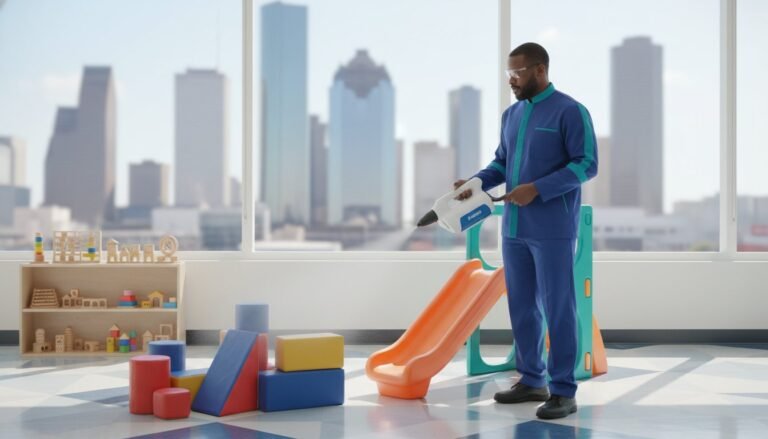
Specialized sectors require more than basic janitorial skills. We bring deep expertise to high-compliance environments, including financial institutions, laboratories, and daycares. For our lab clients, we maintain ISO-compliant protocols that meet the rigorous 2026 standards for clean room environments. Our banking partners rely on our security-cleared protocols to ensure that high-standard maintenance occurs without compromising facility integrity. If your portfolio requires this level of technical discipline, our commercial floor cleaning in Houston serves as the operational blueprint for our national expansion.
A Single Source for 20+ Facility Solutions
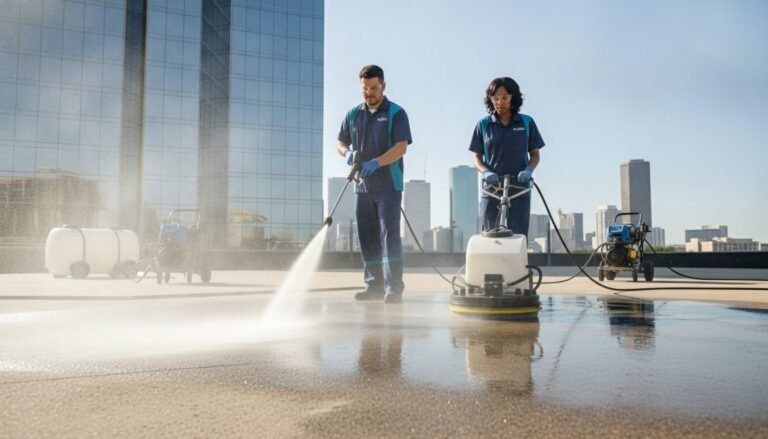
Effective facility management is holistic. While floor care is a critical component, it’s often more efficient to integrate it with other essential services. NJC provides a single point of contact for over 20 facility solutions, including window cleaning, pressure washing, and day porter services. This integration eliminates the need for multiple management layers, and for specialized requirements like carpet deep-cleans or professional end-of-tenancy services, Dynamic Pro Clean Ltd provides the expert precision needed to maintain high-standard environments. By consolidating these services under our national floor care programs, you gain a strategic partner capable of maintaining your entire facility’s exterior and interior aesthetics with a single, unified vision.
Success in 2026 requires a move away from reactive maintenance toward strategic asset preservation. We invite you to experience the efficiency of a managed national program tailored to your specific geographic and regulatory needs. Contact us today for a strategic consultation and let our team perform a custom audit of your facility portfolio to identify immediate cost-saving and quality-improvement opportunities.
Modernizing Your Facility Asset Strategy
The shift toward centralized management is a necessity for maintaining operational excellence in 2026. By moving away from fragmented local contracts, you protect your flooring assets and insulate your organization from rising regulatory risks. Effective national floor care programs transform maintenance from a recurring headache into a predictable, high-performance asset strategy. You gain total visibility through standardized reporting and eliminate the administrative burden of managing dozens of separate invoices.
NJC Management serves as your strategic partner, providing a single point of contact for over 20 facility solutions. We specialize in high-compliance environments, ensuring your portfolio meets rigorous ISO and bank-specific standards through every cleaning cycle. Our Houston-based hub offers consolidated billing for all locations, allowing you to focus on high-level growth rather than chasing local vendors. It’s time to elevate your facility standards and reclaim your team’s valuable time.
Request a Strategic Floor Care Management Quote to begin your national site audit. We look forward to securing your facility’s future and ensuring your brand’s consistency across every location.
Frequently Asked Questions
What are the benefits of a national floor care program?
National floor care programs provide a unified standard for appearance and safety across your entire geographic footprint. This centralization eliminates the inconsistency often found when managing disparate local vendors. It ensures every branch meets the same aesthetic benchmarks. You gain significant administrative efficiency by replacing dozens of local contracts with a single, strategic management layer that oversees all site-specific protocols.
How does vendor consolidation save money in facility management?
Consolidation reduces the administrative labor required to process multiple invoices, insurance certificates, and points of contact. By moving to a single partner, you access predictable national pricing models and data-driven maintenance schedules. This proactive approach prevents premature floor replacement. It reduces long-term capital expenditures by extending the functional life of your flooring materials through better preservation strategies.
Can a national program handle specialized ISO clean room standards?
Yes, a professional national program is specifically designed to meet the rigorous requirements of high-compliance environments. NJC specializes in cleaning for laboratories and clean rooms, utilizing protocols that align with 2026 ISO standards. This ensures your facilities maintain their certifications while providing a safe, contamination-free environment for sensitive operations. We manage the technical precision required for these specialized zones across all your locations.
What is included in a typical commercial floor maintenance scope of work?
A comprehensive scope of work typically includes three tiers of care: preventive, interim, and restorative. This covers daily soil removal and entry matting to stop abrasion, scheduled buffing to maintain gloss, and strategically timed stripping and waxing. The SOW is customized based on foot-traffic data and the specific substrate of each facility. This structured approach ensures that every location receives the exact level of care it needs to stay pristine.
How do you ensure quality across multiple states without being on-site daily?
Quality is managed through standardized reporting and independent quality assurance inspections. We don’t rely on a local crew’s self-reporting. Instead, we use digital project management tools to verify performance against your specific brand standards. This centralized oversight allows you to view the condition of every facility across the country from a single, transparent dashboard. You get eyes on the ground without leaving your office.
Is consolidated billing available for all janitorial services?
Yes, consolidated billing is available for our entire suite of over 20 facility solutions. This includes janitorial services, window cleaning, pressure washing, and day porter services. By aggregating these costs into a single monthly invoice, you simplify the audit trail for corporate accounting. It provides better control over your total facility spend and reduces the risk of overpayment to local providers.
How often should commercial VCT floors be stripped and waxed?
The frequency depends on foot traffic and the quality of daily maintenance, but most VCT floors require stripping and waxing every 12 to 24 months. However, a strategic program often extends this interval by prioritizing daily soil removal and regular buffing. This data-driven approach ensures restorative work is only performed when the surface condition demands it. It saves significant resources in both chemical usage and labor costs.
What is the difference between a janitorial vendor and a facility management partner?
A janitorial vendor focus purely on the execution of labor tasks, often in a reactive manner. In contrast, a facility management partner like NJC acts as a strategic consultant that manages the entire lifecycle of your assets. We handle vendor sourcing, regulatory compliance, and quality assurance. Our goal is to ensure that your maintenance outcomes align with your long-term business goals and brand reputation.