Facility Manager Cleaning Checklist: The 2026 Strategic Houston Guide
In a city where 55% of property owners now mandate quarterly professional maintenance just to preserve asset value, a basic janitorial list is no longer a tool; it’s a liability. You’ve likely felt the frustration of inconsistent quality across multiple vendors or the constant pressure of Houston’s humidity triggering mold concerns before your next inspection. Managing high-compliance spaces like labs or clean rooms only adds another layer of complexity to an already demanding schedule.
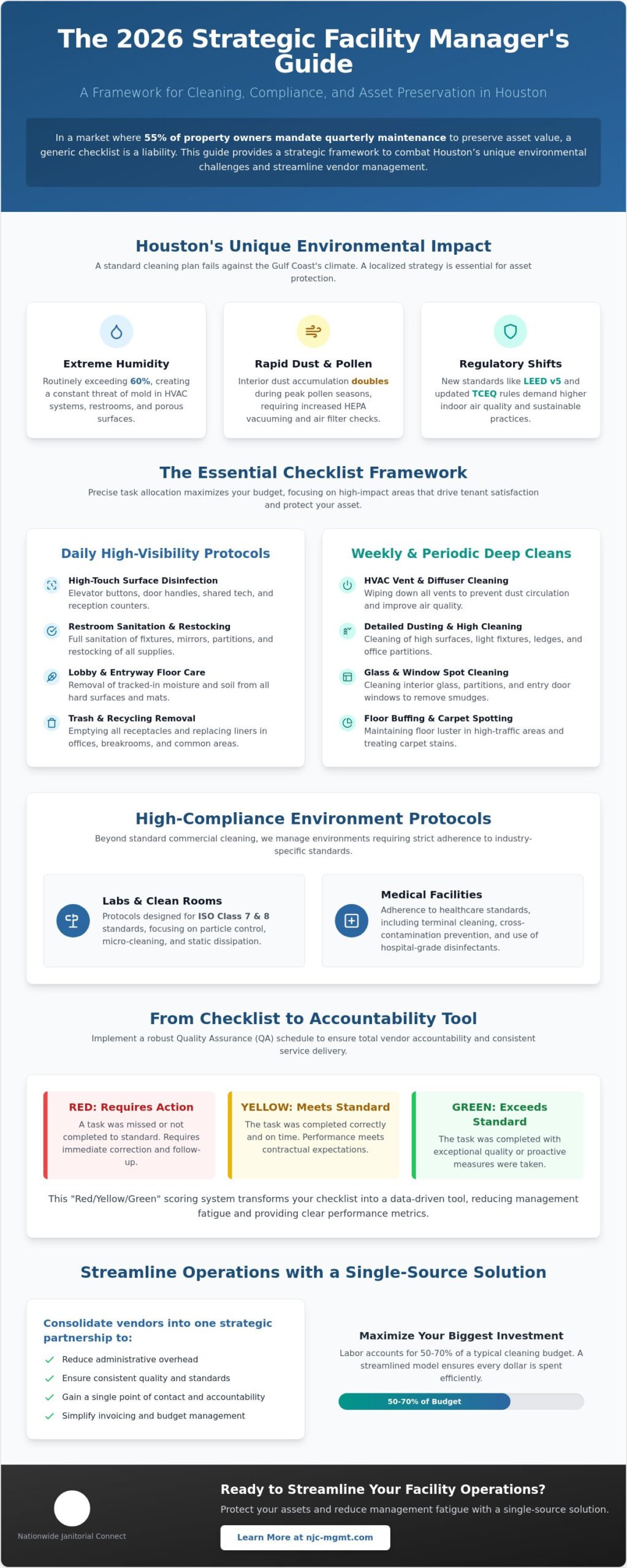
You deserve a standardized, professional protocol that eliminates the guesswork and reduces tenant complaints. This 2026 strategic facility manager cleaning checklist houston guide is designed to help you master facility maintenance through the lens of Houston’s unique climate and the latest regulatory shifts, including LEED v5 standards and updated TCEQ compliance rules. We’ll explore how to build a framework for total vendor accountability while consolidating your management needs into one streamlined, high-precision operation that protects your assets and your time.
Key Takeaways
- Learn why a comprehensive facility manager cleaning checklist houston must account for extreme humidity and rapid dust accumulation to ensure long-term asset preservation.
- Identify the specific daily and weekly protocols for high-touch disinfection and restroom sanitation required for high-occupancy Houston office towers.
- Master the compliance requirements for specialized environments, including ISO Class 7 and 8 clean rooms and medical facility standards.
- Implement a robust Quality Assurance inspection schedule using the “Red/Yellow/Green” scoring system to maintain total vendor accountability.
- Discover how a single-source management model reduces administrative overhead by consolidating multiple specialized vendors into one strategic partnership.
Beyond the Basics: Why Houston Facility Managers Need a Strategic Cleaning Checklist
In Houston’s competitive commercial real estate market, cleaning is a financial strategy. It’s not just about emptying bins; it’s about protecting the building’s physical structure and ensuring tenant retention. A generic checklist won’t suffice here. Generic templates fail because they ignore the specific environmental stressors of the Gulf Coast. A high-precision facility manager cleaning checklist houston transforms janitorial tasks into a framework for asset preservation. By moving away from reactive responses, you can adopt comprehensive facility vendor management solutions that streamline operations and ensure accountability across your entire portfolio.
Effective Facility management requires integrating people, place, and process to improve the quality of life for occupants. In 2026, this integration relies heavily on data-driven maintenance. With 55% of Houston property owners now scheduling professional exterior maintenance on a quarterly basis, the standard for “clean” has shifted from visual appeal to measurable asset protection. This section examines how a localized strategy addresses the unique challenges of our region.
The Houston Environmental Impact
Humidity is the primary antagonist for Houston buildings. When humidity levels routinely exceed 60%, the risk of mold growth in HVAC systems and restrooms becomes a constant threat to indoor air quality (IAQ). Your checklist must include specific mold prevention checkpoints that go beyond surface cleaning. This includes verifying the dryness of porous surfaces and monitoring high-moisture zones like breakrooms. Seasonal adjustments are also vital. During peak pollen months, your interior dust accumulation doubles, requiring increased HEPA vacuuming and air filter inspections to maintain a healthy environment.
The FM Shift: From Task-Oriented to Strategy-Driven
Modern facility managers use their cleaning protocols as a Quality Assurance (QA) instrument. A standardized facility manager cleaning checklist houston reduces the “management fatigue” that often plagues multi-site operations. Instead of micromanaging every vendor, you manage the data provided by the checklist. This approach aligns your cleaning protocols with corporate sustainability goals, such as the new LEED v5 standards that emphasize indoor air quality monitoring. By shifting to a strategy-driven model, you ensure that every dollar spent on janitorial services contributes to the long-term health and value of the property.
The Essential Daily and Weekly Commercial Cleaning Checklist for Houston Facilities
Managing a high-traffic asset requires more than a casual walkthrough. Your facility manager cleaning checklist houston must be a living document that accounts for the constant influx of Gulf Coast grit and the bacterial risks of the Texas heat. Since labor typically accounts for 50-70% of your total cleaning budget, maximizing that investment requires precise task allocation. Every minute spent on a low-impact task is a minute taken away from high-visibility areas that drive tenant satisfaction.
Daily High-Visibility Maintenance
High-touch surface disinfection is the cornerstone of a healthy building. We’ve moved beyond the simple wipe-down to a protocol that meets the ISSA Clean Standard for measurable hygiene. Focus daily on elevator buttons, door handles, and shared technology in conference rooms. These areas are the primary vectors for cross-contamination in high-occupancy towers, especially during peak seasonal illness cycles.
Floors in Houston take a beating from tracked-in moisture and abrasive soil. Implementing commercial floor cleaning best practices ensures that stone and tile surfaces maintain their luster without becoming slip hazards. Daily maintenance should also include trash removal and liner replacement. Under LEED v5 standards, ensure your team uses liners with at least 40% post-consumer recycled content to stay compliant with modern sustainability goals and reporting requirements.
The “First Impression” protocol for lobbies and entryways is equally critical. Glass doors must be wiped of fingerprints twice daily, and walk-off mats must be vacuumed frequently to prevent soil from migrating further into the building. This proactive approach reduces the frequency of expensive deep-cleaning sessions later in the year.
Weekly Deep-Dive Tasks
While daily tasks maintain the status quo, weekly deep-dives protect the building’s long-term health. High-level dusting of HVAC vents, light fixtures, and ceiling corners prevents the rapid dust accumulation that triggers employee complaints. Glass and mirror surfaces require specific attention to remove the streaks and mineral deposits caused by Houston’s pervasive humidity.
Upholstery and Carpet Cleaning spot treatments are essential weekly additions. Addressing stains before they set prevents permanent fiber damage and keeps your lobby looking pristine. For those managing complex portfolios, partnering with a firm that provides dedicated Quality Assurance Inspections can ensure these weekly standards never slip. Consistent oversight is the only way to guarantee that your checklist is being followed to the letter.
Finally, breakroom and kitchen sanitation must be prioritized to prevent pest issues in the Texas heat. Weekly tasks should include cleaning the interior of microwaves and wiping down the gaskets of refrigerators where moisture and food particles often hide. These small details prevent larger, more expensive infestations and maintain a professional atmosphere for your staff.
High-Compliance & Specialized Environment Checklists: Labs, Medical, and Clean Rooms
Specialized environments in Houston, particularly within the Texas Medical Center and the Energy Corridor, demand a level of precision that standard janitorial services cannot provide. A high-precision facility manager cleaning checklist houston must account for these high-compliance zones where a single oversight can compromise sensitive research, patient safety, or institutional security. Managing these spaces requires a strategic partner who understands that cleaning is an extension of your facility’s operational integrity. In these sectors, your protocol isn’t just a guide; it’s a critical component of your risk management strategy.
Clean Room & Lab Protocols
Houston’s biotech sector relies on ISO Class 7 and 8 clean rooms that must meet stringent particulate standards. Your checklist should mandate specialized gowning requirements for all personnel entering these zones to prevent the introduction of outside contaminants. Surface-specific cleaning is equally critical; anti-static and non-porous materials require non-residual cleaning agents to maintain their technical properties. To ensure your lab remains compliant, your protocol should include:
- Mandatory HEPA vacuuming of all horizontal surfaces to manage dust and particulates.
- Strict verification of gowning and PPE compliance before entry.
- Meticulous log-book entries for every cleaning interval to provide an audit trail.
Laboratory settings also introduce the complexity of specialized chemical handling and disposal. Your cleaning protocol must clearly define the boundaries between general waste and hazardous materials. Ensuring that janitorial teams are trained in these distinctions prevents accidental exposure and environmental violations. This is increasingly important given the TCEQ’s updated rules for 2026, which now track minor violations more aggressively in a facility’s compliance history.
Banking & Financial Institution Standards
Financial institutions require a unique blend of high-security protocols and “Professional Elegance.” Cleaning in these sensitive environments is not just about sanitation; it’s about maintaining a secure and trustworthy atmosphere. Your facility manager cleaning checklist houston should specify that all janitorial staff must undergo comprehensive background checks before gaining access to vault areas or executive suites. Security is the priority, but the aesthetic standard must remain high to reflect the institution’s brand.
- Dedicated disinfection of ATM touchscreens and teller counters to manage high-volume public interaction.
- Polishing of high-end finishes in executive boardrooms using pH-neutral cleaners.
- Strict adherence to after-hours security protocols and key management.
In executive suites, the focus shifts to preserving assets like marble flooring and polished wood. Using the wrong chemicals can cause permanent damage, leading to expensive restoration costs. By formalizing these security and aesthetic requirements, you ensure your financial facility remains a secure, premium environment for both clients and staff. This strategic approach reduces the burden on your management team while maintaining the highest standards of accountability.
Audit & Accountability: Turning Your Checklist into a Vendor Management Tool
A static document is merely a list of intentions. For a Houston facility manager, the real power of a facility manager cleaning checklist houston lies in its transition from a chore list to a strategic audit tool. Accountability doesn’t happen by accident; it requires a structured Quality Assurance (QA) framework that removes subjectivity from vendor evaluations. When you treat your checklist as a data source, you gain the leverage needed to ensure every dollar of your janitorial budget is working as hard as you are.
The Inspection Process
Effective oversight requires a tiered approach. Daily spot-checks should focus on high-traffic “impression zones” like lobbies and restrooms, while monthly deep-dive audits examine technical compliance in labs or financial suites. Moving away from physical logs to digital tools provides timestamped accountability that is difficult to dispute. These digital records help you identify “blind spots” in the janitorial schedule, such as areas that are consistently missed during shift changes or high-moisture corners that require more frequent intervention in our humid climate.
Managing Vendor Performance
Objectivity is your greatest asset. Implementing a “Red/Yellow/Green” scoring system allows you to quantify performance at a glance. A “Green” score indicates full compliance, “Yellow” signifies areas needing corrective action within 24 hours, and “Red” triggers an immediate escalation. This system provides a clear roadmap for your janitorial company supervisor during your scheduled joint walkthroughs. By walking the site together, you can perform a root cause analysis: is a failed inspection due to poor performance, or is it a capacity issue where the scope of work has outgrown the current staffing levels?
Clear Key Performance Indicators (KPIs) based on your checklist ensure that expectations are never a matter of opinion. This is particularly vital when managing compliance for specialized sectors like energy or healthcare. If a vendor consistently hits their targets, rewarding that excellence helps maintain a stable, long-term partnership. Conversely, if performance remains in the “Yellow” or “Red” for consecutive months, your documented audit trail provides the necessary justification for budget reallocations or vendor changes. This documentation is essential given that the TCEQ now tracks minor and moderate violations twice a year to determine “repeat violator” status. To ensure your facility meets these rigorous standards without the administrative burden, consider scheduling professional Quality Assurance Inspections to maintain total oversight.
Streamlining Facility Operations with Nationwide Janitorial Connect’s Single-Source Solution
Managing a premier property in Houston often involves juggling 20 or more specialized vendors. From janitorial crews to exterior technicians, the administrative burden is staggering. Every vendor requires separate vetting, scheduling, and invoicing, which consumes hours of your week. This fragmented approach often dilutes the effectiveness of your facility manager cleaning checklist houston, as accountability becomes scattered across multiple points of contact. Nationwide Janitorial Connect resolves this complexity by offering a “Single Point of Contact” model, consolidating every facility need under one strategic umbrella.
Consolidating Your Facility Services
True efficiency comes from a unified service delivery. We manage the entire lifecycle of your facility’s needs, integrating everything from routine Janitorial Services to specialized Window Cleaning and high-pressure washing. Our vetting process for third-party vendors is rigorous. We ensure that every technician on your site meets the same high standards of professionalism and compliance we demand of ourselves. By moving to a single-source model, you gain several operational advantages:
- Elimination of vendor-specific “management fatigue” by dealing with one dedicated partner.
- Consolidated monthly invoicing that simplifies accounting for multi-site operations.
- Centralized documentation for LEED v5 reporting and TCEQ compliance audits.
- Uniform quality standards applied across all service lines, from the lobby to the roof.
Why Nationwide Janitorial Connect Wins for Houston FMs
We specialize in the high-compliance environments that define the Houston economy. Whether you’re managing biotech labs, educational institutions, or financial centers, we understand that your facility manager cleaning checklist houston must be non-negotiable. Our proactive Quality Assurance inspections remove the burden of manual audits from your desk. We don’t wait for you to find a mistake; we identify and correct issues before they impact your tenants or employees. This results-oriented approach is why leading FMs trust us to manage their most sensitive assets.
Nationwide Janitorial Connect combines nationwide reach with deep, localized Houston expertise. We understand how Gulf Coast humidity affects building envelopes and interior air quality. By consolidating your facility management, you reduce administrative overhead and gain a partner dedicated to long-term asset preservation. We’re ready to help you reclaim your time and elevate your property’s standards. Take the first step toward a more efficient operation and Request a Janitorial Management Quote for Houston today.
Strategic Facility Excellence in 2026 and Beyond
Mastering your building’s health requires more than a standard sweep. It demands a localized facility manager cleaning checklist houston that accounts for extreme humidity, rapid dust accumulation, and the rigorous compliance standards of the biotech and energy sectors. We’ve established that a checklist is not just a chore list; it’s a strategic instrument for vendor accountability and long-term asset preservation. By implementing structured Quality Assurance inspections and data-driven audits, you shift from reactive troubleshooting to proactive leadership.
Nationwide Janitorial Connect stands as your strategic partner in this transition. We offer a single-source solution for over 20 facility needs, including specialized lab and clean room expertise that most janitorial vendors cannot match. Our model provides consolidated billing and reporting, significantly reducing your administrative overhead while ensuring your facility remains in peak condition. It’s time to move beyond managing multiple vendors and focus on high-level strategy. Simplify your facility management with Nationwide Janitorial Connect today. Your property deserves the stability and precision of a world-class maintenance protocol.
Frequently Asked Questions
What is the most common cleaning task missed by Houston janitorial companies?
HVAC vents and high-level fixtures are the most frequently overlooked areas in commercial properties. Houston’s high pollen counts and pervasive humidity cause dust to bind to surfaces more aggressively than in drier climates. A comprehensive facility manager cleaning checklist houston must include these high-reach zones to prevent indoor air quality degradation and avoid frequent tenant complaints regarding dust accumulation.
How does Houston’s humidity affect my commercial cleaning checklist?
Humidity levels that routinely exceed 60% in the Gulf Coast region require specific mold prevention protocols. Your checklist should prioritize drying porous surfaces and disinfecting high-moisture areas like breakrooms and restrooms on a daily basis. This proactive approach prevents biological growth from taking hold in your building’s infrastructure before it becomes a structural or health liability.
What are the specific cleaning standards for ISO Class 7 clean rooms?
ISO Class 7 clean rooms require strict particulate monitoring and specialized gowning procedures for all personnel. Cleaning must be performed using non-residual, anti-static agents and HEPA-filtered vacuums to maintain the required air purity levels. Meticulous documentation in a technical log-book is mandatory to maintain regulatory compliance for Houston’s growing biotech and medical manufacturing sectors.
How often should a Houston office building perform a deep carpet clean?
High-traffic office buildings should schedule professional carpet cleaning at least twice a year to combat the abrasive effects of tracked-in soil and Gulf Coast moisture. Since 55% of property owners now schedule professional exterior maintenance on a quarterly basis, aligning your interior deep cleans with these seasonal cycles ensures consistent asset preservation across the entire facility.
Can a facility manager consolidate janitorial and exterior maintenance vendors?
Consolidating vendors is a strategic move that reduces administrative fatigue and significantly improves vendor accountability. By partnering with a single-source provider, you manage one contract and one invoice for everything from pressure washing to daily janitorial services. This model ensures that your facility manager cleaning checklist houston is executed uniformly across all service lines without managing multiple points of contact.
What is the difference between a daily cleaning checklist and a QA inspection?
A daily checklist tracks the completion of specific tasks, while a Quality Assurance (QA) inspection measures the objective quality of that work. QA inspections use scoring systems, such as the “Red/Yellow/Green” model, to provide a data-driven view of vendor performance over time. This distinction allows facility managers to manage results and long-term trends rather than just monitoring nightly activities.
Why is a single point of contact better for multi-location facility management?
A single point of contact eliminates the logistical chaos of managing dozens of separate vendors across different properties. It provides a unified communication channel, ensuring that emergency requests and routine maintenance are handled with consistent speed and quality. This structure is essential for managers who need to maintain high standards across a portfolio without doubling their administrative workload.
How do I handle cleaning in high-security areas like banks or laboratories?
Cleaning in high-security zones requires janitorial staff who have passed rigorous background checks and are trained in specific site protocols. For financial institutions and laboratories, cleaning usually occurs after-hours under strict key-management and surveillance rules. Your protocol must also include specialized training for handling sensitive equipment or hazardous chemicals to ensure both safety and regulatory compliance.