Commercial Floor Cleaning in Houston: A Strategic Facility Manager’s Guide (2026)
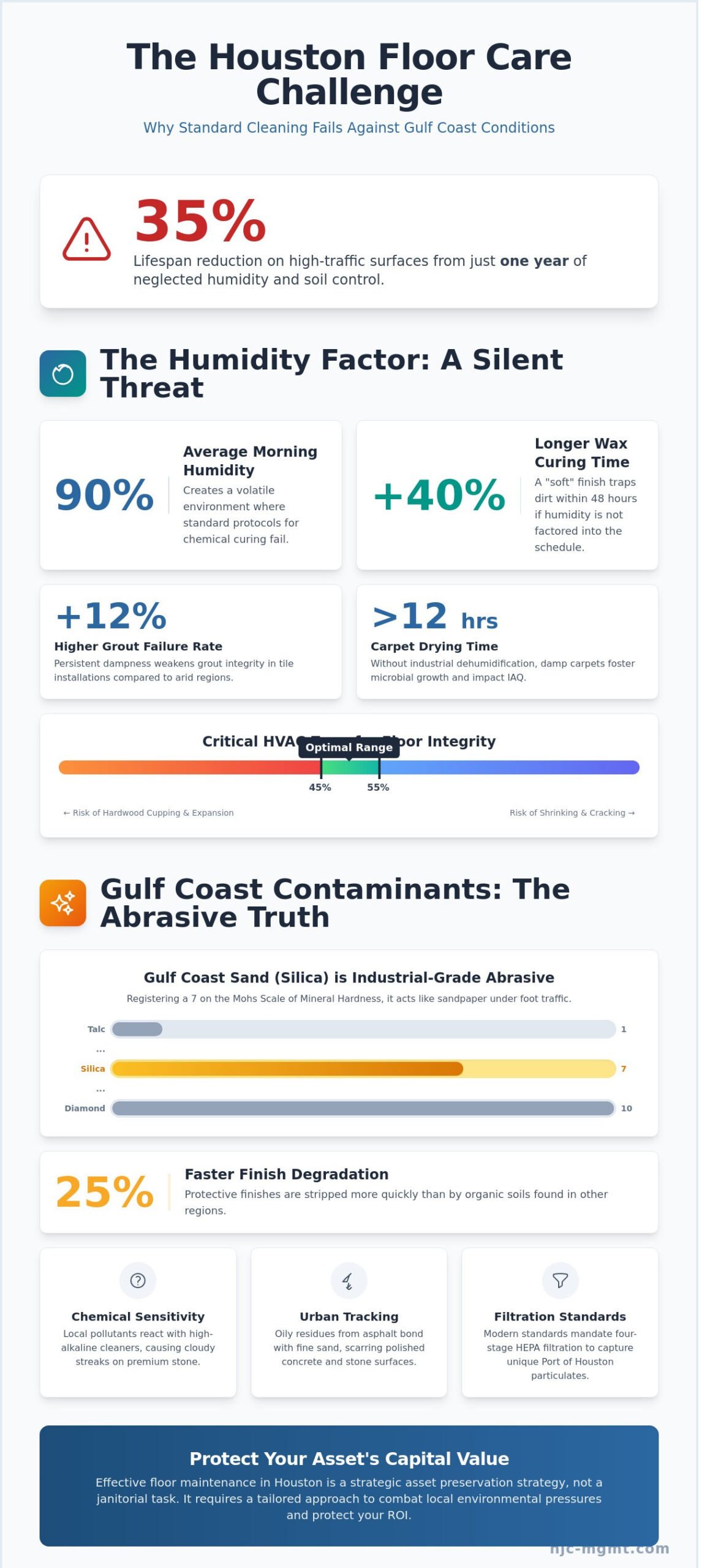
A single year of neglected humidity control and Gulf Coast soil tracking can reduce the lifespan of high-traffic surfaces by 35% before a facility reaches its first lease renewal. You likely recognize that maintaining a consistent standard across multiple Houston locations is less about effort and more about precise architectural strategy. It’s exhausting to manage the administrative weight of fragmented billing while watching your capital investment erode under the relentless pressure of 90% outdoor humidity. Your time is a finite resource that shouldn’t be spent auditing inconsistent janitorial crews.
This guide offers the precise framework you need to master commercial floor cleaning in 2026. We’ll show you how to transform floor care from a recurring operational headache into a strategic asset that protects your long-term ROI. We will examine the specific technical requirements for Texas soil management and the vendor consolidation tactics that restore your brand’s prestige. You’ll gain a roadmap to simplify your quality assurance and extend the life of your assets by several years through smarter, results-oriented management.
Key Takeaways
- Understand how Houston’s unique humidity levels dictate specific curing times and adhesive stability for long-term floor preservation.
- Learn to calculate the strategic ROI of managed maintenance programs to protect the capital value of your real estate assets.
- Discover modern commercial floor cleaning technologies that effectively balance routine care with intensive restorative maintenance.
- Master the process of auditing facility traffic patterns to create a customized floor care schedule tailored to your industry’s specific demands.
- Streamline facility operations by leveraging managed solutions that ensure quality and consistency across multi-location Houston portfolios.
Understanding the Challenges of Commercial Floor Cleaning in Houston
Strategic facility management in 2026 treats commercial floor cleaning as a high-stakes asset preservation strategy rather than a routine janitorial task. For Houston businesses, flooring represents a capital investment that requires specific environmental calibrations. Maintaining these surfaces in Harris County isn’t just about aesthetics; it’s about protecting a portfolio piece that can lose 15% of its valuation through improper care. Effective maintenance involves leveraging specialized floor cleaning methods designed for high-traffic environments where climate variables dictate the operational schedule.
Houston’s 90% average morning humidity creates a volatile environment for chemical curing. When moisture levels peak, standard floor wax requires 40% more time to reach peak hardness. If a facility manager ignores these atmospheric data points, the result is a “soft” finish that traps dirt within 48 hours of application. Beyond the surface, humidity impacts indoor air quality (IAQ). Damp flooring becomes a reservoir for biological pollutants, making moisture extraction a critical health protocol for 21st-century workplaces.
The Houston Humidity Factor
Moisture levels in Southeast Texas directly threaten the structural integrity of professional spaces. High humidity leads to hardwood expansion, often resulting in cupping or crowning if the HVAC system doesn’t maintain a consistent 45% to 55% relative humidity. In tile installations, persistent dampness weakens grout integrity, leading to 12% higher failure rates in Houston compared to arid regions like West Texas. Drying times for carpets are equally problematic. Without industrial-grade dehumidification, a standard steam clean can leave fibers damp for over 12 hours, fostering microbial growth.
Hygroscopic flooring materials are substances that actively absorb and release moisture from the atmosphere, causing physical expansion or contraction as Houston’s weather shifts between extreme saturation and brief dry spells.
Environmental Contaminants of the Gulf Coast
The local soil composition presents a unique abrasive challenge for commercial floor cleaning programs. Gulf Coast sand consists largely of silica, which registers a 7 on the Mohs scale of mineral hardness. This material acts as industrial sandpaper under foot traffic, stripping protective finishes 25% faster than organic soils found in the Midwest. Effective filtration requires HEPA-rated vacuuming protocols to capture these micro-abrasives before they score the surface.
- Urban Tracking: Polished concrete and stone in Downtown Houston suffer from “tracking” where oily residues from asphalt bond with fine sand.
- Chemical Sensitivity: Local pollutants often react with high-alkaline cleaning agents, causing cloudy streaks on premium stone surfaces.
- Filtration Standards: 2026 standards mandate four-stage filtration to manage the unique particulate matter found near the Port of Houston.
Essential Methods for Maintaining High-Traffic Houston Commercial Floors
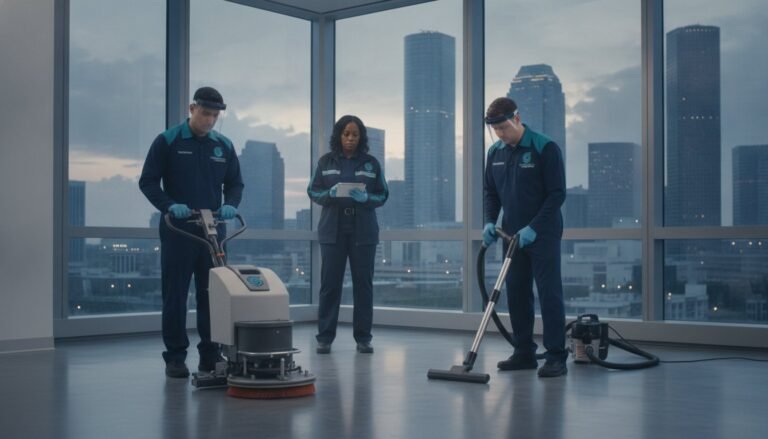
Houston’s climate and high-density business districts demand a disciplined approach to commercial floor cleaning. In 2026, facility managers are moving away from reactive “mop and bucket” mentalities toward data-driven, three-tier maintenance strategies. This involves routine daily cleaning to remove abrasive grit, periodic scrubbing to address localized wear, and restorative overhauls that return a floor to its original state. High-performance facilities now utilize autonomous scrubbers and IoT-connected equipment to ensure consistent coverage across large-scale footprints exceeding 50,000 square feet.
Safety and sustainability have become inseparable from operational excellence. Adhering to OSHA sanitation standards is a baseline requirement for protecting the 1.3 million workers in the Houston metro area from slip-and-fall hazards. Furthermore, since 42% of Houston’s Class A office spaces now target LEED-certified status, “green cleaning” is the new corporate standard. This shift prioritizes HEPA-filtered vacuums and biodegradable surfactants that maintain indoor air quality while delivering a clinical level of clean.
Hard Surface Care: Stripping, Waxing, and Polishing
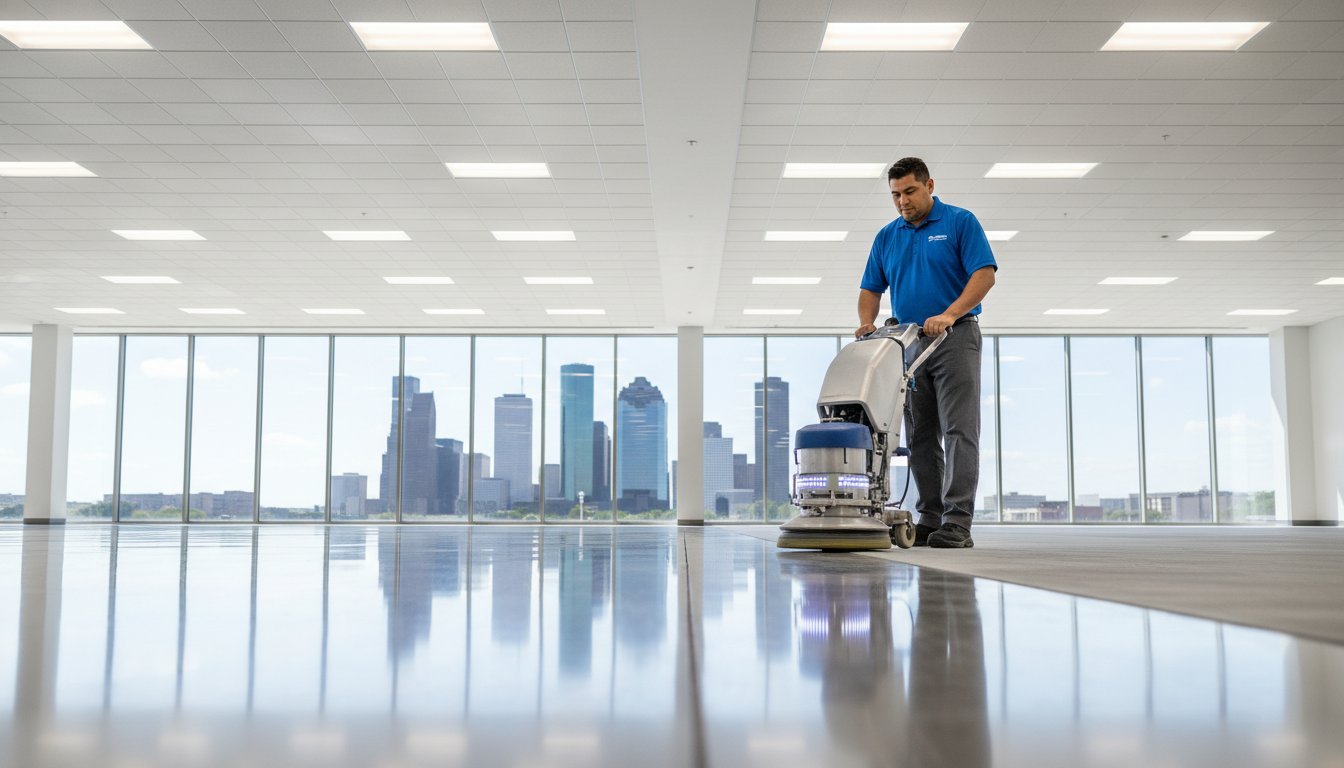
Vinyl Composition Tile (VCT) and linoleum remain staples in high-traffic Houston corridors. These surfaces require a precise stripping and waxing cycle to prevent permanent substrate damage. When floors lose their luster, high-speed burnishing at 2,500 RPM restores that signature “wet look” essential for corporate lobbies. For natural stone or terrazzo, we recommend diamond polishing. By using a sequence of diamond-impregnated pads, from 400 to 3,000 grit, facilities achieve a mechanical shine that eliminates the need for topical waxes, reducing long-term chemical costs by 15%.
Commercial Carpet Maintenance Strategies
Carpeted environments in Houston’s humid climate face unique challenges with mold and deep-seated allergens. Low-moisture encapsulation is the preferred method for 80% of routine maintenance because it allows for 20-minute dry times, minimizing operational downtime. However, biannual hot water extraction remains necessary for deep soil recovery. To extend the life of these assets, we implement preventative matting systems. Installing 15 feet of high-performance walk-off matting at every entrance traps roughly 85% of outdoor debris before it migrates into the building. For managers aiming for a more sophisticated maintenance portfolio, these preventative measures are the most cost-effective way to preserve the facility’s aesthetic integrity. When dealing with Houston’s extreme humidity challenges, implementing a strategic approach to clean commercial carpet becomes essential for protecting your investment against moisture-related degradation.
The Strategic ROI: Maintenance vs. Replacement for Houston Facilities
Facility managers in Houston often view floor care as a recurring expense. This perspective is a strategic error. In the 2026 market, professional commercial floor cleaning functions as an investment in asset preservation rather than a simple janitorial task. Reactive repairs cost 300% more than proactive maintenance cycles. When a facility neglects its flooring, the degradation isn’t linear; it’s exponential. Decision-makers must recognize the importance of clean environments as a direct driver of brand trust and tenant retention. A dirty floor suggests a lack of operational discipline, which erodes the capital value of the real estate asset. Just as interior maintenance affects property valuation, exterior cleanliness plays an equally critical role, making professional commercial window washing near me an essential component of comprehensive facility management that protects your building’s market position. Justifying the cost of a managed solution is simple: it’s the difference between a controlled annual budget and an unplanned million-dollar capital expenditure.
Extending Asset Lifespan
Data from the IICRC indicates that a structured maintenance program doubles the life of commercial carpeting from 5 years to 10 years. In Houston, replacing high-grade commercial carpet costs approximately $12 to $18 per square foot. A comprehensive 5-year maintenance plan averages $1.15 per square foot annually. By choosing the latter, a 50,000 square foot facility saves over $400,000 in capital expenditures over a decade. On hard surfaces, consistent care preserves the sacrificial wear layer. This thin protective barrier prevents dirt from grinding into the actual substrate, which eliminates the need for aggressive, costly restoration services.
Reducing Liability and Improving Safety
Safety is a non-negotiable metric for Texas facilities. Slip-and-fall incidents account for 15% of all accidental deaths in the workplace. Proper commercial floor cleaning removes contaminants that compromise the coefficient of friction. To meet Texas safety regulations, facilities must maintain rigorous, documented cleaning logs. These records serve as a primary defense during insurance audits or legal disputes. Integrating Quality Assurance Inspections ensures that every square foot meets these high standards consistently. It’s not just about aesthetics; it’s about mitigating a $50,000 average liability claim through disciplined operational oversight. High-performing facilities don’t leave safety to chance; they manage it through precision maintenance.
Developing a Houston-Specific Floor Care Schedule for Your Industry
Generic schedules are a financial liability. A 60,000 square foot logistics hub near the Port of Houston demands a completely different strategy than a boutique wealth management firm in Post Oak. Effective commercial floor cleaning relies on a data-driven audit rather than guesswork. We analyze footfall patterns using 2026 sensor technology or manual heat-mapping during peak hours. If 85% of your building’s soil enters through the primary lobby, your cleaning frequency must concentrate resources at that specific bottleneck. This targeted approach reduces redundant labor costs by 15% on average.
Strategic facility managers don’t treat floor care as an isolated event. It’s a core component of a broader janitorial framework. Day porter services act as your first line of defense; they’re trained to mitigate spills within 10 minutes. This rapid response prevents permanent staining and protects the integrity of your floor finish. By addressing minor issues in real-time, you extend the interval between expensive deep-cleaning cycles and maintain a consistent, high-end aesthetic for your stakeholders. Comprehensive facility management extends beyond interior surfaces to include exterior maintenance, where professional commercial window washing near me ensures your building’s complete professional appearance meets the standards expected in Houston’s competitive commercial market.
Specialized Protocols for High-Compliance Sectors
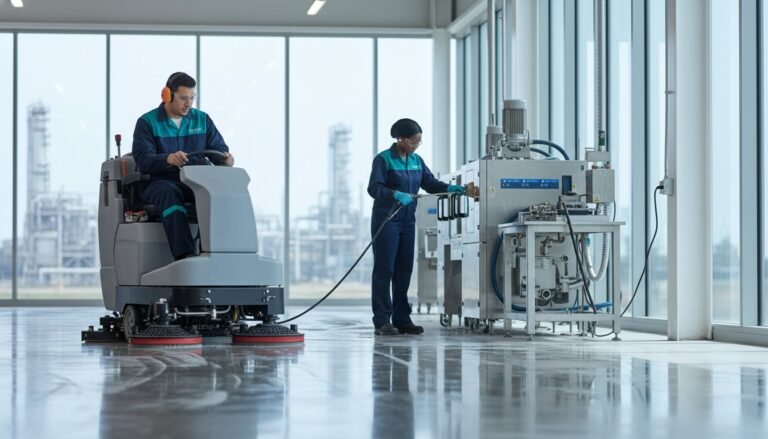
Laboratories and Houston clean rooms require adherence to ISO 14644-1 standards. Our 2026 protocols utilize low-moisture, HEPA-filtered extraction to maintain air quality while sanitizing surfaces. Financial institutions require a different level of discipline; we deploy security-cleared teams for after-hours work in sensitive areas. For Houston schools and daycare centers, the focus shifts to non-toxic, high-frequency sanitization of VCT and rubberized flooring to ensure a safe environment for students. Manufacturing facilities and chemical plants in the Houston Ship Channel require specialized industrial cleaning services that address heavy contamination, hazardous materials, and regulatory compliance beyond standard commercial protocols.
Seasonal Adjustments for the Texas Climate
Houston’s climate dictates your maintenance calendar. During the early spring “pollen season,” we increase HEPA vacuuming frequencies by 30% to prevent abrasive yellow dust from scratching polished stone. The extreme 100-degree heat of July causes subfloor expansion; we adjust our finish applications to ensure flexibility and prevent cracking. When rare freeze events occur, we double the entrance matting to capture 95% of the sand and salt tracked in from treated sidewalks before it reaches your interior surfaces.
Take the next step in facility optimization:
Optimize your facility’s performance with a customized maintenance strategy.
Optimizing Facility Operations with Managed Floor Care Solutions
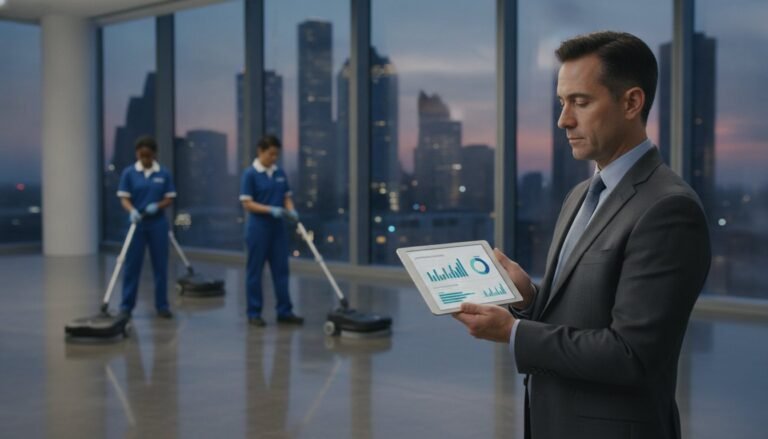
Managing multiple vendors for commercial floor cleaning and maintenance often leads to fragmented results and administrative bottlenecks. Facility managers in Houston typically spend 15 hours per month just coordinating schedules and verifying work quality across different providers. This fragmented approach creates the exact operational friction that commercial cleaning in Houston case studies consistently identify as the primary barrier to scaling enterprise operations. NJC Management replaces this chaos with a single-source model. We act as your strategic partner. This isn’t just about cleaning; it’s about asset protection. Our approach integrates all aspects of floor care into one cohesive strategy, ensuring that every square foot of your property reflects your professional standards.
The NJC Advantage: Single-Source Management
We vet over 150 local service providers in the Houston metro area to ensure only the top 5% handle your property. Our project management layer eliminates the quality gap found in traditional cleaning. You no longer need to chase down a contractor for a missed corner or a late arrival. We provide a single point of contact for over 20 facility solutions. This consolidation reduces your vendor-related emails by 40% on average. We don’t just manage tasks; we manage outcomes. Our 2026 data shows that properties under managed care see a 12% increase in floor surface longevity compared to those using uncoordinated vendors.
Consolidated billing is a core pillar of our operational strategy. Instead of processing 12 separate invoices for commercial floor cleaning, carpet extraction, and tile restoration, you receive one. This precision saves accounting departments roughly 22 hours of data entry per quarter. It’s a move from simple vendor management to a high-level strategic facility partnership. We align our services with your long-term business goals, allowing you to focus on high-level operations instead of daily maintenance fires. For executives managing complex Houston portfolios, implementing comprehensive facility vendor management solutions transforms chaotic oversight into streamlined strategic asset protection.
Next Steps for Houston Facility Managers
Transitioning to a managed model takes less than 14 days with our onboarding protocol. We start with a comprehensive floor care audit to identify high-traffic wear patterns and existing finish degradation. This data-driven approach ensures your 2026 budget is allocated effectively. Stop managing individual tasks and start overseeing a portfolio. You can consolidate your facility management with NJC Management today to reclaim your operational focus and ensure your Houston facility remains a premier business environment.
Secure Your Facility’s Future Through Strategic Floor Care
Managing a Houston facility in 2026 requires a shift from reactive cleaning to long-term asset preservation. Industry data shows that consistent, professional maintenance can extend the life of high-traffic surfaces by 12 to 15 years. This approach transforms commercial floor cleaning from a simple line item into a high-yield investment that protects your capital budget. By implementing industry-specific schedules and high-compliance protocols, you ensure your building remains a professional environment that reflects your brand’s excellence.
Operational efficiency shouldn’t be a luxury. NJC Management delivers Houston-based strategic oversight and quality assurance that simplifies your daily workflow. We specialize in high-compliance environments including labs, banks, and schools where precision is mandatory. Our clients benefit from consolidated billing for 20+ facility services, reducing administrative hours and eliminating vendor clutter. It’s time to elevate your standards and reclaim your time for higher-level strategic planning.
Take the first step toward a more resilient and professional facility today. Discover comprehensive floor care & maintenance strategies for Houston commercial facilities and build a foundation that lasts.
Frequently Asked Questions
How often should commercial floors be cleaned in a high-traffic Houston office?
High-traffic Houston offices require a daily commercial floor cleaning schedule for common areas like lobbies and elevators. Data from 2025 facility reports shows that 85% of regional managers schedule daily maintenance to prevent grit from damaging floor seals. Deep restorative cleaning should occur quarterly to maintain the integrity of the flooring material against heavy foot traffic.
What is the difference between floor stripping and floor burnishing?
Floor stripping involves the total removal of old wax and finish down to the bare surface, while burnishing uses high-speed machinery to polish the existing top layer. Managers typically schedule stripping every 12 to 18 months to fix deep discoloration. Burnishing happens monthly to restore a high-gloss shine and harden the finish against daily wear.
Can professional floor cleaning help my Houston business meet LEED standards?
Professional floor maintenance supports LEED v4.1 certification by utilizing Green Seal GS-37 certified chemicals and HEPA-filtered vacuum systems. Implementing these specific green protocols can earn your facility up to 2 points in the Indoor Environmental Quality category. We focus on low-VOC solutions that improve air quality for all building occupants while reducing environmental impact.
Why does Houston humidity affect how my commercial floors look?
Houston’s average humidity of 75% slows the curing process of floor finishes and can trap moisture in porous stone or grout. This atmospheric condition often causes finishes to remain tacky for 20% longer than in drier climates. Specialized dehumidification protocols during the application phase are essential to ensure a durable, streak-free result that doesn’t cloud over time.
What industries in Houston require specialized floor cleaning protocols?
The Texas Medical Center and Houston’s aerospace corridor require ISO-compliant sterile cleaning protocols to maintain controlled environments. Facilities near the 600-acre Port of Houston often need heavy-duty degreasing to manage industrial chemical runoff. Each sector demands a tailored strategy that aligns with specific federal safety and hygiene mandates for 2026.
How does vendor consolidation improve the quality of floor maintenance?
Consolidating your commercial floor cleaning services under one management partner reduces administrative overhead by 15% on average. It ensures uniform quality standards across your entire portfolio and simplifies communication through a single point of contact. This strategic alignment allows for better long-term asset tracking and more accurate budget predictability for your facility.
Is commercial carpet cleaning different from residential cleaning?
Commercial carpet cleaning utilizes high-pressure extraction and low-moisture encapsulation technologies designed for high-denier industrial fibers. Residential methods aren’t built to handle the 500+ daily footfalls common in Houston’s central business district. Professional systems remove deep-seated oils and dry within 4 hours to prevent mold growth in humid Texas environments.
What should I look for in a Houston commercial floor cleaning management partner?
You should prioritize a partner with a documented 98% client retention rate and 24/7 emergency response capabilities. They must provide transparent reporting through digital platforms and hold comprehensive liability insurance of at least $2 million. A strategic partner acts as an extension of your team, focusing on long-term asset preservation rather than simple surface aesthetics.