
National Commercial Cleaning Contracts: A Strategic Guide for Facility Managers in 2026
Managing twenty different invoices from twenty different vendors isn’t facility management; it’s a logistical bottleneck that drains your strategic energy. In an era where operational efficiency defines the bottom line, relying on fragmented local providers leads to inconsistent results and mounting administrative costs. Transitioning to national commercial cleaning contracts is the most effective way to restore order to your multi-location portfolio while ensuring every site meets the same rigorous standards.
It’s a common frustration to juggle varying quality levels between cities or hunt for specialized vendors capable of meeting strict 2026 clean room requirements. You’ve likely realized that decentralized oversight is no longer sustainable for high-compliance environments. This guide explains how to streamline your operations through strategic vendor consolidation and disciplined janitorial management. We’ll examine the benefits of a single point of contact, the impact of updated OSHA safety mandates, and the path to achieving predictable, consolidated billing for your entire facility network.
Key Takeaways
- Learn how national commercial cleaning contracts replace fragmented local vendors with a centralized management layer to ensure uniform standards across all locations.
- Discover the Single Point of Contact (SPOC) model, designed to eliminate administrative fatigue by consolidating dozens of monthly invoices into one predictable billing cycle.
- Master the technical requirements for high-compliance environments, including ISO-standard laboratory cleaning and secure protocols for financial institutions.
- Identify the essential components of a strategic agreement, from defining precise Scopes of Work (SOW) to establishing measurable Key Performance Indicators (KPIs).
- Follow a disciplined 5-step transition plan to migrate from decentralized operations to a scalable national oversight model without disrupting daily facility functions.
Navigating National Commercial Cleaning Contracts in 2026
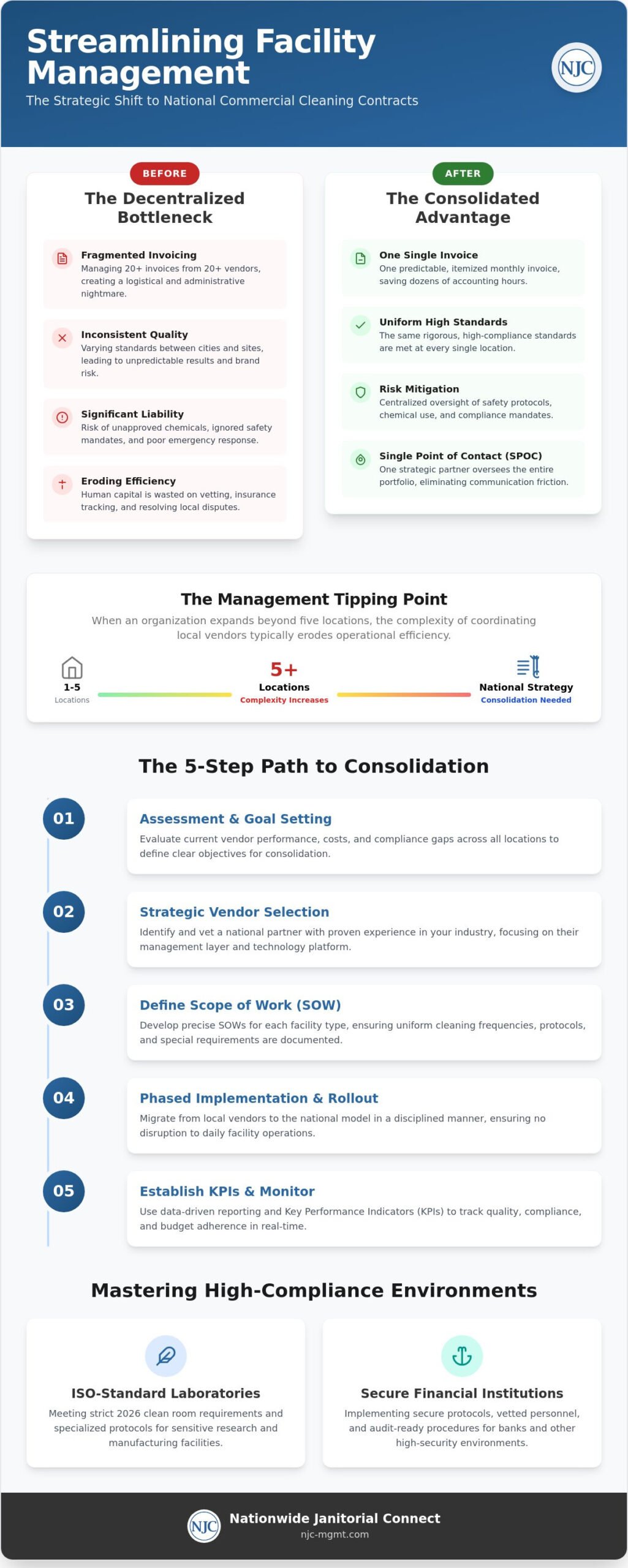
National commercial cleaning contracts represent a shift from reactive local hiring to a proactive, enterprise-level strategy. These agreements cover multiple geographic regions under a single management framework, allowing facility managers to maintain high-compliance janitorial standards across their entire portfolio. In 2026, scalability is no longer a luxury for property management; it’s a requirement for surviving in a competitive market. When an organization expands beyond five locations, they typically hit a management tipping point. At this stage, the complexity of coordinating disparate local vendors begins to erode operational efficiency.
This management tipping point is common across all real estate sectors; for instance, those managing multi-family units might explore Residential Property Management to maintain the same high standards they expect in their commercial spaces.
Strategic consolidation allows for a unified approach to Commercial cleaning industry standards, ensuring that a facility in Houston receives the exact same level of care as one in Chicago. This centralization isn’t just about labor; it’s about establishing a consistent management layer that prioritizes long-term value over short-term fixes. Modern facility leaders now view these contracts as essential tools for risk mitigation and brand protection.
The Evolution of Multi-Site Janitorial Management
The rise of hybrid office models has fundamentally altered how we approach facility maintenance. Cleaning frequencies are no longer set in stone; they’re dynamic. National contracts in 2026 rely heavily on data-driven reporting to justify service levels and demonstrate compliance. Corporate stakeholders now demand transparency that “handshake deals” with local providers simply can’t provide. Professional janitorial management must integrate with digital reporting tools to track everything from chemical safety to real-time quality inspections. This shift ensures that every site remains audit-ready at all times.
Why Decentralized Models Fail Growing Enterprises
Decentralized models often carry hidden costs that don’t appear on a standard balance sheet. Processing 50 or more individual vendor invoices every month is an administrative nightmare that wastes valuable human capital. Beyond the paperwork, inconsistent protocols create significant liability risks. If one site uses unapproved chemicals or ignores updated safety standards, the entire organization faces potential penalties. Local vendors often lack the infrastructure to provide a rapid emergency response during a crisis. A national partner, however, offers a stabilized network that can mobilize resources quickly, regardless of the location. Relying on a fragmented vendor list isn’t just inefficient; it’s a strategic vulnerability.
The Strategic Advantages of Vendor Consolidation
Transitioning to national commercial cleaning contracts isn’t just about changing who holds the mop. It’s about re-engineering your operational architecture to support growth. NJC Management utilizes a Single Point of Contact (SPOC) model to eliminate the friction inherent in multi-vendor environments. Instead of managing a sprawling directory of local contacts, you communicate with one strategic partner who oversees the entire portfolio. This approach transforms facility maintenance from a daily distraction into a streamlined asset. By leveraging professional facility vendor management solutions, procurement teams can shift their focus from troubleshooting local disputes to high-level portfolio optimization.
Consolidation also protects your brand reputation. Inconsistent cleaning standards across different states can signal a lack of operational control to stakeholders. A unified management layer ensures that your corporate identity is preserved through uniform service delivery. When your cleaning strategy is centralized, you gain the ability to implement changes across 50 locations simultaneously rather than negotiating 50 separate updates. This agility is a significant competitive advantage in the fast-moving 2026 business environment.
Streamlining Back-Office Operations
The administrative burden of managing diverse vendors is often underestimated. Every new vendor requires rigorous vetting, W-9 collection, and ongoing insurance tracking to prevent liability gaps. Administrative overhead reduction in facility management is defined as the systematic elimination of non-core clerical tasks through process automation and vendor centralization. By moving to a single, itemized monthly invoice, accounting departments save dozens of hours previously spent on reconciliation. When evaluating and structuring your agreement, consider how much capital is currently lost to fragmented accounts payable processes. A consolidated model ensures that your financial reporting is as clean as your facilities.
Uniformity in Quality and Performance
Brand reputation relies on consistency. A customer or employee should experience the same level of cleanliness in a Seattle office as they do in a Miami branch. Achieving this requires more than just a shared checklist. It demands standardized Quality Assurance Inspections that apply the same rigorous metrics to every square foot of your footprint. NJC Management provides a single KPI dashboard that aggregates performance data from all locations, offering a real-time view of your portfolio’s health. Specialized project managers act as the bridge between corporate expectations and local execution, ensuring that national standards are never compromised by regional variances. For those ready to upgrade their oversight, exploring comprehensive management models is the first step toward total facility control.
High-Compliance and Specialized Environment Requirements
Standard office cleaning is a commodity, but specialized environment maintenance is a strategic asset. When facility managers oversee portfolios with laboratories or financial hubs, the stakes for national commercial cleaning contracts rise significantly. In these sectors, a single lapse in protocol doesn’t just result in a dusty desk. It can lead to compromised research, security breaches, or OSHA penalties that reach up to $165,514 for willful violations. Integrating industrial cleaning services into your national agreement ensures that high-risk areas receive the technical expertise they demand.
Many enterprises suffer from vendor excess where they hire specialized firms for each niche requirement. The strategic advantages of vendor consolidation extend far beyond administrative ease. They allow for a unified training curriculum that addresses specific site hazards and compliance mandates across every state your company operates in. This centralized oversight is the only way to guarantee that a clean room in Houston meets the same ISO standards as a facility in Boston.
Clean Room and Laboratory Janitorial Standards
In controlled environments, particulate control is the primary objective. ISO 14644-1 standards dictate strict limits on airborne particles, requiring cleaning teams to understand gowning procedures and chemical compatibility. NJC manages these high-compliance environments by maintaining rigorous, audit-ready cleaning logs. This documentation is essential for regulatory bodies and internal quality controls. We ensure that specialized labor is trained to handle sensitive equipment without introducing contaminants that could ruin years of research. It’s a level of precision that general janitorial vendors simply aren’t equipped to provide.
Security-Sensitive Facilities: Banks and Schools
Financial institutions and educational facilities require a different layer of management: trust. Background checks and chain-of-custody protocols for cleaning staff are non-negotiable. In banks, discretion is paramount. Cleaners must perform their duties without disrupting sensitive transactions or compromising security zones. Schools, conversely, often require high-visibility day porter services to manage the constant flow of traffic and maintain hygiene in common areas. Balancing these needs requires a national partner who understands that security is as much about process as it is about personnel. A managed approach ensures that these specialized requirements are met consistently across the entire organization.
Evaluating and Structuring Your National Cleaning Agreement
Structuring national commercial cleaning contracts requires more than a simple list of tasks. It demands a rigorous framework that aligns with your corporate objectives and risk profile. A well-defined Scope of Work (SOW) serves as the foundation, but Service Level Agreements (SLAs) translate these tasks into enforceable performance expectations. In the post-2025 office market, flexibility is the most valuable currency. Buildings no longer operate at 100% capacity every day. Your contract must allow for dynamic scheduling that adjusts based on actual occupancy data rather than rigid, outdated calendars.
The choice between fixed-price and cost-plus contracts is a strategic decision for any procurement team. Fixed-price agreements offer budget predictability, which is ideal for stable environments. Cost-plus models provide greater transparency into labor and material expenses, though they require more intensive oversight. Technology plays a critical role here by providing the reporting transparency needed to manage either model effectively. Real-time dashboards replace monthly spreadsheets, offering a single source of truth for every site in your portfolio.
Defining Key Performance Indicators (KPIs)
KPIs are the pulse of your janitorial strategy. They turn subjective opinions about cleanliness into objective data points. Effective agreements include specific metrics for emergency response times and monthly inspection scores. For example, maintaining a 98% inspection pass rate across the portfolio is a standard benchmark for high-compliance environments. You should also include “right to cure” clauses. These provisions give your partner a 24 to 48 hour window to resolve a deficiency before any financial penalties apply. This structure encourages accountability without creating an adversarial relationship between you and your vendor.
Risk Mitigation: Insurance and Liability
Managing risk across multiple states is a complex legal challenge. You must verify that umbrella policies provide adequate coverage for every jurisdiction where you operate. For specialized environments like laboratories or financial centers, staff bonding is an essential layer of protection. A managed solution simplifies this by centralizing the compliance process. NJC Management handles the vetting of insurance certificates and bonding for all sub-vendors, ensuring there are no gaps in your liability shield. This oversight protects your organization from the fallout of a vendor’s administrative oversight. To secure your portfolio with a professional management layer, schedule a consultation with NJC Management today.
Transitioning to NJC Management: The Path to Consolidation
Transitioning to national commercial cleaning contracts is a strategic migration, not a simple vendor swap. It requires a disciplined approach to ensure zero service interruptions across your portfolio. NJC Management operates with a “Houston Heart, National Reach” philosophy. This means you benefit from the accountability of a dedicated, centralized management hub while leveraging a scalable infrastructure that reaches every corner of the country. We don’t function as a distant franchise; we act as a strategic partner that integrates directly with your executive goals to protect your assets and your brand.
Strategic alignment extends beyond physical infrastructure to include the development of your human capital. To complement your operational efficiency with high-end team building, you can explore Ibiza Corporate Retreats and discover how Aura Events designs world-class leadership experiences.
The transition from a fragmented local model to a managed national solution follows a five-step process: audit, design, sourcing, integration, and optimization. This structured path allows facility managers to regain control over their operations without the stress of managing the granular details of a multi-state rollout. By the end of the transition, your facility management moves from a reactive posture to a proactive, data-driven strategy. To begin this process, we recommend a professional commercial cleaning management audit to identify immediate cost-saving opportunities within your current network.
The Audit and Sourcing Phase
The process begins with a comprehensive evaluation of your existing vendor performance. We identify service gaps that create liability, such as outdated chemical logs or inconsistent floor safety testing that fails to meet 2026 OSHA standards. NJC leverages a pre-vetted network to find local teams capable of executing high-standard work under our national oversight. We then design a custom facility maintenance schedule that reflects your specific occupancy levels and compliance needs. This phase ensures that every site has a clear, enforceable roadmap before the first mop hits the floor.
Onboarding and Quality Integration
During onboarding, we establish your dedicated single point of contact. This individual manages the communication flow between your facility team and our field operations, removing you from the day-to-day troubleshooting cycle. We also deploy our consolidated billing and reporting software, giving you immediate visibility into every site’s performance and spend. The first 90 days focus on stabilizing service levels and aligning local teams with your corporate KPIs. It’s a period of intense oversight where we refine processes to ensure that the high standards established in the audit phase are maintained consistently across your entire footprint.
Optimizing Multi-Site Operations for 2026
The landscape of facility management is shifting from simple labor procurement to strategic asset protection. By adopting national commercial cleaning contracts, you replace the friction of fragmented vendor lists with a disciplined, centralized management layer. This transition doesn’t just reduce your administrative overhead; it ensures that every location, from corporate offices to high-compliance laboratories, adheres to the same rigorous safety and quality standards required in 2026.
NJC Management provides a single point of contact for over 20 facility solutions, allowing you to focus on high-level growth while we handle the operational details. With consolidated billing for your entire multi-property portfolio and specialized expertise in ISO-class clean room environments, we offer the stability your organization needs to thrive in a complex regulatory environment. Our approach ensures that your facility standards are uniform, audit-ready, and strategically aligned with your business goals.
Take the first step toward total facility control and operational clarity. Request a Strategic Facility Management Quote from NJC Management to see how we can streamline your portfolio today. Your facilities deserve a partner that matches your professional standards and ambitions.
Frequently Asked Questions
What is the difference between a national franchise and a managed facility solution?
A managed facility solution provides a strategic oversight layer that a standard franchise often lacks. While franchises rely on decentralized local owners with varying standards, a managed partner like NJC acts as your single point of accountability. This model ensures that corporate directives are executed uniformly across every location, regardless of geography.
How does consolidated billing work for businesses with locations in multiple states?
NJC aggregates all service costs from your various properties into one itemized monthly invoice. This system eliminates the administrative burden of processing dozens of individual payments for different vendors. Your accounting team receives a single, transparent document that simplifies budget tracking and financial reporting across your entire national footprint.
Can a national cleaning contract accommodate specialized needs like clean rooms or labs?
Yes, national commercial cleaning contracts can be specifically structured to meet ISO-standard requirements for laboratories and clean rooms. NJC employs specialized labor trained in particulate control and chemical compatibility. We ensure that these high-compliance environments receive the technical precision and documented cleaning logs necessary for regulatory audits.
What insurance coverage should I look for in a national janitorial agreement?
You should prioritize comprehensive umbrella policies that provide consistent coverage across all states in your portfolio. It’s also essential to verify staff bonding for security-sensitive areas like financial institutions. NJC simplifies this process by vetting every sub-vendor to ensure they meet your specific corporate liability and insurance requirements.
How do you ensure quality control when using third-party cleaning vendors?
Quality control is maintained through standardized inspections and a centralized KPI dashboard. NJC project managers conduct regular on-site audits to verify that local execution aligns with your national standards. This data-driven approach allows us to identify and resolve performance gaps before they impact your facility operations.
What are the typical cost savings associated with vendor consolidation?
Savings are primarily driven by the significant reduction in administrative overhead and the optimization of labor schedules. By consolidating your national commercial cleaning contracts, you eliminate the hidden costs of managing multiple vendor relationships and vetting processes. This streamlined management model allows for more predictable facility spending and better resource allocation.
How long does it take to transition 20+ locations to a single national contract?
A successful transition for a portfolio of this size typically takes between 60 and 90 days. This timeframe allows for a thorough audit of current sites, the sourcing of high-quality local labor, and the integration of reporting software. A disciplined rollout ensures that service remains continuous while you migrate to the new management framework.
Does NJC Management handle emergency or on-demand cleaning requests?
NJC manages emergency and on-demand requests through a centralized dispatch system. Whether you need an urgent post-construction cleanup or immediate pressure washing after a storm, our network is structured for rapid response. This capability ensures that unplanned facility needs are addressed quickly without requiring you to source new vendors under pressure.