
National Janitorial Service Contracts: A Strategic Guide for Facility Managers (2026)
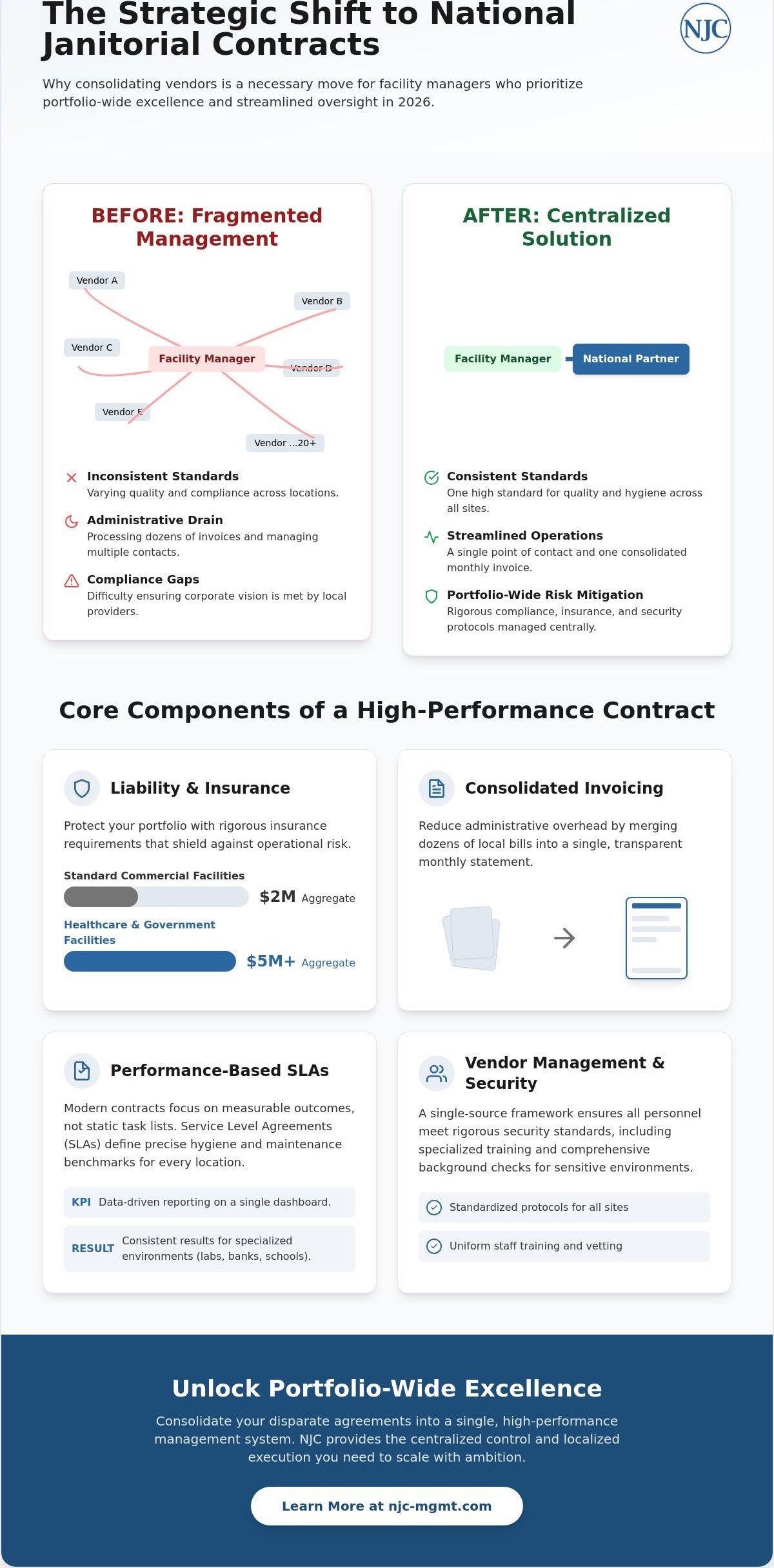
Managing twenty different cleaning vendors isn’t a logistical challenge; it’s a strategic drain on your corporate resources. You’ve likely felt the friction of inconsistent cleaning standards across your regional offices and the administrative weight of processing dozens of invoices every month. It’s difficult to ensure corporate compliance when local providers lack a centralized vision. Transitioning to national janitorial service contracts is no longer just an operational choice. In 2026, it’s a necessary move for facility managers who prioritize portfolio-wide excellence and streamlined oversight.
We understand that your time is a valuable resource, and managing communication gaps shouldn’t be your primary focus. This guide provides the framework you need to consolidate disparate agreements into a single, high-performance management system. You’ll learn how to master the complexities of multi-site agreements and secure a strategic partnership that scales with your ambition. We’ll examine the shift toward performance-based structures and the specific metrics that define a successful national rollout.
Key Takeaways
- Define the strategic transition from fragmented local sourcing to a centralized model that ensures consistent standards across every location.
- Identify the rigorous insurance and liability requirements necessary to protect high-traffic facilities in a complex regulatory environment.
- Quantify the hidden costs of administrative bloat and discover how national janitorial service contracts bridge the gap that local vendors can’t close.
- Master the negotiation of KPIs that drive actual facility value, particularly for specialized environments like laboratories and financial institutions.
- Learn how a single-source management framework simplifies complex operations, so you don’t have to manage dozens of separate accounts.
What Are National Janitorial Service Contracts?
National janitorial service contracts represent a unified management architecture for facility leaders overseeing expansive portfolios. At its core, this type of agreement consolidates cleaning services across multiple geographic locations under a single, accountable entity. The days of managing a patchwork of twenty different local vendors are over. Modern facility management requires a centralized solution that delivers consistency, transparency, and high-performance results. This isn’t just about cleaning floors; it’s about portfolio-wide risk mitigation and operational excellence.
The industry has shifted significantly toward managed facility solution partners. In 2026, a simple scope of work is no longer sufficient. High-performance agreements now incorporate sophisticated technology and real-time reporting. This data-driven approach allows you to monitor performance across your entire portfolio from a single dashboard. Commercial cleaning has evolved into a strategic asset that supports your broader business objectives, turning a line-item expense into a measurable value driver.
Scope of Work and Performance Standards
Modern contracts focus on measurable outcomes rather than static task lists. It’s about the result, not just the activity. For example, when you integrate specialized needs like industrial cleaning services in Houston, the contract must account for specific local safety and compliance standards. Service Level Agreements (SLAs) are the primary tool for maintaining this national consistency. They define the exact hygiene and maintenance benchmarks every location must achieve, ensuring that a facility in one state meets the same rigorous standards as a site across the country.
Multi-Location vs. Single-Site Agreements
Scalability is where single-site agreements often fall short. A multi-state operation involves diverse labor markets and regional regulatory differences that a local vendor simply can’t navigate. National janitorial service contracts solve this by standardizing protocols for sensitive environments. Whether you’re managing laboratory & clean room cleaning or daycare & school cleaning, the protocols remain uniform across your organization.
This structure doesn’t ignore regional nuances; it masters them. By leveraging regional expertise within a national framework, you ensure that local sites receive specialized attention while you maintain corporate oversight. It’s a balance of localized execution and centralized control. This approach eliminates the communication gaps that typically plague multi-site operations, turning your facility maintenance into a streamlined, high-performance engine.
Core Components of a High-Performance Cleaning Contract
A high-performance agreement acts as a shield against operational risk. National janitorial service contracts must be built on a foundation of rigorous protection and financial clarity. They aren’t just service descriptions; they’re strategic instruments that define the health and safety of your entire portfolio. When you consolidate multiple sites under one framework, the contract must address the specific vulnerabilities of high-traffic facilities while maintaining a lean administrative profile.
Liability allocation is the most critical pillar of these agreements. Standard commercial general liability insurance minimums usually require $1 million per occurrence and $2 million aggregate. However, for healthcare or government facilities, these requirements often jump to $5 million aggregate. Understanding the government RFP process for cleaning contracts is helpful here, as it highlights the strict compliance standards necessary for large-scale operations. Consolidated invoicing is a strategic tool for reducing accounts payable department overhead by merging dozens of local bills into a single monthly statement. This efficiency allows your team to focus on high-level facility strategy instead of chasing missing invoices from twenty different vendors.
Liability, Insurance, and Compliance
Vendors must meet specific security standards, especially for financial institutions or medical environments. This involves more than just a standard cleanup. It requires rigorous background checks and specialized training for all personnel. To ensure these standards don’t slip over time, verify that Quality Assurance Inspections are explicitly written into the contract. These regular audits provide the data needed to justify contract renewals or trigger corrective actions.
Payment Terms and Financial Transparency
Financial transparency is essential for long-term value. A typical overhead and profit margin for janitorial services sits between 15% and 25%. Your contract should clearly outline these figures alongside labor and chemical costs to avoid hidden markups. While Net-30 terms remain the industry standard, some providers now offer Net-15 for better cash flow management. A strategic approach to vendor sourcing and management through Nationwide Janitorial Connect ensures these financial details are handled with precision and professionalism across all your locations.
The Invisible Costs of Managing Multiple National Vendors
Hourly rates are often a distraction. While many facility managers focus on the per-square-foot cost of a cleaning crew, the true drain on your budget lies in the management hours required to oversee a fragmented vendor list. When you manage twenty different providers, you aren’t just paying for cleaning; you’re paying for the administrative friction of twenty different relationships. This administrative bloat is the primary reason why national janitorial service contracts have become the preferred architecture for modern, multi-site operations. Fragmented management isn’t just inconvenient. It’s an expensive strategic failure.
The communication gap is where localized issues transform into national facility headaches. If a branch manager in a different time zone can’t reach a local vendor during an emergency, the problem eventually lands on your desk. These gaps lead to delayed responses, inconsistent compliance, and a lack of accountability. Managing unvetted third-party contractors increases your risk profile significantly. Without a centralized management layer, you’re essentially gambling on the insurance and safety standards of every individual provider in your network.
Administrative Burden and Communication Gaps
Consolidating twenty or more vendors into a single monthly invoice does more than save paper. It drastically increases the ROI of your internal team. Instead of spending forty hours a month on vendor sourcing, performance monitoring, and payment processing, your staff can focus on high-level portfolio strategy. A single point of contact is essential for emergency needs. It eliminates the “fragmented reporting” trap where data from one site doesn’t match the metrics of another, making it impossible to get a clear picture of your total facility health.
Quality Assurance Discrepancies Across Regions
Cleanliness shouldn’t be subjective. However, “clean” often looks different in Houston than it does in Chicago due to regional environmental factors like humidity or winter salt. Standardizing services such as commercial floor cleaning in Houston and across your other locations requires a unified set of protocols. Digital reporting bridges the gap between local sites and corporate HQ by providing visual proof of performance. By implementing third-party quality audits within your national janitorial service contracts, you ensure that every facility meets your corporate excellence standard, regardless of its zip code.
How to Evaluate and Negotiate Your Janitorial Agreement
Evaluating national janitorial service contracts requires a shift from cost-based selection to value-based procurement. While it’s tempting to prioritize the lowest monthly fee, the lowest bid often masks hidden operational risks. In 2026, labor constitutes 50% to 60% of the total cost in most janitorial agreements. If a bid seems suspiciously low, the provider might be cutting corners on wages or specialized training. This eventually compromises your facility’s safety and hygiene standards. A strategic negotiation focuses on long-term stability rather than immediate, short-lived savings.
A strategic partner must demonstrate agility beyond routine maintenance. When your portfolio expands through new developments, you need to assess their ability to provide post-construction cleaning in Houston or other major metropolitan hubs. This capability ensures a seamless transition from construction to operational status without the friction of sourcing additional vendors. You aren’t just buying a cleaning service; you’re investing in a management layer that scales with your business objectives.
Key Performance Indicators (KPIs) to Include
Effective contracts rely on data, not just promises. You should demand a response time for emergency requests that matches the criticality of your operations. Inspection pass rates and client satisfaction scores provide a clear view of performance across different sites. Additionally, monitor employee turnover rates within the janitorial team. High turnover is a reliable proxy for poor service quality and inconsistent results. If your provider can’t retain staff, they can’t maintain your standards.
Vetting Specialized Cleaning Capabilities
High-stakes environments like ISO Class 7 clean rooms or high-compliance laboratories require specific expertise. Ask potential partners about their specialized protocols and how they ensure local crews follow national standards. Security protocols for financial institutions are equally critical. Your national partner must have a vetted network of specialized local vendors who understand corporate compliance. They should act as the single point of accountability for every specialized task, from laboratory & clean room cleaning to bank security.
Selecting the right partner is a strategic decision that impacts your entire organization’s efficiency. If you’re ready to move beyond fragmented vendor management, discover how our vendor sourcing and management solutions can consolidate your operations into a single, high-performance framework.
Strategic Vendor Management: The NJC Connect Advantage
Nationwide Janitorial Connect functions as the definitive management layer between your corporate strategy and local facility execution. We don’t just provide services; we engineer a comprehensive maintenance ecosystem. By acting as a single point of contact for over 20 facility solutions, we remove the friction that typically compromises national janitorial service contracts. Our model is built on 100% transparency, providing you with unfiltered data on vendor performance, chemical usage, and quality assurance metrics across your entire portfolio.
The transition to a managed framework represents a shift from reactive maintenance to proactive facility leadership. This management layer ensures that every site, regardless of its location, adheres to a singular corporate vision. Nationwide Janitorial Connect handles the complexities of vendor sourcing so your team can focus on high-value business objectives. This isn’t about adding another vendor to your list. It’s about implementing a strategic partnership that scales with your ambition and protects your brand’s reputation.
The Single-Source Management Solution
Fragmented workflows are the enemy of operational scale. We solve this by consolidating diverse needs, including janitorial services, floor care & maintenance, and window cleaning, into one streamlined management framework. This approach turns your facility maintenance from a series of disconnected tasks into a strategic asset. You gain the immediate benefit of consolidated invoicing and reporting, which reclaims the hours your team previously lost to administrative friction. Nationwide Janitorial Connect acts as your strategic partner, ensuring your facility standards reflect your brand’s commitment to excellence.
Houston Roots with Nationwide Reach
Our journey began with a focus on precision in the Texas market. We leverage our Houston HQ expertise to set the benchmark for nationwide facility standards. For many facility managers, choosing the right janitorial company in Houston serves as the pilot program for broader national success. Our vetting process is notoriously rigorous. We only allow the top 5% of local providers into our network, ensuring that every link in your national chain is as strong as the first. This level of scrutiny is what differentiates a managed solution from a simple broker.
We take the guesswork out of facility operations by applying a consistent, high-performance standard across every geographic location. Whether you’re managing financial institutions or high-compliance laboratories, our framework adapts to your specific regulatory needs without increasing your workload. Streamline your national facility operations with Nationwide Janitorial Connect today to experience a new standard of operational clarity and portfolio-wide consistency.
Consolidate Your Portfolio for Sustainable Operational Excellence
Transitioning to national janitorial service contracts is a move toward long-term stability and portfolio-wide consistency. We’ve explored how fragmented vendor management drains your administrative resources and creates communication gaps that compromise your corporate standards. By centralizing your oversight, you ensure that high-compliance environments, including laboratories and financial institutions, receive the specialized attention they require. This strategic framework isn’t just about cleaning. It’s about reclaiming your time through consolidated billing and a single point of accountability for over 20 facility solutions across your entire footprint.
The complexity of multi-site operations shouldn’t be a barrier to your growth. A managed solution provides the transparency and reporting needed to make informed decisions for your facility’s future. It’s time to replace the administrative nightmare of dozens of invoices with a single, high-performance management framework. Your facility standards define your brand’s reputation, so let’s build a maintenance architecture that supports your vision. Request a Strategic Facility Management Quote today and take the first step toward streamlined operational excellence.
Frequently Asked Questions
What is the average length of a national janitorial service contract?
Standard initial terms for these agreements are typically 12 months with automatic annual renewals. In specialized sectors or government contracting, a “one base plus four option years” structure is common. This provides long-term stability while allowing for annual performance reviews. It ensures that the partnership remains aligned with your evolving facility needs and corporate objectives.
How do national janitorial contracts handle emergency or one-time cleaning requests?
Emergency requests are managed through a centralized communication hub that bypasses the friction of local vendor sourcing. Your single point of contact coordinates the response; this ensures that urgent needs like pressure washing or post-construction cleanup are addressed within agreed-upon response times. This structure eliminates the need for you to track down local managers during a crisis. It provides a reliable safety net for your entire operation.
Can I consolidate multiple facility services, like window washing and floor care, into one contract?
Yes, consolidating diverse services into a single management framework is a primary benefit of national janitorial service contracts. You can bundle carpet cleaning, floor care & maintenance, and window cleaning under one agreement. This ensures a cohesive maintenance standard across your entire portfolio while reducing the complexity of managing separate service schedules and disparate vendor requirements.
How does consolidated billing work for multi-site commercial properties?
Consolidated billing merges every local service charge into one comprehensive monthly statement. It’s an architectural solution for reducing accounts payable overhead. Instead of chasing missing invoices from twenty different vendors, your team receives a single, transparent digital document. This provides a clear, high-level view of your total facility spend while simplifying your monthly close process and improving financial transparency.
What are the most important KPIs to track in a national cleaning agreement?
Focus on data-driven metrics. These include inspection pass rates, emergency response times, and employee turnover within the cleaning crews. These KPIs serve as a reliable proxy for service quality. They ensure the provider remains accountable to your corporate standards. Regular reporting on these metrics allows you to identify and correct regional performance dips before they become portfolio-wide issues.
How do you ensure consistent quality across different geographic regions?
Consistency is maintained through standardized protocols and centralized reporting. We use digital auditing tools to bridge the gap between local sites and corporate headquarters. Centralized Quality Assurance Inspections ensure that a facility in one region meets the exact same hygiene benchmarks as a site in another. This eliminates the subjective “clean” standards that often plague fragmented vendor models.
Is it possible to maintain specialized compliance standards (like clean rooms) under a national contract?
Specialized compliance is entirely achievable when your management partner utilizes a vetted network of technical experts. This allows you to maintain rigorous ISO standards for laboratory & clean room cleaning across multiple locations. You benefit from the administrative efficiency of a national agreement without sacrificing the precision required for high-stakes, sensitive environments like financial institutions or medical laboratories.
What happens if a local vendor under a national contract fails to perform?
The management partner takes immediate corrective action based on your performance-based agreement. Because national janitorial service contracts prioritize portfolio-wide standards, the provider can replace a failing local crew without requiring you to source a new vendor yourself. This ensures that a localized failure doesn’t compromise your overall facility health or corporate compliance, maintaining seamless service continuity.