Creating a Commercial Cleaning Scope of Work in Houston: A 2026 Strategic Guide
A Scope of Work isn’t a mere checklist; it’s the strategic foundation that separates a facility that looks clean from one that actually meets Houston’s 2026 regulatory benchmarks. You’ve likely experienced the frustration of inconsistent quality across multiple locations or discovered hidden costs buried in vague contracts. When you’re managing high-compliance standards like ISO or Clean Room requirements, ambiguity is a liability you can’t afford. Master the process of creating a commercial cleaning scope of work houston to transform your janitorial services from a line-item expense into a high-performance asset.
We understand that your time is a valuable resource and vendor accountability is paramount. This strategic guide provides the exact framework needed to reduce management overhead and ensure every square foot of your facility meets rigorous standards. We’ll examine how to integrate critical 2026 updates, including the new OSHA penalty structures and the FIFA World Cup “Clean Zone” regulations, into your documentation. By the end of this article, you’ll have a repeatable template and the KPIs necessary to hold any vendor to a standard of professional excellence.
Key Takeaways
- Define your Scope of Work as a technical foundation to eliminate scope creep and prevent unexpected billing surcharges.
- Implement a frequency-based task structure that prioritizes high-touch disinfection protocols essential for 2026 health standards.
- Master the technical nuances of creating a commercial cleaning scope of work houston for high-compliance sectors, including ISO Class 7 and 8 clean rooms.
- Eliminate the “Vague Language Trap” by replacing ambiguous terms with precise metrics that account for Houston’s unique humidity and environmental factors.
- Explore how managed facility solutions can consolidate over 20 services into a single point of contact for streamlined multi-location operations.
The Strategic Importance of a Precise Commercial Cleaning Scope of Work
Excellence in facility management begins with clarity. For decision-makers, creating a commercial cleaning scope of work houston is the most effective way to transition from reactive maintenance to strategic oversight. This document serves as the technical foundation of your janitorial partnership. It defines the specific performance standards, frequencies, and methodologies that govern your facility’s health and appearance. Without this level of detail, you aren’t managing a service; you’re simply hoping for the best.
A precise SOW is your primary defense against “scope creep” and the unexpected billing surcharges that often plague vague agreements. When tasks aren’t clearly defined, vendors may interpret certain requirements as “extra” or “specialty” services. By documenting exact expectations, you lock in operational costs and eliminate financial ambiguity. According to a Commercial Cleaning Industry Overview, a well-defined scope is essential for maintaining consistent standards across diverse property portfolios. It shifts the relationship from a simple task list to a results-oriented management framework.
SOW vs. Cleaning Contract: Understanding the Difference
It’s vital to distinguish between your master service agreement and the SOW. The contract handles the legalities: indemnity, insurance requirements, and payment terms. Conversely, the SOW handles the operational execution. We recommend treating the SOW as a dynamic exhibit. This allows you to update frequencies or task lists as your facility needs evolve without renegotiating the core legal contract. Central to this document is the “Standard of Clean.” This defines whether a surface is “visibly clean” or “sanitized to ISO Class 7 standards,” providing a clear metric for quality assurance.
Why Houston Facilities Require a Specialized Approach
Houston’s commercial landscape is unique. With over 2 billion square feet of commercial space and a high concentration of Class A buildings, occupancy rates often demand higher cleaning frequencies than national averages. Local environmental factors, such as high humidity and construction dust, necessitate specific anti-mildew protocols and specialized floor care. Managing these complexities across multiple sites requires robust facility vendor management solutions. These solutions ensure that every vendor across your Houston portfolio is executing the same high-performance SOW, maintaining brand consistency and operational safety at every location.
Essential Components of a Houston-Specific Cleaning Task List
A high-performance facility operates on a rhythm. When you’re creating a commercial cleaning scope of work houston, you must move beyond a simple list of chores and adopt a frequency-based structure. This ensures that resources are allocated where they impact the facility most. A strategic SOW categorizes tasks into daily, weekly, monthly, and quarterly intervals, preventing the accumulation of dust and biological contaminants that thrive in the Gulf Coast climate.
Clarity regarding equipment and supplies is equally vital. Your SOW should explicitly define whether the vendor or the client provides chemicals, machinery, and consumables. To avoid budgetary surprises, we recommend that vendors provide all specialized cleaning agents and industrial equipment, while clients manage consumable restocks like paper products and hand soaps. This distinction keeps your operational costs predictable and ensures that only professional-grade, compliant chemistry is used on your surfaces.
Health standards in 2026 demand a rigorous focus on high-touch point disinfection. It’s not enough to wipe down a desk; your scope must specify the treatment of elevator buttons, door handles, and shared breakroom appliances using hospital-grade disinfectants. Adhering to OSHA Sanitation Standards isn’t just a legal requirement; it’s a commitment to employee wellness that reduces absenteeism and maintains a productive work environment.
Daily Maintenance: The Foundation of Facility Health
Daily tasks focus on high-visibility and high-utility areas. Non-negotiable items include restroom sanitation, trash removal, and the maintenance of your primary lobby. For facilities with constant foot traffic, integrating Day Porter Services ensures that reception areas maintain a “Class A” appearance throughout the business day. This continuous upkeep prevents small spills or litter from becoming permanent stains or safety hazards.
Periodic Deep Cleaning: Beyond the Surface
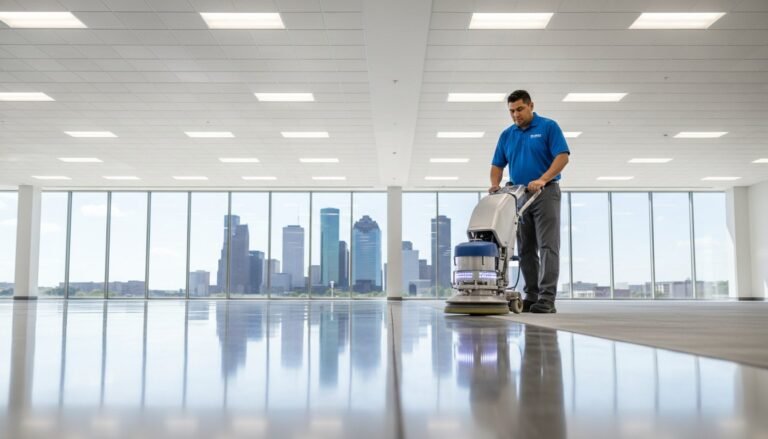
Periodic tasks address the long-term integrity of your assets. Houston’s high humidity increases the risk of mold in carpets, making quarterly extraction a necessity rather than an option. Your SOW should also include specific commercial floor cleaning schedules for stripping, waxing, and high-speed burnishing. These interventions protect hard surfaces from the abrasive effects of Houston’s clay-heavy soil. Aligning your facility’s needs with professional janitorial standards ensures your SOW remains competitive and effective.
Specialized Scopes: Clean Rooms, Labs, and High-Compliance Facilities
Houston’s economic landscape is shifting toward high-tech manufacturing and life sciences. With the expansion of the Texas Medical Center and the burgeoning biotech corridor, generic cleaning protocols are no longer sufficient. When you’re creating a commercial cleaning scope of work houston for these specialized sectors, the document’s focus moves from aesthetics to strict contamination control. A failure to specify technical standards in these environments doesn’t just lead to a dirty office; it risks compromised research and expensive audit failures.
Technical precision is the hallmark of high-compliance facility management. For instance, ISO Class 7 and 8 clean rooms require specific particulate count maintenance that must be codified within your SOW. These standards dictate everything from the direction of air pressure to the specific gowning procedures for janitorial staff. Integrating Green Seal Cleaning Standards into your scope ensures that the chemistry used doesn’t introduce volatile organic compounds (VOCs) that could interfere with sensitive laboratory equipment or biological samples.
Clean Room and Laboratory Protocols
Sterile environments demand a “top-down” cleaning methodology. This means starting with ceiling HEPA filters and light fixtures before moving to walls and, finally, the floors. Your SOW should explicitly require non-shedding microfiber tools and specialized vacuum systems with multi-stage HEPA filtration. Beyond the physical tasks, audit readiness is a critical component. We recommend requiring digital logs that track cleaning times, chemical lot numbers, and technician certifications. This level of documentation ensures your facility remains compliant with both internal quality controls and external regulatory bodies.
Financial and Secure Facility Standards
Secure environments, such as financial institutions and data centers, present a different set of challenges centered on chain-of-custody. The SOW must outline rigorous background check protocols and access control measures for all personnel. In these settings, we often see a strategic balance between “after-hours” deep cleaning and “day-porter” presence for immediate needs. For facilities with complex, high-security footprints, leveraging industrial cleaning services provides the specialized labor force trained to operate within sensitive perimeters without disrupting core business operations. Every task in a secure facility SOW should be tied to a specific security protocol, ensuring that cleanliness never comes at the cost of safety.
Specialized environments require specialized people. Your SOW should mandate that all staff assigned to these areas undergo site-specific training. This isn’t a suggestion; it’s a strategic requirement for maintaining the integrity of your most sensitive assets. By defining these high-compliance needs upfront, you ensure your vendor selection process identifies partners capable of meeting Houston’s most demanding professional standards.
Avoiding Common Pitfalls in Houston Commercial Cleaning Contracts
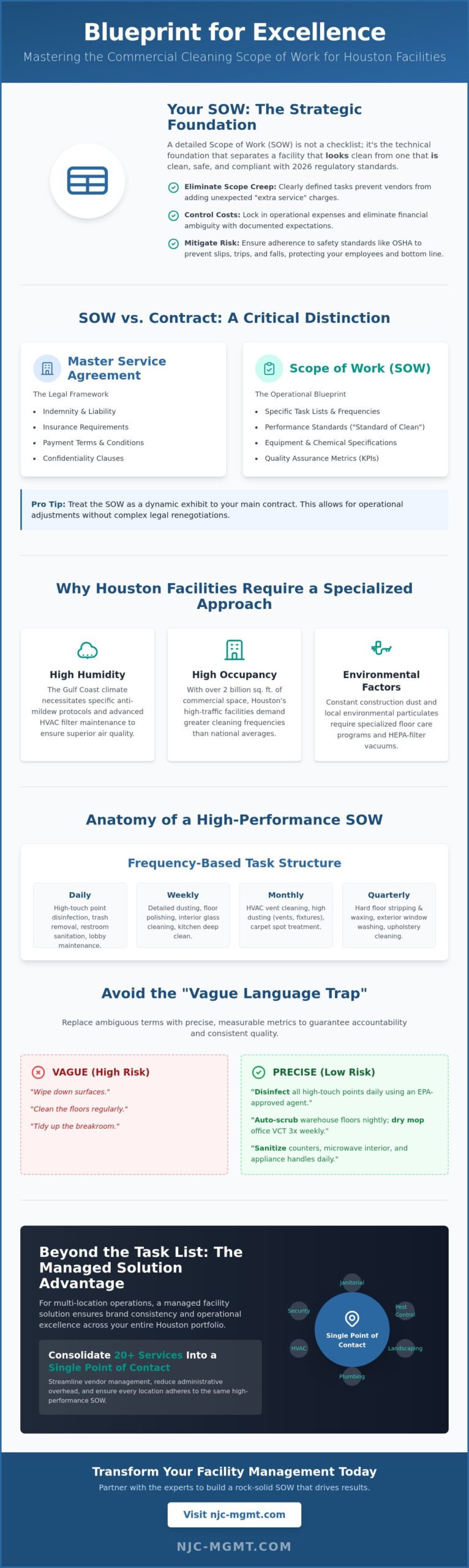
Even the most detailed document can fail if it’s built on a foundation of ambiguity. When you’re creating a commercial cleaning scope of work houston, facility managers often fall into the “Vague Language Trap.” This happens when you use qualitative terms instead of quantitative metrics. Phrases like “clean as needed” or “regularly maintained” are subjective. They invite vendor disputes and lead to a slow degradation of service quality over time. Avoiding the common pitfalls of creating a commercial cleaning scope of work houston ensures your facility remains a safe, professional environment.
Budgeting becomes impossible when tasks aren’t tied to a specific frequency. If a vendor interprets “as needed” as once a month while you expect once a week, you’ll inevitably face “extra service” charges that blow your quarterly projections. A professional SOW defines the “Standard of Clean” as a measurable KPI. This ensures both parties agree on what “finished” looks like before the work begins. Precision is your best tool for financial predictability.
Another pitfall is the “Franchise Gap.” Many Houston cleaning companies operate on a franchise model where the local owner lacks a robust management layer. Without a national or regional oversight structure, quality assurance often falls on the client’s shoulders. Your SOW must mandate Quality Assurance (QA) inspections as a core deliverable. These shouldn’t be informal walkthroughs; they must be documented, scored audits that hold the vendor accountable to the agreed-upon standards.
The Problem with “As Needed” Tasks
Precision is the enemy of inefficiency. Replacing “as needed” with specific frequencies, such as “twice weekly” or “daily after 6 PM,” provides a clear roadmap for operational success. This level of detail allows you to audit performance with zero ambiguity. For Houston managers, a high-performance SOW establishes a “Standard of Clean” that is verified through objective data rather than subjective opinion.
Houston Climate Considerations for SOWs
Houston’s environment is uniquely aggressive toward commercial interiors. High humidity levels aren’t just uncomfortable; they accelerate the accumulation of dust and allergens in HVAC systems. Your SOW should include increased frequencies for HVAC vent dusting and coil cleaning to maintain indoor air quality. Additionally, facilities near Houston’s heavy construction zones face a constant influx of fine particulate matter. This requires specialized floor care and, in cases of new facility transitions, a dedicated post construction cleaning protocol to remove industrial debris before standard maintenance begins.
To ensure your facility remains compliant and cost-effective, consider partnering with a team that provides comprehensive managed facility solutions as part of your strategic plan.
Beyond the Task List: Implementing Managed Facility Solutions in Houston
Drafting a technical document is a critical first step, but the true value of creating a commercial cleaning scope of work houston is realized during its execution. For many facility managers, the burden of overseeing multiple vendors across various Houston locations leads to administrative fatigue. Managing a janitorial crew at one site, a window cleaning team at another, and a floor care specialist at a third creates a fragmented ecosystem where accountability often disappears. This is where a managed facility solution transforms your operational strategy.
Nationwide Janitorial Connect acts as the strategic layer between your SOW and the actual performance on the ground. We don’t just provide a list of tasks; we provide a professional project management framework that ensures every line item in your scope is met with precision. By positioning ourselves as your single point of contact, we eliminate the friction of vendor management. This allows you to focus on high-level facility goals rather than day-to-day cleaning disputes or service gaps.
The Power of Vendor Consolidation
Managing over 20 different facility solutions through separate vendors is an inefficient use of corporate resources. Each vendor requires separate vetting, insurance verification, and communication channels. Our model consolidates these touchpoints into a streamlined process. We leverage a rigorous vetting system for all Houston janitorial partners, ensuring they possess the specialized training discussed in previous sections. The most significant administrative advantage is our “Single Monthly Invoice.” Instead of processing dozens of payments for multi-location portfolios, you receive one clear, consolidated statement that covers your entire facility footprint, from pressure washing to day porter services.
Quality Assurance and Performance Monitoring
An SOW is only as effective as the inspection process that validates it. We implement a data-driven Quality Assurance program that moves beyond subjective walkthroughs. Our inspectors use the specific KPIs established in your scope of work to generate objective performance reports. This documentation provides you with the transparency needed to justify facility budgets to stakeholders. When you can prove that your cleaning standards are being met through hard data, you move from a defensive management posture to a proactive, strategic one. It’s about ensuring the art of creating a commercial cleaning scope of work houston translates into a pristine environment every single day.
Optimize your Houston facility management with NJC today.
Securing Operational Excellence Through Strategic Oversight
Mastering the technical nuances of creating a commercial cleaning scope of work houston is more than a procurement exercise; it’s a commitment to your facility’s long-term value. By defining precise frequencies and measurable standards, you eliminate the ambiguity that leads to service degradation and financial surprises. Whether you’re managing sterile laboratory environments or Class A office spaces, your SOW serves as the definitive blueprint for vendor accountability and safety compliance.
Transitioning from a manual task list to a managed facility model allows you to reclaim your time. We provide a single point of contact for over 20 facility solutions, ensuring that high-compliance protocols are met with uncompromising precision. Our consolidated billing and rigorous quality assurance inspections provide the transparency needed for multi-site operations to thrive in Houston’s competitive landscape. You don’t have to manage the complexities of vendor oversight alone.
Request a Strategic Janitorial Management Quote for Your Houston Facility and experience the stability of a truly managed solution. Your facility deserves a partner that matches your professional ambition and delivers consistent, high-performance results.
Frequently Asked Questions
What is the most common mistake when writing a commercial cleaning SOW?
The most common mistake is using qualitative, ambiguous terms like “regularly” or “as needed” instead of quantitative metrics. This creates a vague language trap that leads to service degradation and unexpected billing surcharges. When creating a commercial cleaning scope of work houston, you should define exact frequencies and measurable performance standards. This level of precision protects your budget and ensures that vendors understand your specific expectations from the first day of the contract.
How often should a Houston office update its cleaning scope of work?
We recommend reviewing and updating your cleaning scope at least once every twelve months or whenever your facility’s occupancy significantly changes. Houston’s dynamic commercial environment and environmental factors like high humidity or nearby construction can alter your cleaning requirements. A regular audit ensures your SOW remains aligned with current health standards and operational needs. Keeping the document as a dynamic exhibit rather than a fixed contract clause allows for these necessary adjustments.
Can I include specialized lab cleaning in a general janitorial SOW?
You can include specialized laboratory or clean room cleaning within a general janitorial SOW, but it must be isolated as a distinct, technical section. These areas require unique protocols, such as ISO Class 7 or 8 standards, and specialized chemistry that differs from standard office maintenance. Explicitly defining these requirements ensures that only trained technicians manage your high-compliance zones. This prevents cross-contamination and ensures your facility remains audit-ready for regulatory inspections.
What Houston-specific environmental factors should be in my cleaning contract?
Your contract must specifically address Houston’s high humidity and the resulting risks of mold and mildew growth. This necessitates increased frequencies for HVAC vent dusting and specialized anti-mildew treatments in restrooms and common areas. Additionally, if your facility is located near one of Houston’s frequent construction zones, your SOW should include enhanced floor care protocols. These measures protect your interior assets from the abrasive effects of clay-heavy soil and industrial dust.
How do I ensure my cleaning vendor is following the SOW?
Vendor accountability is best achieved through documented, data-driven Quality Assurance inspections that are written directly into your SOW. These shouldn’t be informal walkthroughs; they must be scored audits based on the specific KPIs you’ve established. Utilizing digital logging systems allows you to track cleaning times and performance metrics in real-time. This level of transparency ensures that the work performed actually matches the technical requirements you’ve codified in your management framework.
What is the difference between a task-based and a results-based cleaning scope?
A task-based scope focuses on the activity, while a results-based scope focuses on the final outcome. For example, a task-based instruction might say “mop the lobby floor daily.” A results-based instruction would state “the lobby floor must be free of visible debris, streaks, and scuff marks at the start of each business day.” Results-based scopes are often superior for creating a commercial cleaning scope of work houston because they prioritize the actual standard of clean over mere activity.
Is consolidated billing available for multi-location facilities in Houston?
Yes, consolidated billing is a primary advantage of utilizing a managed facility solution for multi-location operations in Houston. Instead of processing separate payments for dozens of different vendors across the city, you receive a single monthly invoice. This streamlines your accounts payable process and reduces administrative overhead. It also provides a clear, high-level view of your entire facility spend, making it easier to manage budgets and identify cost-saving opportunities across your portfolio.
How does NJC Management handle Quality Assurance inspections?
NJC Management utilizes a professional project management layer to conduct rigorous inspections that validate SOW compliance. We move beyond subjective opinions by using site-specific KPIs and data-driven reporting tools. These inspections ensure that every vendor in our network is meeting your exact performance standards. By providing these documented results, we help facility managers justify their budgets to stakeholders and maintain a consistent “Class A” appearance across all their Houston properties.