Slip and Fall Prevention Floor Care in Houston: A 2026 Strategic Guide
Did you know that 95% of slip and fall claims are settled out of court, yet a single severe injury in a Texas facility can result in settlements exceeding $500,000? For commercial property managers, the stakes of slip and fall prevention floor care houston have never been higher. You’re likely dealing with the relentless Houston humidity that leaves moisture on your tiles and the frustration of inconsistent cleaning vendors who miss the mark on safety standards. It’s a cycle that drives up insurance premiums and creates unnecessary legal exposure.
We understand that you need more than just clean floors; you need a strategic partner to manage risk. This guide provides a 2026 roadmap to mitigate liability and ensure workplace safety through advanced, managed floor care protocols tailored for Houston commercial facilities. We’ll examine the latest ANSI A326.3 standards, the nuances of the Texas “Modified Comparative Fault” rule, and how streamlined vendor oversight through a single point of contact can finally give you peace of mind.
Key Takeaways
- Understand the legal landscape of 2026 to protect your Houston business from high-cost liability and insurance premium hikes.
- Learn why Dynamic Coefficient of Friction (DCOF) has become the essential metric for meeting modern ANSI safety compliance standards.
- Implement a high-compliance slip and fall prevention floor care houston program to eliminate common hazards like “Dirty Mop Syndrome.”
- Discover a 5-step strategic protocol designed to secure high-risk transition zones where floor types change.
- Simplify facility operations by leveraging strategic vendor oversight to ensure consistent quality and reduced workplace accidents.
The High Stakes of Slip and Fall Incidents in Houston Commercial Spaces
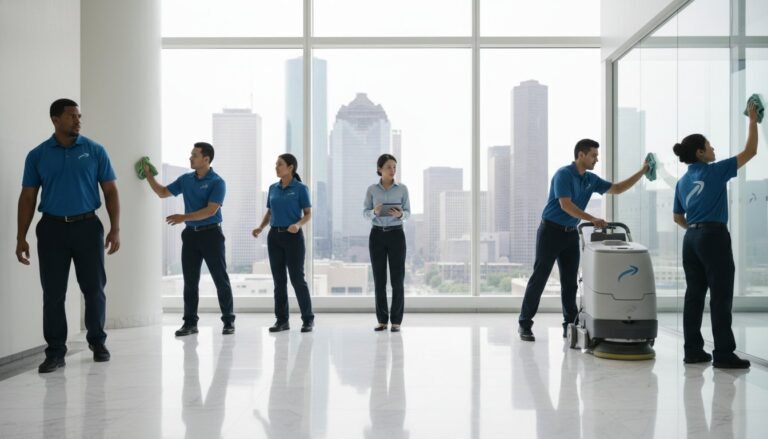
Effective facility management in 2026 requires more than a reactive approach to cleanliness. It demands a proactive strategy centered on risk mitigation. Slip and fall prevention floor care houston is no longer a line item for janitorial tasks; it’s a fundamental pillar of commercial asset protection. When you prioritize high-compliance floor protocols, you aren’t just cleaning surfaces. You’re actively defending your bottom line against rising insurance premiums and legal exposure.
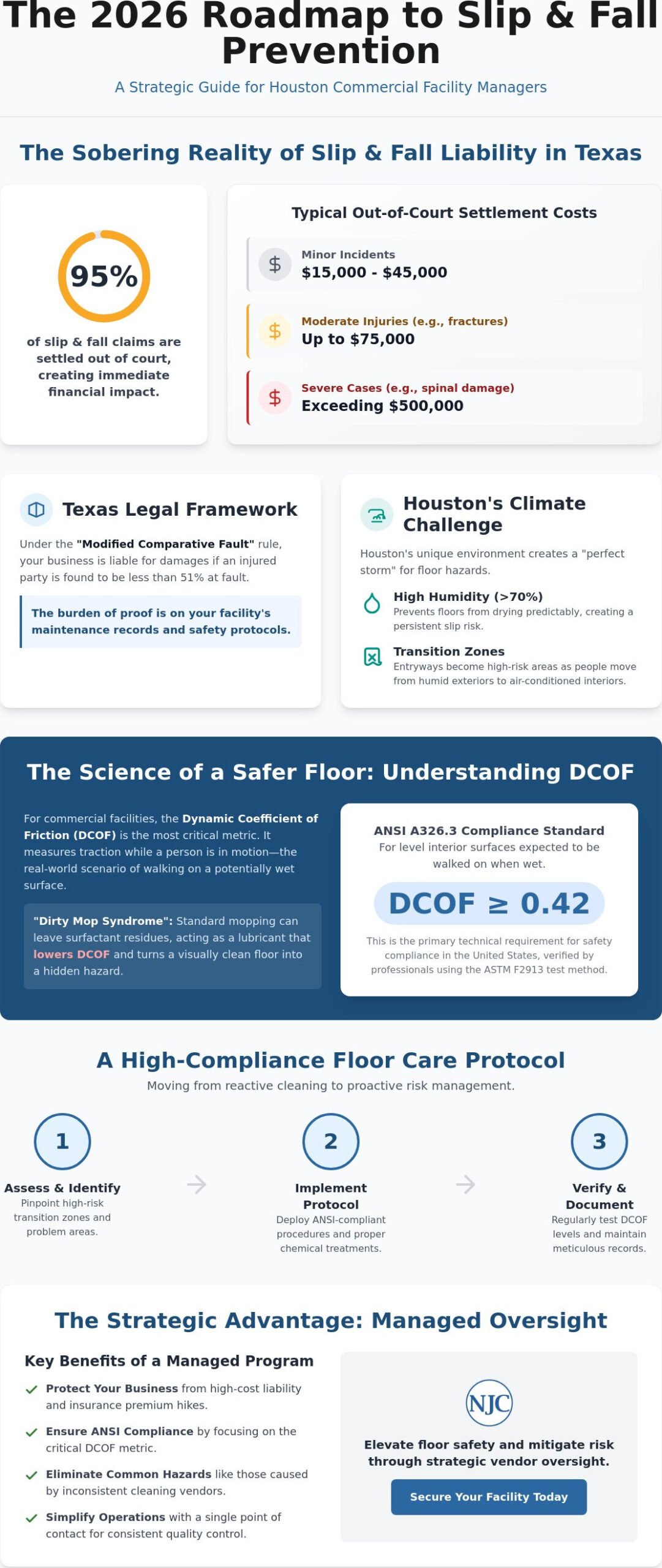
The financial reality for Houston business owners is sobering. Typical out-of-court settlements for slip and fall incidents range from $15,000 to $45,000. However, moderate injuries like fractures can quickly escalate to $75,000, while severe cases involving spinal damage often exceed $500,000. Under the Texas “Modified Comparative Fault” rule, your liability hinges on the maintenance of safe conditions. If a visitor is found to be less than 51% at fault, your business is responsible for damages. This legal framework places the burden of proof on your facility’s maintenance records and The Science of Floor Safety protocols you have in place.
The True Cost of Liability in Texas
Beyond the immediate settlement, the “ripple effect” of an accident can be devastating. Frequent incidents lead to a direct spike in workers’ compensation insurance premiums, often lasting for years. You also face hidden costs that don’t appear on a balance sheet. Lost productivity during investigations, the administrative burden of claims management, and the erosion of brand reputation are all significant factors. A single high-profile accident can signal a lack of oversight, deterring both top-tier talent and premium clients from your facility.
Houston-Specific Environmental Risks
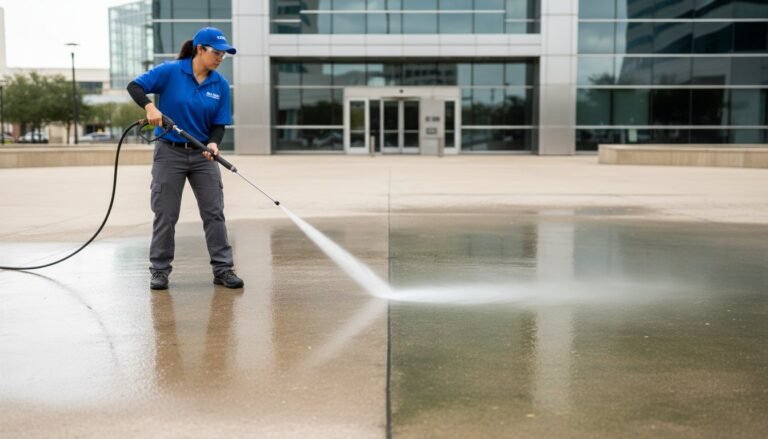
Houston’s unique climate creates a “perfect storm” for indoor floor hazards. With humidity levels frequently exceeding 70%, standard cleaning methods often fail because floors don’t dry at a predictable rate. This lingering moisture creates a persistent slip risk, especially in transition zones where employees move from humid exteriors into air-conditioned lobbies. Sudden afternoon thunderstorms exacerbate this by turning entryways into high-risk zones within minutes. Track-in moisture and debris accumulate rapidly in high-traffic areas, requiring a managed floor care protocol that accounts for these micro-climate shifts. Relying on a standard cleaning schedule is insufficient when Houston’s weather can compromise your floor’s traction in an instant.
The Science of Floor Safety: COF and Compliance Standards
Understanding the technical metrics of floor safety is the first step in moving from a reactive cleaning model to a high-compliance safety protocol. In the professional facility management sector, we rely on the Coefficient of Friction (COF) as the definitive measure of traction. While Static COF (SCOF) measures the force required to start movement, Dynamic COF (DCOF) measures the friction of a surface while an object is already in motion. For commercial facilities, DCOF is the more critical metric because it accurately reflects the reality of a person walking across a wet or contaminated surface. Implementing a robust strategy for slip and fall prevention floor care houston requires a precise understanding of these physical variables.
Understanding ASTM and OSHA Requirements
High-performing facility managers look to established benchmarks to validate their maintenance programs. The ANSI A326.3 standard specifies a minimum DCOF of 0.42 for level interior surfaces expected to be walked on when wet. This serves as the primary technical requirement for safety compliance in the United States. OSHA 1910.22 further mandates that walking-working surfaces must be maintained in a clean, orderly, and sanitary condition. To verify these levels, professionals use the ASTM F2913 test method, which provides a repeatable way to measure traction in real-world environments. Neglecting these standards contributes to the High Stakes of Slip and Fall Incidents that can destabilize a business’s liability profile.
Chemical Engineering for Slip Resistance
A frequent error in facility management is equating a shiny floor with a safe one. Standard mopping often leaves behind surfactant residues or soap films that actually lower the floor’s DCOF once moisture is introduced. This residue acts as a lubricant, turning a visually clean floor into a significant hazard. Effective slip-resistant treatments for VCT, tile, and polished concrete work by chemically altering the surface profile at a microscopic level to increase grip without compromising the aesthetic finish.
Using pH-neutral cleaners is essential in this process; they remove contaminants without stripping the protective slip-resistant layers or leaving dangerous films. Maintaining this balance ensures your facility remains compliant with safety standards while preserving the longevity of your flooring assets. If you’re unsure whether your current protocols meet these benchmarks, it’s time to evaluate your facility vendor management solutions to ensure professional oversight. You can also consult with a strategic partner at NJC Management to audit your current chemical usage and safety compliance.
Managed Care vs. Standard Mopping: Why Your Current Service Might Be Failing
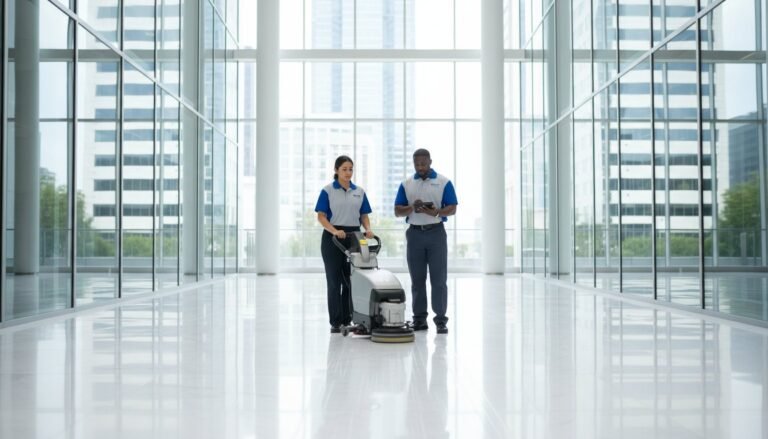
Most facility managers assume their floors are safe because they see a janitor with a mop every night. This assumption is a liability trap. Traditional mopping often creates more hazards than it solves, especially when vendors prioritize speed over safety compliance. Transitioning to a high-compliance commercial floor cleaning program ensures that every square foot is treated with fresh solution and proper mechanical agitation. For effective slip and fall prevention floor care houston, the difference between a visually clean surface and a safe one is a matter of strict management oversight.
One of the most pervasive issues in the industry is ‘Dirty Mop Syndrome.’ When a cleaning crew relies on a single bucket of water for an entire lobby, they’re simply redistributing contaminants. As the water becomes saturated with grease and sediment, it leaves behind a thin, slippery film once it dries. This film drastically reduces the floor’s traction, creating a invisible hazard that standard inspections might miss. Managed floor care protocols eliminate this by mandating frequent water changes and the use of microfiber technologies that trap soil rather than spreading it.
The Pitfalls of Unmanaged Janitorial Vendors
Standard cleaning contracts often lack the rigorous Quality Assurance (QA) needed for modern safety standards. Without strategic oversight, inconsistent training leads to incorrect chemical dilution ratios. If a solution is too concentrated, it leaves a sticky residue that attracts more dirt; if it’s too diluted, it fails to remove the oils that cause slips. Vendors may also skip high-compliance protocols to save time, neglecting the specific requirements of OSHA’s Walking-Working Surfaces Standard. A managed approach provides the KPIs and documentation necessary to prove that safety is being actively maintained, not just promised.
Strategic Floor Stripping and Waxing
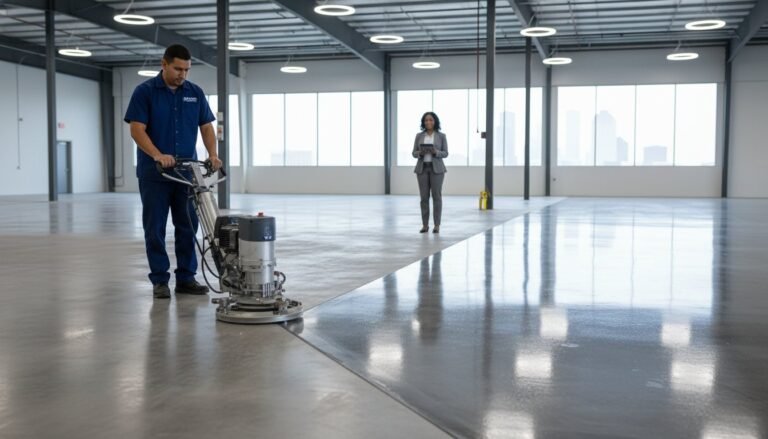
Old, yellowed wax is more than an aesthetic eyesore. Over-waxing creates a brittle, uneven surface that can flake and reduce overall slip resistance. Strategic floor care and maintenance requires a timeline for stripping and waxing based on actual foot traffic rather than a generic calendar date. High-traffic Houston facilities need a customized plan that removes built-up layers before they become a hazard. This ensures the floor remains resilient and maintains the necessary grip to protect occupants.
One-size-fits-all cleaning schedules consistently fail in multi-tenant Houston buildings. A medical clinic on the third floor has vastly different soil loads and safety requirements than a corporate law office on the tenth. A strategic partner understands these nuances, adjusting protocols to match the specific traffic patterns and environmental risks of each tenant space. This level of customization is what separates a basic janitorial service from a professional risk management strategy.
A Strategic Floor Care Protocol for Houston Facility Managers
Execution is where strategy meets reality. For a program focused on slip and fall prevention floor care houston, you need a repeatable framework that your team can follow without deviation. Consistency is the enemy of liability; a documented 5-step daily and periodic protocol ensures that no high-traffic area is left to chance. This starts with daily soil removal using microfiber technology, followed by precise chemical management with pH-neutral solutions. You must also account for extended drying times caused by local humidity, monitor high-risk transition zones, and schedule periodic deep restoration to maintain the floor’s original traction properties.
Transition zones are the most dangerous areas in any commercial facility. These are the points where floor types change, such as from carpet to polished stone or near elevator banks. The change in the Coefficient of Friction (COF) can catch a visitor off guard, leading to an immediate fall. A strategic protocol prioritizes these zones for extra attention, ensuring they remain dry and free of residue at all times. Documenting every safety inspection is your primary defense in a premises liability case; if it isn’t recorded, it didn’t happen.
The 2026 Walkway Safety Audit
Conducting a monthly visual inspection is a non-negotiable requirement for modern facility management. During these audits, you should identify ‘low-spot’ areas where water tends to pool during Houston’s frequent afternoon rain showers. It’s also vital to track ‘near-miss’ incidents. If employees report slipping without falling in a specific hallway, that data should trigger an immediate adjustment in cleaning frequency or a re-evaluation of the chemicals used in that area. This data-driven approach transforms your floor care from a chore into a risk management asset.
Matting and Entryway Management
Your matting system is the first line of defense against Houston’s relentless humidity. Following the ’10-to-15 foot rule’ ensures that visitors take enough steps on an absorbent surface to remove the majority of exterior moisture before they reach your hard floors. In our climate, choosing the right materials is critical; you need mats that resist mold and dry quickly despite the heat. Scheduling professional mat cleaning is equally important to prevent saturation. A soaked mat doesn’t just stop working; it becomes a secondary source of moisture that increases the risk of an accident.
To implement these high-compliance standards and protect your facility, you need a partner who understands the complexities of strategic oversight. If you’re ready to upgrade your facility’s safety profile, contact NJC Management today to discuss our tailored floor care solutions.
NJC Management: Elevating Floor Safety Through Strategic Oversight
Strategic oversight is the final piece of the risk management puzzle. Nationwide Janitorial Connect (NJC) operates as your single-source solution, bridging the gap between high-level safety standards and daily execution. While earlier sections detailed the technical requirements of DCOF and the environmental impact of Houston’s humidity, NJC provides the management infrastructure to ensure these protocols are followed without exception. Our facility vendor management solutions are designed for leaders who require precision and accountability across their entire property portfolio.
We don’t just source vendors; we vet them through a rigorous process tailored to the specific needs of Houston commercial facilities. This includes verifying their expertise in specialized slip and fall prevention floor care houston and their ability to maintain ANSI compliance under local environmental pressures. By managing the vendor relationship, NJC removes the burden of oversight from your team. This allows you to focus on core business objectives while we maintain your safety compliance through structured, high-compliance programs.
Consolidating Safety Protocols Across Locations
For facility managers overseeing multi-property portfolios in Houston, consistency is the primary challenge. NJC ensures that the same rigorous safety standards are applied whether you’re managing a downtown high-rise or a suburban medical complex. You gain the benefit of a single point of contact for emergency spill response or urgent floor repairs, eliminating the chaos of managing multiple vendor contacts. This centralized approach reduces administrative burden through consolidated billing and real-time reporting, providing a transparent view of your facility’s safety status at any moment.
The NJC Quality Assurance Advantage
Our independent Quality Assurance (QA) inspections are what hold vendors accountable to the highest standards. We don’t rely on the vendor’s self-reporting; instead, we conduct our own audits to guarantee that every floor surface meets the required traction benchmarks. This commitment to using high-standard, specialized environment cleaning protocols ensures that your liability risk remains low and your floors remain safe for every visitor. We treat floor care as a long-term asset management strategy, not a recurring chore.
Protecting your brand and your bottom line requires a partner who values precision as much as you do. Contact NJC Management today to audit your Houston floor care program and discover how our strategic oversight can transform your facility’s safety profile.
Securing Your Facility’s Future Through Strategic Floor Management
Maintaining safe walking surfaces in Houston’s volatile climate is a management challenge that rewards precision. By shifting from standard janitorial tasks to a data-driven protocol, you protect your assets from the high costs of premises liability. Remember that meeting the 0.42 DCOF benchmark is a continuous process; it requires the right chemicals, proper matting, and strict vendor oversight to succeed. It’s about building a culture of safety that starts at the entryway and extends through every square foot of your property.
NJC Management serves as your strategic partner in this effort. We provide a single point of contact for over 20 facility solutions, specializing in high-standard environments like laboratories and financial institutions. Our rigorous QA inspections ensure that your slip and fall prevention floor care houston remains compliant with the latest safety standards, giving you back the time to focus on your core business goals. It’s time to move beyond the uncertainty of inconsistent cleaning vendors and embrace a more organized, results-oriented approach.
Take the first step toward a safer, more efficient facility today. We’re ready to help you align your individual vision with market realities and business safety goals.
Request a Strategic Floor Care Audit for Your Houston Facility
Frequently Asked Questions
What is the most common cause of slip and fall accidents in Houston offices?
Tracked-in moisture from Houston’s frequent afternoon thunderstorms is the leading cause of these incidents. Lobbies and entryways become hazardous when matting systems become saturated and fail to absorb incoming water from visitors’ shoes. This moisture, combined with smooth interior surfaces, creates an immediate traction deficit that leads to accidents.
How does Houston’s humidity affect floor safety and drying times?
High humidity levels in Houston significantly extend floor drying times by slowing the natural evaporation process. This means a floor that appears dry may still have a microscopic layer of moisture that compromises traction. Facility managers must account for these extended windows to prevent employees from walking on surfaces that haven’t fully cured after cleaning.
What is the difference between a clean floor and a slip-resistant floor?
A clean floor is simply free of visible debris, while a slip-resistant floor meets specific friction benchmarks like the 0.42 DCOF standard. Visual cleanliness is often deceptive; standard mopping can leave behind surfactant films that actually increase slipperiness. True safety is measured by the surface’s ability to provide grip, not its level of shine.
How often should commercial floors be stripped and waxed for safety?
High-traffic commercial facilities typically require stripping and waxing every six to twelve months to maintain a safe and resilient surface. Areas with lower foot traffic might extend this timeline to eighteen months. Regular inspections are necessary to identify when wax has become brittle or yellowed, as these conditions significantly reduce the floor’s slip resistance.
What OSHA standards apply to commercial floor maintenance?
OSHA standard 1910.22 requires that all walking-working surfaces be maintained in a clean, dry, and orderly condition. While OSHA doesn’t mandate a specific friction number, it refers to consensus standards like ANSI as best practices for slip and fall prevention floor care houston. Compliance involves both the physical state of the floor and the documentation of your maintenance efforts.
Can professional floor care help lower my insurance premiums?
Implementing a documented, high-compliance floor care program provides tangible evidence of risk mitigation to your insurance provider. This proactive stance demonstrates that you’re actively reducing the likelihood of claims. Many providers view such strategic oversight favorably during policy renewals, which can lead to more competitive premium rates for your facility.
How do I know if my cleaning vendor is using non-slip chemicals?
You should request the Safety Data Sheets (SDS) for all products used in your facility and verify they’re labeled as slip-resistant or friction-enhancing. A professional vendor should also be able to provide regular friction testing results. This data proves the chemicals are working as intended to maintain the required safety benchmarks on your specific flooring types.
Why is a managed facility solution better than hiring a standard cleaning company?
Managed solutions provide a layer of strategic oversight and independent quality assurance that standard janitorial companies don’t offer. This model ensures that safety protocols are consistent across multiple properties and provides a single point of contact for all facility needs. It transforms floor care from a recurring chore into a structured risk management asset for your business.