Average Janitorial Rates in Houston: A 2026 Strategic Cost Guide for Facility Managers
In Houston’s competitive 2026 commercial landscape, relying on a simple “average” to budget your facility maintenance is a strategic risk that often leads to budget overruns. While understanding the average janitorial rates in houston is a necessary starting point, the true cost of a clean environment is hidden in the management layer and vendor efficiency. You’ve likely faced the frustration of receiving three wildly different quotes for the same square footage; this leaves you to justify inconsistent spending to executive leadership without a clear benchmark.
It’s understandable why transparency feels out of reach when contracts are buried in fine print and unexpected surcharges. This guide provides the clarity you need by delivering current market data alongside a disciplined framework for evaluating vendor value. You’ll gain a precise understanding of regional pricing for specialized environments and learn how to consolidate your facility spend without compromising the high standards your brand demands.
Key Takeaways
- Understand the shift toward contract-based pricing and how Houston’s current labor market defines the 2026 baseline for commercial facilities.
- Benchmark your facility budget against the average janitorial rates in houston while accounting for the specific security and sanitization needs of specialized environments.
- Identify the risks associated with low-ball quotes by verifying insurance, bonding, and Texas-specific tax compliance in your service agreements.
- Learn how to leverage vendor consolidation and quality assurance inspections to reduce administrative overhead and ensure consistent service delivery.
- Develop a strategic framework to justify facility spend to executive leadership by aligning cleaning costs with long-term asset protection and risk management.
Understanding Commercial Janitorial Rates in Houston (2026)
Strategic facility management begins with a clear distinction between basic cleaning and professional maintenance. Many facility managers mistakenly look to residential benchmarks to set their expectations. This approach creates a significant disconnect. In a professional B2B context, the average janitorial rates in houston reflect a sophisticated ecosystem of risk management, specialized equipment, and administrative oversight. Treating these rates as a commodity leads to under-budgeting and service gaps that can threaten your operational continuity.
Relying on residential platforms like Angi or Care.com for commercial budgeting is a dangerous shortcut. These sites provide data for domestic help, where the primary cost is simple labor. Commercial facilities operate under entirely different standards. A high-rise office or a medical facility in the Houston-The Woodlands-Sugar Land metro area requires more than a vacuum and a mop. It requires a partner who understands the logistics of large-scale environment management and the specific regulatory burdens of the Texas market.
The Disconnect: Residential Maid Rates vs. Commercial Janitorial Standards
Commercial pricing must account for overhead that residential services simply don’t carry. This includes high-limit general liability insurance, umbrella policies, and comprehensive bonding to protect your physical assets. A detailed Commercial cleaning industry overview reveals that professional standards also involve rigorous background checks and continuous safety training. These elements are non-negotiable for businesses that prioritize security and compliance.
- Insurance and Bonding: Protecting against property damage and theft in high-value commercial spaces.
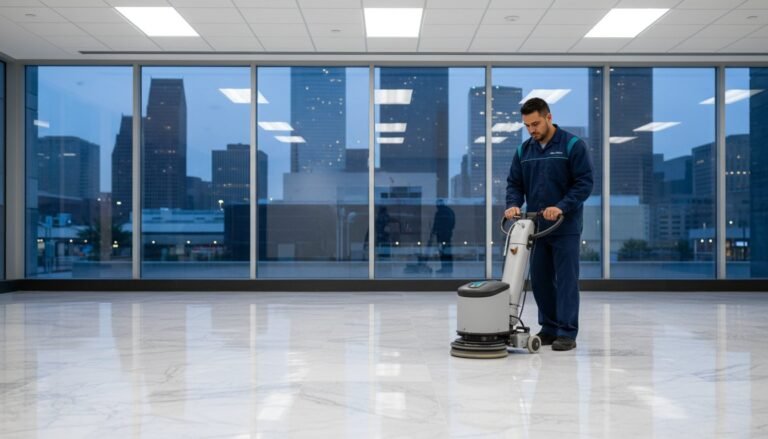
- Specialized Equipment: Industrial-grade floor scrubbers, HEPA-filter vacuums, and eco-friendly chemical management systems.
- Certification Costs: Maintaining standards for LEED v5 compliance or specialized sanitization protocols.
Commercial janitorial rates represent a total facility solution that integrates risk mitigation, asset preservation, and operational continuity rather than just a simple tally of labor hours.
Houston’s 2026 Labor Market and Economic Drivers
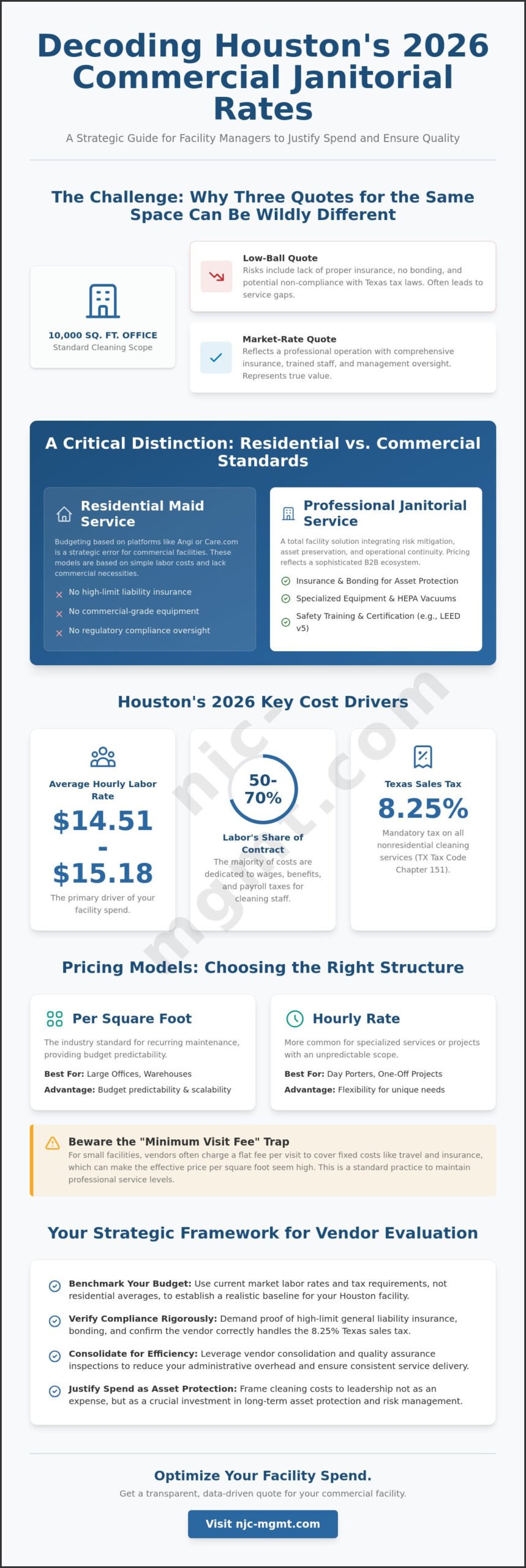
The Houston economic landscape directly shapes service costs. As of June 2026, the average hourly pay for a janitor in Houston is approximately $14.51 to $15.18. Since labor typically accounts for 50% to 70% of a janitorial contract, these wage trends are the primary driver of your facility spend. Vendors must balance these competitive wages with the 8.25% sales tax mandated by Texas Tax Code Chapter 151 for nonresidential cleaning services. This tax is a fixed reality for Houston businesses and must be factored into every strategic budget. When evaluating the average janitorial rates in houston, you’re seeing the convergence of rising labor demands, regional fuel costs for mobile crews, and the stringent requirements of the local regulatory environment.
Commercial Pricing Models: Square Footage vs. Hourly Rates
Selecting the right pricing structure is a pivot point for facility budget optimization. In the Houston market, vendors typically present costs through either a square footage model or an hourly rate structure. While square footage pricing is the standard for recurring maintenance in large office complexes and industrial warehouses, hourly rates are more common for specialized day porter services or one-off projects. Understanding the average janitorial rates in houston requires looking beyond the bottom line to see how these models distribute risk and administrative costs. A recurring contract provides budget predictability, but it must be based on an accurate assessment of your facility’s specific layout and traffic patterns.
Small facilities often encounter the “Minimum Visit Fee” trap. When a space falls below a certain size threshold, the price per square foot becomes irrelevant because the vendor must cover the fixed costs of mobilization, insurance, and travel. For these smaller footprints, you’ll likely see a flat fee per visit that exceeds standard market averages. This ensures the vendor can maintain professional standards without operating at a loss. For larger operations, the economy of scale allows for more competitive rates, provided the scope of work is clearly defined to avoid “scope creep” during the contract term.
The Square Foot Model: Benchmarking Large-Scale Houston Facilities
In standard office environments, pricing is driven by the density of workstations and the ratio of “wet” areas like restrooms and breakrooms. High-traffic retail spaces demand a different approach due to the constant influx of dirt and debris. When calculating your budget, distinguish between gross square feet and “cleanable” square feet. Furniture-heavy layouts increase the labor time required per foot, which vendors reflect in their proposals. For a deeper dive into maintaining high-value surfaces, consult our Commercial Floor Cleaning in Houston guide to see how floor type influences long-term maintenance costs.
Hourly Rate Structures for Specialized Day Porter Services
Day porter services provide a visible, proactive presence that square foot pricing rarely covers effectively. These roles are typically billed hourly because the tasks are dynamic and shift based on daily facility needs. When reviewing these rates, consider that a professional vendor’s hourly charge includes much more than base wages. It covers payroll taxes, workers’ compensation, and the cost of supervision. According to National wage data for janitorial staff, labor is the most significant variable in any contract. Managed vendor solutions often prove more cost-effective than internal hiring because they eliminate the administrative burden of recruitment and training. If you are looking to streamline your operations, our team can assist with vendor sourcing and management to find a structure that fits your unique operational rhythm.
Industry-Specific Cost Drivers for Houston Facilities
Facility type is the most influential variable in your maintenance budget. While standard office spaces set the baseline for average janitorial rates in houston, specialized sectors operate under rigorous financial and operational frameworks. These environments demand a level of precision that general cleaning crews simply cannot provide. Whether you manage a biotech lab or a downtown financial headquarters, your investment reflects the specialized training and equipment necessary to maintain safety and regulatory compliance.
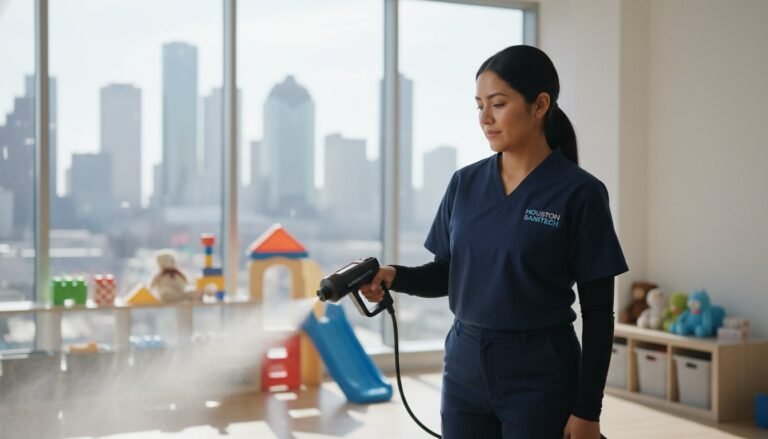
The bottom line is heavily impacted by the technology deployed on-site. High-performance tools like HEPA-certified vacuums and electrostatic sprayers are no longer optional in high-traffic or high-sensitivity areas. These systems require significant capital investment and technical proficiency from the vendor. When a partner includes these in their scope, they’re providing a layer of risk mitigation that protects your staff and your facility’s long-term value. This is especially critical in medical facilities, where terminal cleaning and pathogen control are essential to preventing healthcare-associated infections.
High-Compliance Premiums: Labs, Clean Rooms, and Financial Institutions
Houston’s biotech and laboratory sectors are expanding rapidly, bringing with them a need for ISO-compliant maintenance. Adhering to recognized cleaning industry standards in these spaces involves more than basic tidiness; it requires the use of specialized chemicals and strict protocol adherence. For financial institutions in downtown Houston, security is the primary cost driver. Vendors must account for the administrative overhead of extensive background checks and security clearances for every technician on the crew. To understand how these requirements scale in heavy-duty environments, explore our Industrial Cleaning Services in Houston guide.
Educational Facilities: Sanitization Standards in Houston School Districts
School districts manage a unique set of challenges that require a proactive approach to sanitization. High-frequency touchpoints such as desks, door handles, and cafeteria surfaces need constant attention to ensure a safe learning environment. This intensity increases during post-construction cleanup for new school buildings, where crews must remove fine dust and construction debris without damaging new finishes. Compliance-driven cleaning in these sectors typically costs 20-30% more than standard office janitorial due to the increased labor intensity and the rigorous vetting required for staff working around students. This specialized focus ensures that your facility meets state health mandates while providing a stable environment for education.
Evaluating Janitorial Quotes: Identifying Hidden Costs and Quality Gaps
Low-ball quotes often signal a lack of compliance or inadequate labor investment. When a bid falls significantly below the average janitorial rates in houston, it’s rarely a sign of operational efficiency. It’s usually a red flag for missing insurance coverage, high employee turnover, or a lack of proper worker vetting. These gaps create immediate liability for your organization. If a vendor doesn’t provide comprehensive workers’ compensation or professional bonding, your facility absorbs the legal and financial risk of every on-site incident. Cheap vendors prioritize volume over precision, which inevitably leads to service fatigue and neglected high-traffic areas.
Transparency in supply management is another area where costs can spiral. Some vendors include industrial chemicals and paper goods in their base rate to provide budget stability. Others bill these as pass-through costs with a significant markup. A professional quote should clearly delineate these items to prevent “invoice shock” at the end of the month. Without this clarity, your facility spend becomes an unpredictable variable rather than a fixed operational cost. Implementing rigorous Quality Assurance (QA) inspections is the only way to verify that you are receiving the level of service promised in the contract. These inspections move maintenance from a reactive task to a proactive strategy.
Vetting for Liability: Insurance, Bonding, and Worker’s Comp
Protecting your physical assets requires more than just a signed agreement. You must verify that your vendor uses specialized labor for technical tasks like floor care and window cleaning. Generalists often lack the training to handle high-value surfaces, leading to permanent damage that exceeds any initial savings. Ask potential partners about their specific training protocols and employee retention rates. High turnover is a primary driver of service inconsistency and security breaches. For a deeper look at the selection process, read our guide on Choosing the Right Janitorial Company in Houston.
The Hidden Cost of Administrative Overhead in Multi-Vendor Management
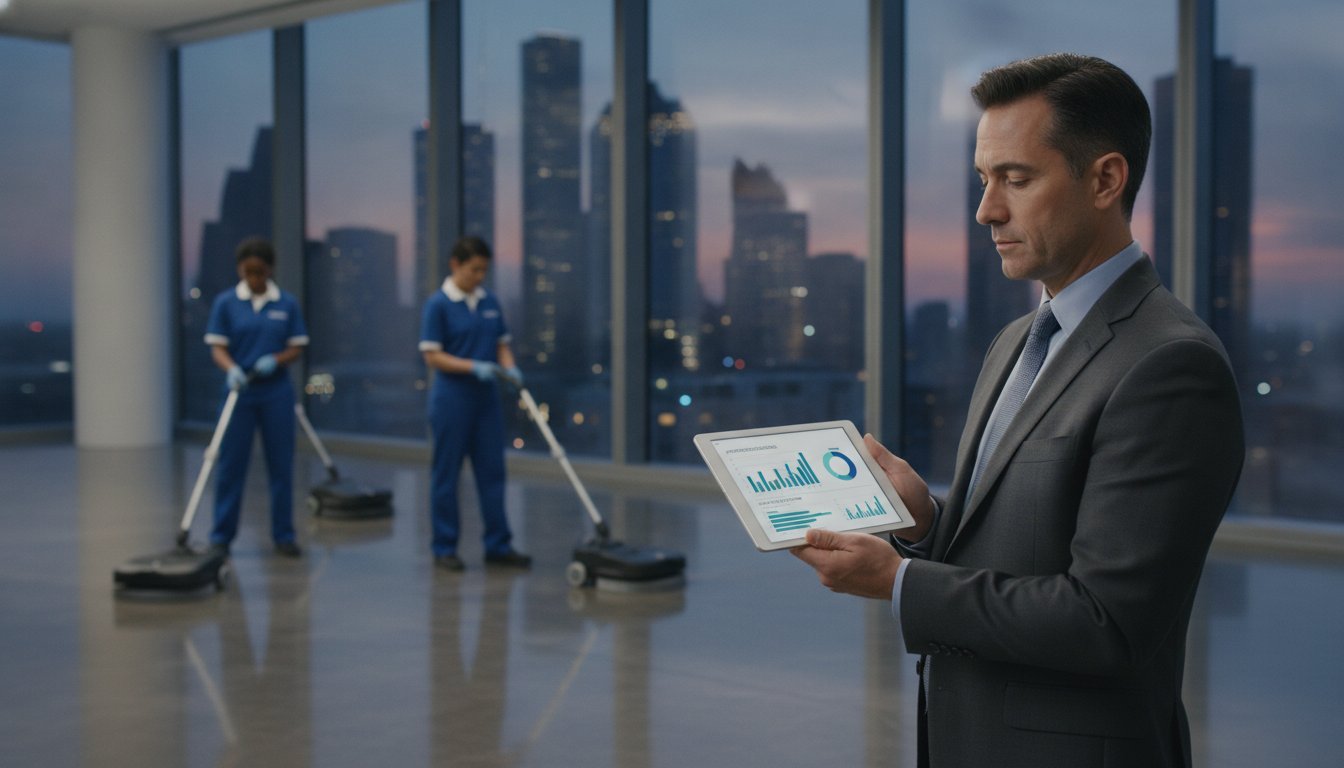
Administrative friction is a silent budget killer for facility managers. Managing ten different vendors for carpet cleaning, pressure washing, and daily janitorial tasks creates a massive burden for your accounting and procurement teams. Each vendor requires separate vetting, invoicing, and quality checks. Consolidating these services under a single-source management layer reduces this overhead and ensures a unified standard of quality across your entire portfolio. A professional management report should provide a consolidated view of facility health and performance metrics, allowing you to make data-driven decisions. To streamline your facility operations, contact our team for comprehensive Quality Assurance Inspections and vendor management solutions.
Optimizing Facility Spend Through Strategic Vendor Management
Consolidation is more than a convenience; it’s a proven financial strategy. Our data shows that facility managers can reduce their administrative management time by 40% simply by centralizing their vendor communications. Instead of juggling separate contracts for floor care, pressure washing, and daily janitorial, you move to a single-source model. This shift allows for a unified standard of excellence where every service line supports the other. When one partner is responsible for the entire facility’s health, accountability becomes a built-in feature rather than a constant struggle.
Consolidating 20+ Facility Solutions into One Managed Monthly Invoice
Managing a high-performance facility shouldn’t require a mountain of paperwork. By bundling services like window cleaning, carpet care, and daycare cleaning into one managed plan, you gain oversight without the accounting headache. Our rigorous vendor vetting and Facility Vendor Management Solutions ensure that every technician on your property meets elite standards. This approach provides a single point of contact for all 20+ facility solutions, ensuring that your strategic goals are communicated clearly and executed consistently across every square foot.
The Nationwide Janitorial Connect Quality Assurance Framework: Protecting Your Facility Investment
Maximizing your budget starts with a clear-eyed assessment of your current operations. We conduct a detailed facility audit to identify cost-saving opportunities and service overlaps that often go unnoticed. This data-driven approach ensures that your maintenance plan is built for efficiency, not just activity. We focus on long-term asset protection, ensuring that your floors, windows, and structural surfaces are maintained to the highest standards. If you’re ready to move beyond the average janitorial rates in houston and implement a professional maintenance strategy, take the first step today. Request a customized facility management quote from Nationwide Janitorial Connect to see how strategic consolidation can transform your bottom line.
Secure Your Facility’s Strategic Future
Navigating the 2026 market requires more than just knowing the average janitorial rates in houston. It demands a shift toward vendor consolidation and proactive quality assurance. You’ve seen how hidden liabilities and administrative overhead can erode your budget. By centralizing your operations, you move from managing individual tasks to overseeing a cohesive facility strategy that protects your long-term assets.
Nationwide Janitorial Connect, headquartered in Houston, provides a single point of contact for 20+ facility solutions. We specialize in high-compliance environments, including laboratory and clean room cleaning, ensuring that your space meets the strictest industry standards. This local expertise allows you to focus on high-level business objectives while we handle the operational details with professional precision.
Ready to optimize your spend and elevate your facility standards? Get a Strategic Janitorial Management Quote for Your Houston Facility. Your property is a significant investment; let’s ensure it reflects the excellence of your brand.
Frequently Asked Questions
What is the average cost per square foot for commercial cleaning in Houston?
Commercial cleaning costs are primarily calculated based on the cleanable square footage and the specific “wet” density of the facility, such as the number of restrooms and breakrooms. High-traffic environments or spaces with complex layouts generally see higher rates per foot compared to open-plan warehouses or low-occupancy offices. When evaluating the average janitorial rates in houston, it’s essential to distinguish between gross area and the actual surface area requiring daily maintenance.
How much do commercial cleaners charge per hour in Texas for 2026?
Hourly rates in the Texas market reflect the total cost of managed labor, which includes base wages, payroll taxes, and professional supervision. These rates vary depending on whether the service is a recurring day porter role or a specialized one-off project requiring industrial equipment. A professional hourly rate ensures the vendor can maintain rigorous safety standards and background check protocols required for secure business environments.
Does the type of facility significantly change the janitorial rate?
Yes, the facility type is one of the most critical factors in determining your final contract price. Medical facilities and financial institutions require specialized sanitization protocols and higher security clearances, which naturally increase the service cost. These environments demand a level of precision and regulatory compliance that standard office cleaning doesn’t require, justifying the premium for specialized expertise.
Are cleaning supplies and paper goods usually included in Houston janitorial quotes?
Supplies can be handled as either an all-inclusive flat fee or as pass-through costs billed separately each month. Most comprehensive average janitorial rates in houston will clearly delineate these options to provide the facility manager with better budget transparency. It’s vital to confirm if industrial chemicals and high-volume paper goods are part of the base agreement to avoid unexpected invoice markups.
How often should a commercial facility in Houston be deep cleaned to maintain value?
What are the typical rates for specialized clean room janitorial services in Houston?
Clean room janitorial services carry a premium due to the technical requirements of ISO-compliant environments and the cost of specialized PPE. These services involve rigorous protocol adherence and the use of specific, non-residual chemicals to prevent contamination. The price reflects the specialized training and administrative oversight necessary to maintain the integrity of biotech and laboratory spaces.
Can vendor consolidation actually lower my total janitorial spend?
Consolidating your facility services under a single management layer significantly reduces your total spend by eliminating administrative friction. Instead of managing multiple contracts for floor care, window washing, and daily janitorial, you benefit from a unified procurement process. This efficiency reduces the time your team spends on vetting and accounting, allowing for better resource allocation across your entire portfolio.
How do I verify if a Houston janitorial company is properly insured and bonded?
You should request a current Certificate of Insurance (COI) that names your organization as an additional insured party. A reputable Houston vendor will also provide documentation of their bonding and workers’ compensation coverage to protect you from on-site liabilities. Verifying these credentials is a non-negotiable step in the vetting process to ensure your facility is protected against property damage or legal claims.