
Local vs. National Janitorial Services in Houston: A 2026 Strategic Guide
Choosing between a small local crew and a massive national chain is actually the wrong starting point for a Houston facility manager in 2026. While the debate over local vs national janitorial services houston usually centers on price or scale, the real conflict lies in the administrative burden of managing 20 different invoices versus the frustration of slow, impersonal response times from a national help desk. You’ve likely experienced the inconsistency that occurs when a national model fails to account for the specialized requirements of a Houston clean room or the specific wastewater regulations monitored by the TCEQ.
It’s understandable to want the best of both worlds: the agility of a local partner and the professional infrastructure of a global leader. This strategic guide explores how a managed hybrid approach eliminates the trade-offs that traditionally plague facility operations. You’ll discover how to consolidate your billing and secure a single point of contact while maintaining the high-compliance standards required for modern labs and financial institutions. We’ll examine the 2026 Houston market landscape, from the impact of the World Cup Clean Zones to the shift toward data-driven maintenance, providing a clear roadmap for superior facility performance.
Key Takeaways
- Evaluate the specific strengths and infrastructure gaps of local vs national janitorial services houston to determine which model aligns with your 2026 operational goals.
- Eliminate administrative overhead by transitioning from fragmented vendor management to a consolidated billing system that saves hours of accounting labor.
- Secure specialized cleaning compliance for clean rooms and financial institutions without sacrificing the responsiveness of a dedicated local partner.
- Discover how the Managed Hybrid approach bridges the gap between community-level agility and standardized, national-grade project oversight.
- Shift from a reactive “help desk” mentality to a proactive quality assurance model that ensures consistency across every shift and facility location.
The Houston Janitorial Landscape: Why the Choice Matters in 2026
Houston’s commercial skyline is currently undergoing its most significant transformation in a decade. With 28.7 million square feet of commercial space under construction, the demand for sophisticated maintenance has never been higher. Facility managers are no longer just comparing prices; they’re evaluating the fundamental trade-offs of local vs national janitorial services houston to protect these massive capital investments. The city’s status as a global hub for energy, aerospace, and medical research means that “standard” cleaning is no longer sufficient. Specialized environments like the Texas Medical Center or the Energy Corridor require a level of precision that traditional models often struggle to provide.
The current market is also being shaped by immediate regulatory pressures. The FIFA World Cup 2026 has introduced strict “Clean Zones” across the Central Business District and NRG Park, effective from late May through July. These regulations, combined with the shift toward data-driven maintenance and digital quality assurance, have made the binary choice between a small local crew and a faceless national chain obsolete. Progressive facility leaders are looking for a strategic partner that can bridge the gap between local accountability and national-grade infrastructure.
Defining Local vs. National Models
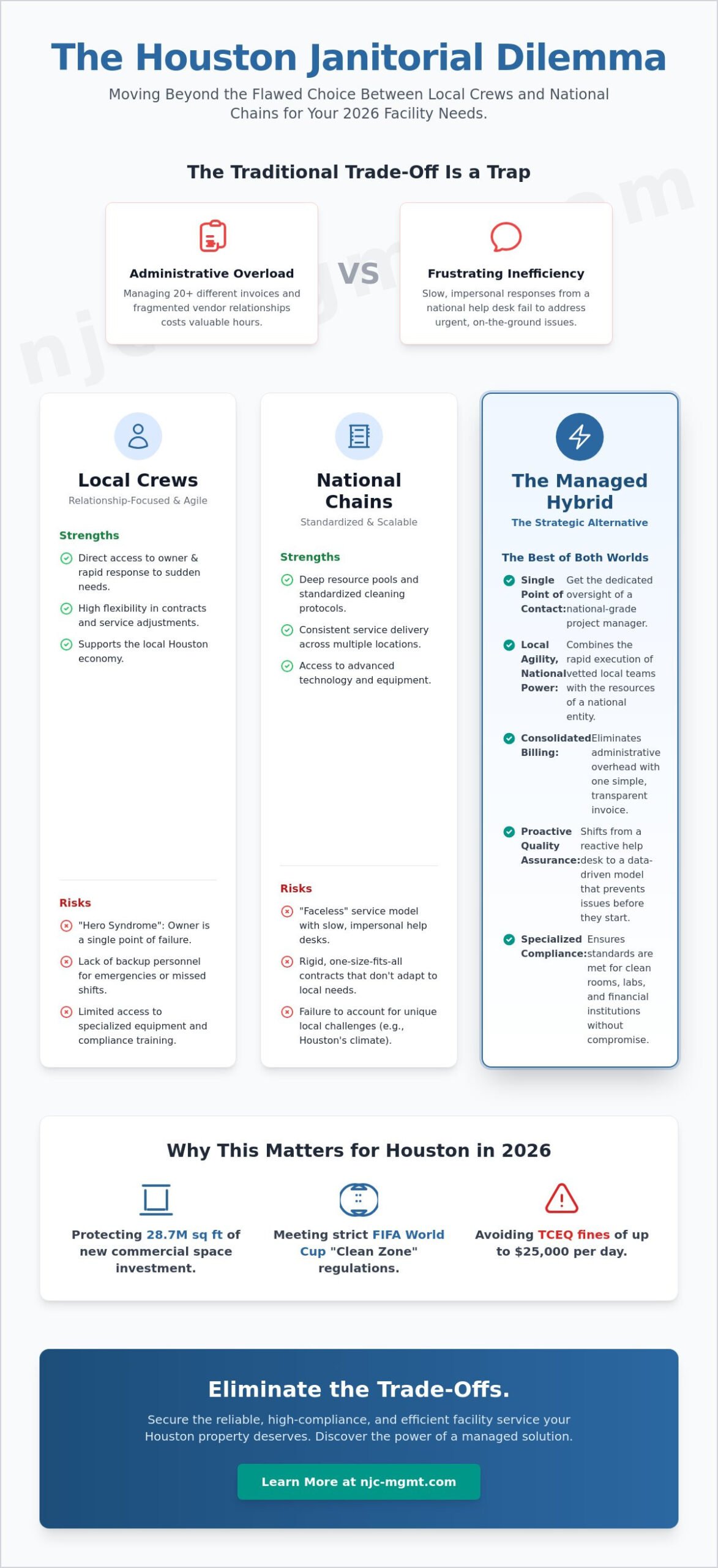
The commercial cleaning industry in Houston generally falls into three categories. Local firms are small to mid-sized operations with deep roots in the metro area. They offer direct access to ownership but often lack the backup personnel or specialized equipment needed for large-scale crises. National chains provide standardized protocols and deep resource pools, yet they frequently suffer from a “faceless” service model and rigid contracts that don’t adapt to Houston’s humid climate. The Managed Solution, exemplified by the Nationwide Janitorial Connect model, provides a single-source management layer. It combines the execution of vetted local teams with the high-level project management and consolidated billing of a national entity.
The Stakes of Your Selection
Your choice of a janitorial partner directly impacts property value and tenant retention. In a market where the Texas Commission on Environmental Quality can impose fines of up to $25,000 per day for a single wastewater violation, compliance isn’t optional. Substandard cleaning doesn’t just look bad; it degrades building assets and lowers employee productivity. While “cheap” cleaning might seem attractive on a monthly ledger, it almost always leads to higher long-term costs through accelerated carpet wear, floor damage, and administrative fatigue. A strategic partner ensures that your facility meets ISO standards and clean room requirements, turning maintenance from a line-item expense into a value-add for your organization.
Local Janitorial Companies: Agility vs. Infrastructure in Houston
Facility managers often start their search by weighing local vs national janitorial services houston through the lens of personal connection. There’s a distinct sense of security in knowing the business owner’s name and having their direct mobile number. This proximity allows for agility that larger corporations struggle to replicate. When a sudden tropical storm causes a localized leak or an executive meeting requires an immediate lobby refresh, a local partner can often redirect resources within the hour. Supporting the Houston economy also aligns with the corporate social responsibility goals of many firms headquartered in the Energy Corridor.
This intimacy frequently masks what industry veterans call the “Houston Hero” syndrome. In this scenario, a local owner overextends their personal capacity by acting as the lead salesperson, the site supervisor, and the emergency backup cleaner. While their dedication is admirable, it creates a fragile operational model. If that single individual becomes unavailable, the entire service chain can falter. This lack of organizational depth is the primary risk factor for facilities that cannot afford a single missed shift.
The Benefit of Local Relationships
Local firms excel in boutique environments where the scope of work is stable and the relationship is paramount. They offer significant flexibility in contract terms, often avoiding the rigid commitments required by national franchises. This adaptability is particularly useful for smaller professional offices or daycare centers where cleaning needs might fluctuate seasonally. Because these firms have deep roots in the metro area, they possess an intuitive understanding of Houston’s specific environmental challenges, such as the high humidity levels that affect floor wax curing times.
The Infrastructure Gap
The limitations of the local model become apparent when assessing long-term reliability and technical sophistication. Meeting rigorous OSHA safety and health standards requires documented training programs and consistent oversight that small firms often lack the capital to maintain. The investment required for advanced technology, such as electrostatic sprayers or robotic floor scrubbers, is typically beyond the reach of a local budget.
Reliability remains the most significant hurdle. When a crew member misses a shift, a local firm rarely has a “float pool” of vetted employees to fill the gap. This leads to inconsistent results and places the burden of quality control back on the facility manager. Additionally, many smaller operators carry limited insurance coverage, which may not adequately protect high-value commercial assets in the event of a major accident. Evaluating whether a partner has the resources to scale with your portfolio is a vital step in optimizing your vendor strategy for the coming year.
In high-compliance environments like clean rooms or laboratories, these infrastructure gaps are not just inconvenient; they’re a liability. Specialized cleaning requires precise chemical knowledge and strict adherence to protocol. Without the standardized training programs found in larger organizations, local firms often struggle to provide the level of compliance documentation required by modern medical and aerospace facilities.
National Cleaning Chains: Consistency vs. Customization
National cleaning chains represent the opposite end of the spectrum in the ongoing debate over local vs national janitorial services houston. These corporations operate with a level of scale that allows for deep resource pools and sophisticated logistics. For a facility manager overseeing a portfolio that spans from the Houston Ship Channel to The Woodlands, the promise of a single, standardized service level is compelling. These entities thrive on predictability. They use documented protocols to ensure that a lobby in Houston receives the same attention as one in any other major metropolitan area.
The Power of Standardization
Standardization is the primary asset of a national provider. They typically adhere to global benchmarks like the ISSA Clean Standards, which provide a framework for measurable quality across large portfolios. Because of their sheer volume, they negotiate bulk pricing on chemicals and consumables, theoretically passing those savings to the client. Their training programs are often more robust than local competitors, featuring formalized background checks and digital tracking systems. This infrastructure provides a layer of security for financial institutions and corporate headquarters that require strict personnel auditing and digital footprints of every service call.
The Customization Challenge
The same rigidity that creates consistency also creates a significant hurdle: the inability to adapt. National brands often utilize a “one-size-fits-all” scope of work that fails to account for Houston’s specific environmental factors. A floor care schedule designed in a corporate office in a different climate won’t work in our humid Gulf Coast environment. Moisture levels here dictate different drying times and chemical concentrations that national SOPs rarely address. When a local facility manager needs to modify a contract to handle these realities, they often hit a wall of bureaucracy. Addressing a quality complaint can take days as the request moves through a national help desk rather than a local decision-maker.
The most critical risk with national chains is the “Subcontractor Trap.” It’s common for a national brand to win a major Houston contract only to outsource the actual labor to a local crew they’ve never met. This creates a disconnect between the high-level professional marketing and the reality on the ground. The facility manager pays a premium for national oversight but receives the same limited infrastructure of a small local firm, minus the direct accountability. You’re effectively paying for a management layer that doesn’t have its boots on the ground. This disconnect is why the choice of local vs national janitorial services houston remains a complex strategic decision for those managing high-value assets.
The Facility Manager’s Dilemma: Hidden Costs and Management Fatigue
Managing a commercial property in Houston is a high-stakes balancing act that requires constant vigilance. The debate over local vs national janitorial services houston often overlooks the most significant expense in any facility budget: the manager’s own time. When you’re juggling 20 or more different vendors for window washing, pressure cleaning, and day porter services, you aren’t just managing a building. You’re managing an administrative nightmare. Every additional vendor represents a new invoice to verify, a separate insurance certificate to track, and another point of failure in your operational chain.
Consolidated billing is the primary antidote to this management fatigue. By moving toward a single-invoice model, organizations can save dozens of accounting labor hours every month. This streamlined approach eliminates the need to cross-reference multiple payment schedules and simplifies the audit process. It’s a strategic shift that allows facility leaders to focus on high-level asset management rather than chasing down paperwork from fragmented service providers.
Soft Costs vs. Hard Costs
The true cost of a cleaning contract isn’t just the number at the bottom of the proposal. You must calculate the “soft costs” of your own hourly rate spent managing subpar performance. If a facility manager spends five hours a week addressing tenant complaints or supervising a local crew that missed a shift, that’s thousands of dollars in lost productivity annually. Inconsistent maintenance also leads to the premature degradation of building materials. High-traffic Houston lobbies and corridors require precise care to avoid permanent damage to expensive stone or wood surfaces. For a deeper look at protecting these assets, consult our guide on Commercial Floor Cleaning in Houston.
The Vetting and Quality Assurance Gap
Most facility managers lack the digital tools required for objective quality inspections. They often rely on “the eye test” or wait for a tenant to complain before realizing a standard has slipped. This reactive posture is particularly dangerous in secure environments like Houston financial institutions. Allowing unvetted subcontractors into sensitive areas represents a major security liability that national help desks often fail to monitor effectively.
Strategic vendor sourcing is a full-time commitment that requires constant market analysis and performance auditing. Our approach to Quality Assurance Inspections replaces manual checklists with data-driven platforms, ensuring that every shift meets your specific compliance requirements. To see how much management fatigue is currently costing your operation, contact our team for a comprehensive vendor audit and discover the value of a managed facility strategy.
The Strategic Alternative: Managed Facility Solutions in Houston
The traditional debate over local vs national janitorial services houston is a relic of a fragmented market. Facility managers no longer have to settle for the limited resources of a small crew or the bureaucratic indifference of a national chain. The managed facility solution represents a strategic evolution. It combines the granular accountability of local execution with the sophisticated oversight of national project management. This hybrid model ensures that your facility standards are never compromised by a single point of failure or a rigid corporate policy. By utilizing a managed connection layer, you gain the agility of a Houston-based team backed by the professional infrastructure of a national leader.
Consolidating 20+ Services into One Contact
Modern facility management shouldn’t involve an administrative mountain of invoices and vendor vetting. A managed solution transforms your operations by consolidating disparate services into a single, streamlined point of contact. Whether you require window cleaning, pressure washing, or floor care, you deal with one partner who understands your entire portfolio’s needs. This isn’t just about cleaning; it’s about strategic consulting. We analyze your facility’s traffic patterns and environmental stressors to optimize service frequencies, ensuring you aren’t overpaying for unnecessary labor while maintaining peak aesthetic standards. Consolidated reporting provides a clear, high-level view of performance across multi-location Houston portfolios, turning maintenance data into an executive asset.
High-Compliance Expertise
Houston’s status as a hub for medical research and aerospace technology demands a level of precision that standard cleaning companies rarely reach. Our model prioritizes specialized training for high-compliance environments. We implement rigorous protocols for Clean Room Janitorial Services in Houston, ensuring that sensitive laboratories meet stringent ISO standards. This expertise extends to financial institutions and banks, where security protocols and personnel vetting are non-negotiable. For Houston schools and daycares, we focus on advanced sanitation methods that protect student health without disrupting the educational environment. You get the specialized knowledge of a niche provider with the scalability of a national firm.
Next Steps: Reclaiming Your Time
In 2026, facility management is a strategic asset that preserves property value and enhances occupant experience. It shouldn’t be a daily chore that drains your professional bandwidth. Transitioning from a fragmented vendor list to a managed solution is a controlled, data-driven process. It begins with a comprehensive facility audit to identify hidden costs and performance gaps. From there, we build a customized management plan that aligns with your specific operational goals. Stop managing janitors and start managing your facility’s future. Simplify your Houston facility management with NJC today.
Elevating Your Houston Facility Strategy for 2026
The traditional conflict of local vs national janitorial services houston is no longer a binary decision for modern facility managers. We’ve explored how local agility often lacks infrastructure and how national scale can lead to bureaucratic indifference. The most effective path forward involves a managed hybrid approach that eliminates administrative overhead through consolidated billing and a single point of contact for over 20 different facility solutions. This model ensures that your operational standards remain high without the management fatigue of tracking fragmented vendors.
By leveraging specialized expertise in clean room and laboratory maintenance, you protect your most sensitive assets while ensuring total compliance. This shift from simple vendor management to a strategic partnership allows you to reclaim your time and focus on high-level property performance. Your facility is a direct reflection of your organization’s professional standards; don’t let a fractured service model dilute that image. NJC provides the stability and innovation required to scale with your ambition in the evolving Houston market.
Request a Strategic Janitorial Management Quote for Your Houston Property and experience the clarity of a unified facility strategy today.
Frequently Asked Questions
What is the main difference between local and national janitorial services?
The primary difference involves the balance between personalized accountability and operational scale. Local firms provide direct access to decision-makers but often lack the backup personnel for large-scale emergencies. National providers offer standardized systems but frequently suffer from rigid contracts and impersonal help desks. Deciding between local vs national janitorial services houston requires an assessment of whether your facility needs bespoke attention or a standardized, multi-site protocol.
How do I know if my Houston business needs a managed facility solution instead of a single cleaner?
Transition to a managed solution when vendor coordination begins to compromise your strategic focus. If you’re managing multiple invoices and disparate crews for window cleaning, floor care, and day porter services, the administrative burden is likely costing you more than the cleaning itself. A managed approach provides a single oversight layer that ensures quality without requiring your constant intervention or daily supervision of staff.
Can a national janitorial company handle specialized clean room requirements in Houston?
National chains often fall short in high-compliance settings because their staff training isn’t specialized for clean room environments. Laboratories in Houston require strict adherence to chemical protocols and ISO standards. While national brands have deep resources, their reliance on generic SOPs often fails the rigorous documentation and precision required for medical and aerospace facility compliance. Specialized environments need a partner with dedicated technical expertise.
What are the benefits of vendor consolidation for commercial properties?
Vendor consolidation eliminates the common problem of conflicting schedules when multiple crews share a space. It streamlines communication through a single point of contact and ensures that every service, from pressure washing to carpet cleaning, adheres to a unified quality standard. This strategy significantly reduces administrative labor and provides a more cohesive aesthetic for your commercial property while simplifying your internal management processes.
Is it more expensive to use a managed janitorial service like NJC?
Managed services focus on the total cost of ownership rather than just the hourly rate. By preventing premature wear on expensive building assets and reducing tenant complaints, these solutions often prove more cost-effective than budget-tier providers. You aren’t just paying for labor; you’re investing in a management infrastructure that protects your property’s long-term value and reduces the soft costs of your own management time.
How does consolidated billing work for multi-location businesses in Texas?
Multi-location businesses receive one unified invoice that covers all sites and services across their Texas portfolio. This eliminates the need for your accounting team to process dozens of individual payments each month. Each service is clearly itemized, providing full transparency while drastically reducing the time spent on manual billing reconciliation and vendor payment tracking. It’s a more efficient way to manage large-scale facility budgets.
What should I look for in a janitorial quality assurance inspection?
A modern quality assurance inspection should provide objective, digital evidence of performance. Look for reports that include high-resolution photos, timestamped completions, and compliance checks against specific sanitation protocols. Effective inspections go beyond simple cleanliness; they should audit chemical safety, equipment maintenance, and adherence to your facility’s unique scope of work to ensure that standards never slip over time.
How often should I audit my Houston cleaning service provider?
Perform a deep audit of your service provider annually to ensure your contract still reflects current market realities. In the fast-moving landscape of local vs national janitorial services houston, facility needs can change rapidly due to occupancy shifts or new regulations. Regular auditing ensures your provider remains proactive and that you are receiving the specialized expertise and competitive value required for your specific industry.