
How to Switch Commercial Cleaning Companies in Houston: A Strategic 2026 Guide
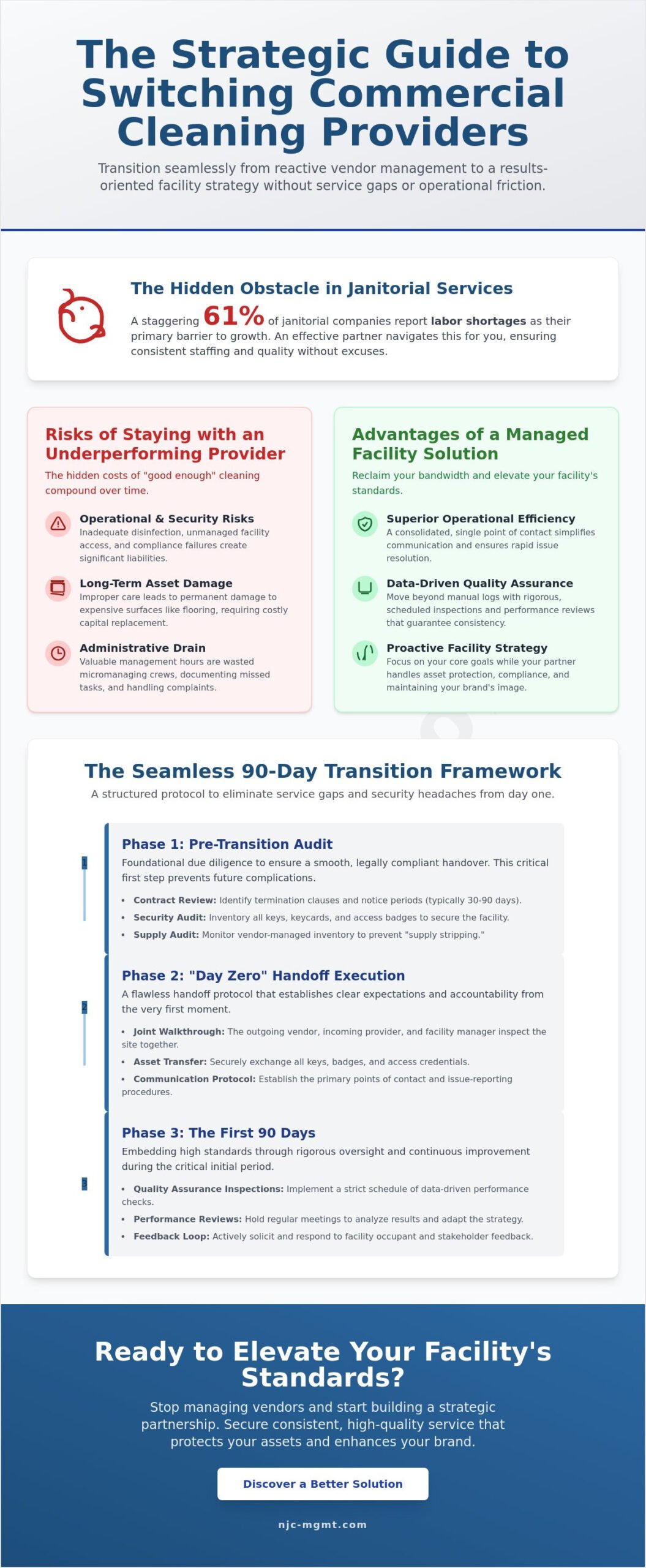
Most facility managers view a change in janitorial providers as a necessary headache, but it’s actually your best opportunity to reclaim your professional bandwidth. You’ve likely spent too many hours documenting missed details or worrying about security risks during key handovers. It’s exhausting to manage a vendor who requires constant oversight just to meet basic standards. If you’re looking for how to switch commercial cleaning companies in houston, this 2026 guide provides the strategic framework you need. We’ll show you how to transition providers without service gaps or operational friction. We understand the stakes are high, especially when 61% of janitorial companies report that labor shortages are their primary obstacle to growth. You deserve a partner who navigates these market realities for you. This guide outlines a seamless 90-day transition plan, covers essential contract negotiations, and explains how to secure higher standards for specialized environments from day one. By the end, you’ll have the tools to move from reactive vendor management to a sophisticated, results-oriented facility strategy.
Key Takeaways
- Identify the hidden operational risks and “sunk cost” traps of maintaining an underperforming janitorial provider to protect your facility’s long-term value.
- Master the logistics of how to switch commercial cleaning companies in houston by auditing termination clauses and securing facility access points before the handoff.
- Discover the strategic advantages of moving from fragmented direct vendors to a consolidated managed facility solution for superior operational efficiency.
- Execute a flawless “Day Zero” transition using a structured joint walkthrough protocol that eliminates service gaps and security headaches.
- Secure consistent cleaning standards during the critical first 90 days by implementing a rigorous schedule of quality assurance inspections and data-driven performance reviews.
The Strategic Necessity of Switching Commercial Cleaning Companies in Houston
Many facility managers fall victim to the sunk cost fallacy. They hesitate to change providers because they’ve already invested significant time training a crew or building a relationship. However, staying with an underperforming vendor is a strategic error that compounds over time. When your facility’s standards slip, it isn’t just a minor annoyance. It’s a direct threat to your operational efficiency and brand reputation. Understanding how to switch commercial cleaning companies in houston starts with recognizing that cleaning is an investment in asset protection, not just a line-item expense.
The commercial cleaning industry has shifted toward high-tech, data-driven solutions. If your current provider still relies on outdated manual logs and inconsistent oversight, they’re likely costing you more than you realize. Poor janitorial standards lead to higher employee turnover and a diminished professional image. In Houston’s competitive business environment, a first impression is often the only one you get. When “good enough” cleaning becomes the norm, you’ve reached the tipping point where a transition is no longer optional; it’s mandatory for your facility’s health.
Signs Your Current Provider Has Outgrown Your Facility
Service creep is a frequent issue in long-term contracts. You might notice that the high standards promised during the first 90 days have slowly eroded into a routine of missed trash cans and dusty surfaces. This fade in quality often signals that the provider lacks the internal systems to maintain consistency at scale. If you’re managing specialized environments like laboratories or clean rooms, recurring compliance failures are a major red flag. Communication delays also indicate a lack of proactive management. A professional partner should identify and resolve issues before you ever have to send an email. If you’re wondering how to switch commercial cleaning companies in houston, start by documenting these gaps to justify the transition to your stakeholders.
The Risks of Staying with a Failing Janitorial Partner
The consequences of retaining a failing provider go far beyond aesthetics. In Houston medical facilities or schools, inadequate disinfection protocols create genuine health and safety liabilities. Beyond health risks, improper floor care and maintenance can lead to permanent damage to expensive surfaces. Replacing commercial flooring is a capital-intensive project that could have been avoided with professional-grade care. There’s also the administrative drain to consider. Every hour you spend micromanaging a cleaning crew is an hour taken away from your core strategic goals. Your time is a valuable resource; don’t waste it doing a vendor’s job for them.
Pre-Transition Audit: Reviewing Contracts and Compliance Standards
Beyond the paperwork, you need a physical and digital inventory of your facility’s security assets. This includes tracking every key, keycard, and security badge currently in the hands of the outgoing crew. A comprehensive security audit ensures that no unauthorized personnel retain access to your building after the contract concludes. Simultaneously, perform a supply audit. If your contract includes vendor-managed inventory, monitor levels closely during the notice period to prevent “supply stripping,” where a departing vendor allows stock to dwindle to zero. Aligning your transition with ISSA cleaning industry standards ensures that management remains accountable for quality even during the final weeks of service.
Understanding Your Legal and Operational Notice Requirements
The “lame duck” period between giving notice and the actual provider swap is a high-risk window for facility standards. Quality often drops as the outgoing team loses motivation. To mitigate this, your termination letter should be professional yet firm, outlining expected performance levels until the final day. You don’t want your building’s hygiene to crater while you’re waiting for the new team to arrive. If you’re unsure about your current contractual obligations, a strategic facility assessment can help identify the best window for a clean break.
Specialised Compliance Audits for Houston Industries
Houston’s diverse economy requires highly specific cleaning protocols that vary by sector. For those managing high-stakes environments, such as clean room janitorial services houston, the audit must include a review of particle control and chemical compatibility standards. Financial institutions and banking centers require a different focus, primarily centered on strict background checks and secure-area access logs. Educational facilities and daycares must meet stringent sanitation standards to protect student health. Each of these sectors has unique regulatory requirements that your new provider must be prepared to meet from day one. Don’t leave these details to chance; document every compliance need before the new team steps on-site.
Moving from Direct Vendors to a Managed Facility Solution
Most facility managers approach a provider change by simply swapping one cleaning crew for another. This lateral move rarely solves the underlying issues of inconsistent quality or administrative burden. When you research how to switch commercial cleaning companies in houston, the most impactful decision you can make is moving from a direct vendor model to a managed facility solution. This shift represents a transition from being a supervisor of janitorial staff to being a strategic director of facility outcomes. A managed partner acts as a sophisticated buffer, handling the daily operational friction so you can focus on high-level asset management.
The challenges of switching vendors often stem from the fear of operational gaps during the transition. A managed model mitigates this risk by providing a single point of contact who oversees every detail of the handoff. Instead of juggling multiple invoices from different providers for floor care, window cleaning, and daily janitorial tasks, you receive one consolidated monthly bill. This administrative leaness transforms your facility’s efficiency, turning a chaotic vendor list into a streamlined, professional operation.
The Efficiency of Facility Vendor Management Solutions
A managed solution introduces a professional management layer that eliminates the need for client-side oversight. This partner maintains a network of vetted, high-performing vendors, ensuring you always have a backup plan. In an industry where 61% of janitorial companies identify labor shortages as a major obstacle, having access to a pre-vetted network is a critical safety net. Whether you need routine janitorial services or specialized project work like pressure washing or post-construction cleanup, a managed partner handles the sourcing, scheduling, and quality control. This ensures that standards never slip, even when market conditions are volatile.
Comparing Traditional Janitorial Services vs. Managed Solutions
Traditional direct vendors often place a high management burden on your team. When a crew member misses a shift or a detail is overlooked, you’re the one who has to resolve it. In contrast, a managed solution provides third-party quality assurance and proactive problem-solving. This model is significantly more resilient to Houston’s dynamic labor market. By consolidating your facility needs under one strategic partner, you gain:
- Zero management burden through dedicated account leadership.
- Consistent, documented quality through regular inspections.
- Financial clarity with a single, transparent monthly invoice.
If you’re evaluating how to switch commercial cleaning companies in houston, look beyond the cleaning supplies. Seek a partner who offers a scalable management framework designed for the complexities of 2026 facility operations.
Executing the Handoff: A Step-by-Step Transition Protocol
Execution is the ultimate test of your facility strategy. A flawless transition depends on a clearly defined “Day Zero” timeline, the precise moment when operational responsibility shifts. Mastering how to switch commercial cleaning companies in houston requires more than just signing a new contract; it demands a tactical execution plan for the final handoff. You must coordinate the departure of the old crew with the arrival of the new team to ensure no service gaps occur. This isn’t just about emptying trash; it’s about maintaining building security and operational continuity during a high-risk window.
A joint walkthrough with the incoming management team is non-negotiable. During this session, you’ll identify specific site nuances, high-traffic zones, and existing “legacy” issues left by the previous provider. This walkthrough serves as the baseline for your new quality standards. Securing facility access is equally critical. You must update alarm codes, revoke old biometric permissions, and confirm that every physical key has been returned. Standardizing communication channels immediately is the final piece of the puzzle. Whether it’s a dedicated portal or a direct line to an account manager, feedback loops must be operational from the first hour of the first shift.
The 24-Hour Changeover Checklist
The final 24 hours before the new team starts are the most intense. Your checklist must be absolute. Verify that all badge transfers are 100% complete and that the incoming crew has verified access to every closet and mechanical room. Ensure that specialized commercial floor cleaning equipment and necessary chemicals are on-site and staged for use. The first-night crew must be briefed on your specific site requirements, from high-security zones to delicate surface care. If you want to ensure your transition is handled with this level of precision, schedule a professional transition audit with our team today.
Communicating the Change to Your Staff and Stakeholders
Your employees and stakeholders will be the first to notice the change. Manage their expectations by communicating the switch at least 48 hours in advance. Provide a clear, simple channel for them to report initial observations. This transparency builds trust and allows you to address minor teething issues before they become major complaints. You might encounter legacy issues, such as deep-seated carpet stains or neglected high-dusting areas, that the new provider will need time to rectify. Be clear that the first week is about establishing a new baseline of excellence.
- Set realistic expectations for the first 72 hours of service.
- Designate a single point of contact for internal feedback.
- Document any pre-existing facility damage to protect your new provider’s accountability.
This structured approach minimizes disruption and ensures your building’s transition is viewed as a significant upgrade by everyone who uses it. By following a disciplined protocol, you turn a potentially chaotic event into a demonstration of professional management.
The First 90 Days: Ensuring Quality and Accountability with NJC
The first 90 days represent more than a trial period; they’re the foundation of a new operational standard. Successfully navigating how to switch commercial cleaning companies in houston concludes not with the first night of service, but with the establishment of a rigorous accountability framework. During this critical window, your focus must shift from transition logistics to performance data. It’s the time to verify that the high standards promised during the procurement phase are being executed consistently on the floor. By implementing a structured review process, you ensure that the initial “honeymoon period” doesn’t give way to the service creep that likely prompted your provider search in the first place.
A sophisticated facility strategy relies on data, not just visual spot checks. You should review performance metrics against the baseline established in your initial facility audit. This allows you to fine-tune the cleaning scope based on real-world usage patterns that may not have been apparent in your previous contract. Perhaps certain high-traffic zones require more frequent attention, or specialized laboratory spaces need adjusted disinfection protocols. The NJC single-source model excels here, providing a scalable management layer that adapts to these findings without requiring a complete contract overhaul. This responsiveness is what separates a managed partner from a traditional janitorial vendor.
The Role of Quality Assurance Inspections
Accountability requires objectivity. While many providers claim to self-monitor, third-party or management-led inspections are far superior to self-reporting by the cleaning crew. Utilizing photo documentation and digital logs provides a transparent record of service quality. These digital reports allow you to track trends over time and identify minor deviations before they evolve into recurring failures. If a specific area consistently misses the mark, the data will show it, allowing for immediate corrective action. This proactive approach maintains the professional elegance of your facility while removing the administrative burden of manual oversight from your desk.
Strategic Growth and Facility Maintenance Scaling
Once the daily janitorial routine is stabilized, you can begin the final phase: optimizing your facility’s long-term value. This involves scaling your maintenance plan to include specialized services like window cleaning, pressure washing, or deep carpet care. In Houston, seasonal environmental factors like high humidity and heavy pollen counts necessitate a dynamic maintenance schedule. A managed solution allows you to integrate these project-based needs into your consolidated monthly billing. You move beyond the basic mechanics of how to switch commercial cleaning companies in houston and enter a phase of strategic facility optimization. This long-term vision ensures your environment remains a premium asset that supports your brand’s image and your employees’ health for years to come.
Elevate Your Facility Strategy Beyond the Transition
Transitioning providers is a strategic pivot that redefines your building’s operational baseline. You’ve learned how to audit contracts, manage the “lame duck” period, and execute a “Day Zero” handoff with precision. By moving from fragmented direct vendors to a managed facility model, you eliminate the administrative drain that stalls your professional growth. Understanding how to switch commercial cleaning companies in houston is just the first step. The second is choosing a partner who offers long-term scalability and measurable results through a disciplined management layer.
NJC provides a single point of contact for over 20 facility solutions, ensuring your standards never slip. Our specialized ISO-compliant cleaning expertise and consolidated monthly billing bring financial clarity to your operations. Stop managing cleaning crews and start directing outcomes with our transparent QA reporting systems. You deserve a partner who views your facility as a premium asset, not just a series of tasks to be completed. Request a Strategic Janitorial Management Quote for Your Houston Property today to secure your facility’s future. You’re ready to lead your building into a new era of efficiency and professional excellence.
Frequently Asked Questions
How much notice do I typically need to give my current cleaning company?
Standard commercial cleaning contracts in Houston typically require a 30-day written notice for termination. However, you must review your specific agreement, as some providers mandate a 60 or 90-day window. Miscalculating this timeline can trigger automatic renewals, locking you into another term. Always send your notice via certified mail to ensure you have a documented paper trail of the cancellation.
What happens to the cleaning supplies and equipment when I switch providers?
Equipment ownership depends on your specific contract terms. Usually, the outgoing provider removes their floor machines and vacuums, while consumable supplies you’ve already paid for remain on-site. Perform a joint inventory audit before the final week to prevent supply stripping. This ensures your new team has the necessary materials to maintain standards from their first shift without requiring immediate emergency orders.
Will my security alarm codes and physical keys be safe during a transition?
Security is maintained through a disciplined revocation protocol. You should deactivate all alarm codes and biometric access for the outgoing crew immediately after their final shift concludes. If physical keys were used, re-keying the facility or moving to a smart access system is a prudent step. A managed partner oversees this transition to ensure no unauthorized personnel retain access to your property.
How do I avoid a “service gap” on the first night of the new contract?
You avoid a service gap by establishing a clear “Day Zero” timeline where the incoming team’s start time aligns perfectly with the outgoing provider’s exit. When you’re researching how to switch commercial cleaning companies in houston, the key is a joint walkthrough 48 hours before the swap. This ensures the new crew understands site nuances and has verified access codes before their first scheduled shift.
Can a managed facility solution handle specialized clean room or medical standards?
Managed facility solutions are specifically designed to handle high-compliance environments like clean rooms and medical centers. These providers use a network of vetted vendors who possess the necessary ISO certifications and specialized training for sterile environments. This model provides an extra layer of quality assurance, as the management team audits the cleaning crew’s performance against strict regulatory standards.
Is it more expensive to hire a management company than a direct cleaning crew?
Managed solutions often provide a better return on investment than direct cleaning crews by eliminating the hidden costs of micromanagement. While the monthly invoice might look comparable, you save significant professional bandwidth and reduce the risk of expensive asset damage. Consolidated billing and third-party quality inspections further streamline your facility budget, making the managed model more cost-efficient for complex Houston properties.
What are the most common mistakes Houston businesses make when switching cleaners?
The most common mistake is failing to document existing facility damage before the new provider starts. This lack of a baseline makes it difficult to hold the new team accountable for their performance. Other frequent errors include missing the contract’s non-renewal window and neglecting to update security protocols. A structured transition plan prevents these oversights from compromising your building’s operational integrity during the swap.
How do I handle a cleaning company that refuses to return keys or badges?
If a provider refuses to return keys or badges, you should immediately notify your legal counsel and initiate a full facility re-keying. It’s standard practice to hold the final payment until all property, including access cards and keys, is returned and verified. When learning how to switch commercial cleaning companies in houston, always include a clause in your new contract that specifies penalties for failing to return security assets.