Industrial Cleaning for Workplace Safety in Houston: A 2026 Strategic Guide
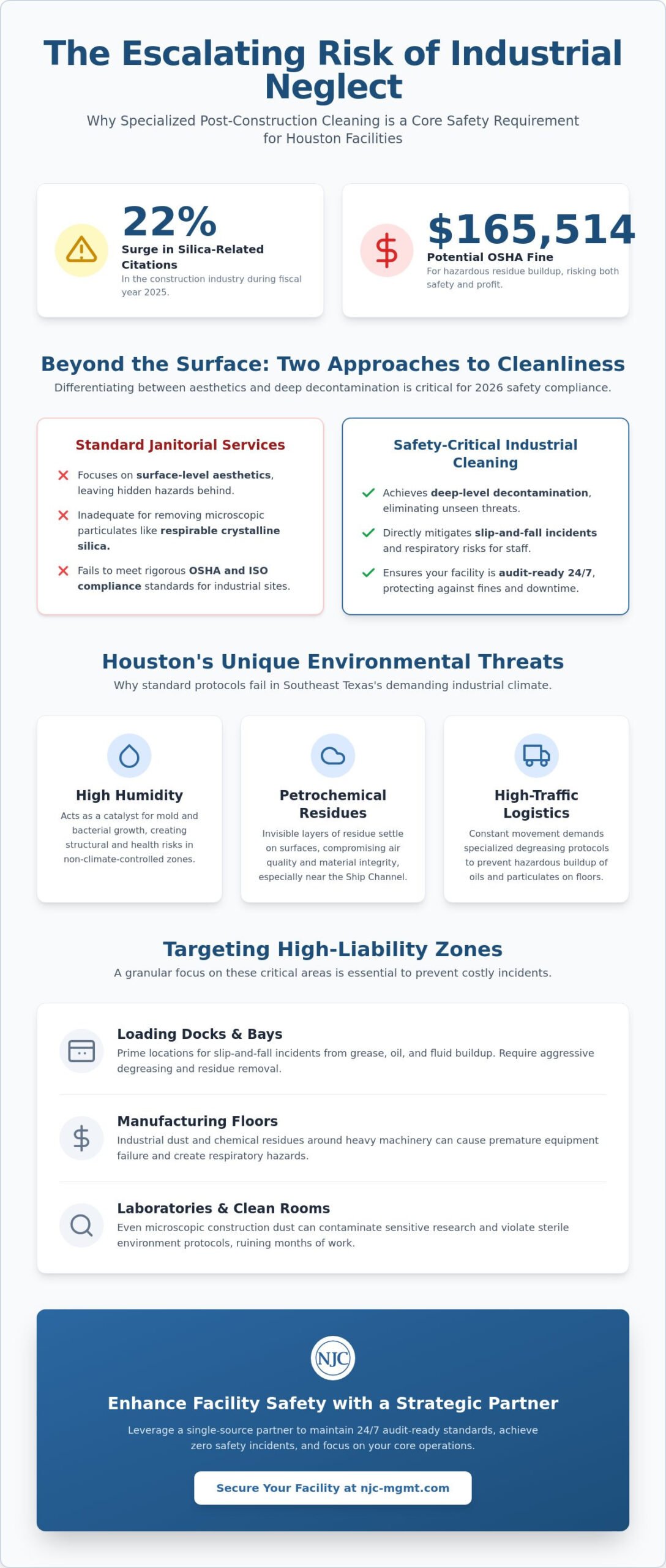
In fiscal year 2025, silica-related citations in the construction industry surged by 22%, marking a significant escalation in federal enforcement. For operations leaders in Southeast Texas, securing specialized post-construction cleaning for industrial facilities houston has evolved from a final checklist item into a core safety requirement. You likely understand that inconsistent cleaning quality does more than just hurt your facility’s appearance. It introduces tangible hazards, from slip-and-fall incidents to the risk of $165,514 OSHA fines for residue buildup.
Managing these risks shouldn’t be a logistical nightmare. This 2026 strategic guide demonstrates how a sophisticated approach to industrial cleaning mitigates Houston-specific environmental threats while ensuring your facility remains audit-ready 24/7. We’ll explore the latest respirable crystalline silica standards, the transition toward measurable cleaning performance, and how vendor consolidation reduces your administrative burden. By aligning your maintenance strategy with current regulatory realities, you can achieve zero safety incidents and focus on long-term value creation.
Key Takeaways
- Define the intersection of industrial hygiene and risk management to establish a safety-critical cleaning standard for your Houston operations.
- Identify high-liability zones, such as loading docks and manufacturing floors, where specialized post-construction cleaning for industrial facilities houston prevents costly slip-and-fall incidents.
- Differentiate between surface-level aesthetics and deep-level industrial decontamination to ensure compliance with 2026 safety regulations.
- Streamline facility oversight through strategic vendor management, leveraging a single-source partner to maintain audit-ready standards 24/7.
The Critical Link Between Industrial Cleaning and Workplace Safety in Houston
Safety-critical cleaning is the strategic intersection of industrial hygiene and proactive risk management. In the high-stakes environment of a Houston manufacturing plant or distribution center, sanitation isn’t a janitorial afterthought. It’s a fundamental pillar of workplace safety and occupational hygiene. As Houston’s industrial sector expands, with 29 million square feet of space under construction in early 2026, the demand for standardized safety protocols has reached a critical threshold. Project managers can’t afford to view cleanliness as a cosmetic goal. It’s a baseline for operational continuity and workforce protection.
Professional sanitation directly correlates with a reduction in worker compensation claims. By eliminating particulate matter and chemical residues immediately after building completion, facilities mitigate the primary triggers for respiratory issues and slip-and-fall incidents. For Houston operations, this level of precision is essential for maintaining OSHA and ISO compliance. With silica-related citations increasing by 22% in fiscal year 2025, the margin for error in post-construction cleaning for industrial facilities houston has effectively disappeared. A facility that isn’t audit-ready is a facility that’s potentially hemorrhaging profit through liability and regulatory exposure.
Houston’s Environmental Impact on Industrial Hygiene
Houston’s climate presents unique challenges that standard cleaning services often overlook. High humidity levels in East Texas act as a catalyst for mold and bacterial growth, especially in non-climate-controlled warehouses and storage zones. This isn’t just an aesthetic issue; it’s a structural and health risk that requires constant vigilance. In the Houston Ship Channel area, petrochemical residues settle on surfaces, creating invisible layers that can compromise both air quality and material integrity. High-traffic logistics hubs require specialized degreasing protocols to prevent the buildup of oils and particulates that lead to hazardous floor conditions. We see a clear “flight-to-quality” in the 2026 market, where tenants demand these modern, decontaminated spaces to protect their teams and their inventory.
The Economic Cost of Poor Safety Standards
Neglecting hygiene standards leads to measurable financial loss. Preventable workplace accidents in manufacturing cause significant downtime, halting production lines and disrupting supply chains. Beyond immediate injuries, corrosive industrial dust and chemical buildup cause long-term facility degradation. This leads to premature equipment failure and expensive structural repairs that could’ve been avoided with a strategic maintenance plan. In 2026, the ROI of managed industrial cleaning is defined by the total avoidance of regulatory penalties and the preservation of high-value capital assets. A clean facility isn’t a luxury; it’s a strategic insurance policy against operational failure.
Targeting High-Risk Zones: Where Industrial Residue Becomes a Liability
Identifying liability in a newly constructed or renovated facility requires looking beyond the visible surfaces. Industrial residue often migrates to areas that escape standard janitorial sweeps, creating hidden hazards that compromise your safety record. Executing a precise scope for post-construction cleaning for industrial facilities houston requires a granular focus on these high-risk zones. From the grease-slicked concrete of a loading bay to the microscopic particulates in a clean room, every square foot must meet rigorous 2026 safety benchmarks. Failure to address these areas doesn’t just risk an audit failure; it invites physical injury and equipment downtime.
Cleaning around heavy machinery and active production lines demands a specialized protocol that prioritizes both technician safety and asset protection. Technicians must strictly adhere to OSHA guidelines for cleaning industry safety, particularly regarding lock-out/tag-out procedures and chemical compatibility. In Houston’s burgeoning laboratory and clean room sector, this precision extends to achieving sterile environments where even a trace amount of construction dust can ruin months of sensitive research. For operations managers, the goal is clear: transition from construction to production without a single safety incident.
Loading Docks and High-Traffic Flooring
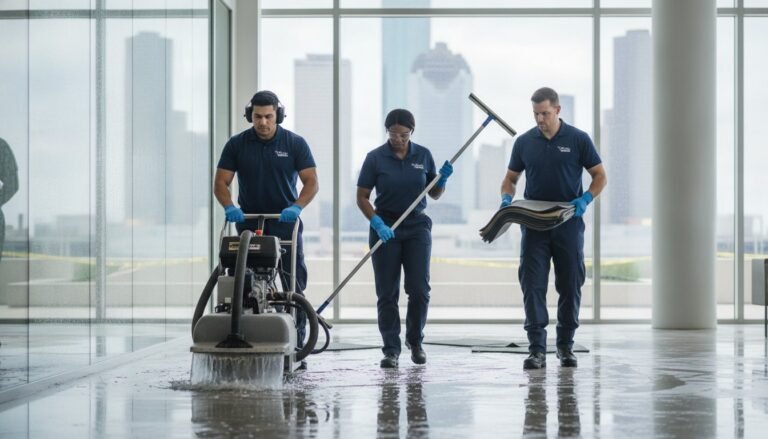
Loading docks are the frontline of industrial safety. Houston’s persistent humidity often mixes with hydraulic fluids and tire marks, creating a treacherous surface for both personnel and forklifts. Removing deep-seated oil, grease, and moisture from industrial concrete requires more than a standard mop. It needs heavy-duty pressure washing and specialized degreasers that break down petrochemical bonds without damaging the substrate. Implementing a strategic commercial floor cleaning program that includes anti-slip treatments is essential for long-term risk mitigation. These treatments provide the necessary traction to keep your logistics hub moving safely during peak cycles.
Combustible Dust and Overhead Safety
One of the most overlooked risks in Houston manufacturing plants is the accumulation of combustible dust on “out-of-sight” surfaces. Rafters, joists, and HVAC ductwork act as shelves for fine particulates that can ignite under the right conditions. Specialized HEPA vacuuming and high-dusting techniques are mandatory to eliminate these ignition risks before they reach critical levels. In dusty industrial environments, high-level cleaning should be scheduled quarterly to maintain compliance and prevent secondary explosions. Partnering with a specialist like NJC Management ensures these overhead zones are documented and cleared using industrial-grade equipment, keeping your facility audit-ready and your workforce protected from the top down.
Industrial Cleaning vs. Standard Janitorial: Why Specialized Protocols Matter
Industrial cleaning is a distinct discipline from standard janitorial work. While office cleaning focuses on surface aesthetics and daily maintenance, the decontamination of a warehouse or manufacturing plant requires a technical approach to risk mitigation. Standard janitorial services simply aren’t equipped to handle the microscopic debris left behind after major renovations. Effective post-construction cleaning for industrial facilities houston involves removing heavy particulates, such as respirable crystalline silica, which can settle into crevices and compromise air quality. This process is essential for meeting OSHA’s general requirements for workplace safety, which mandate that all walking-working surfaces remain clean, dry, and orderly to prevent accidents.
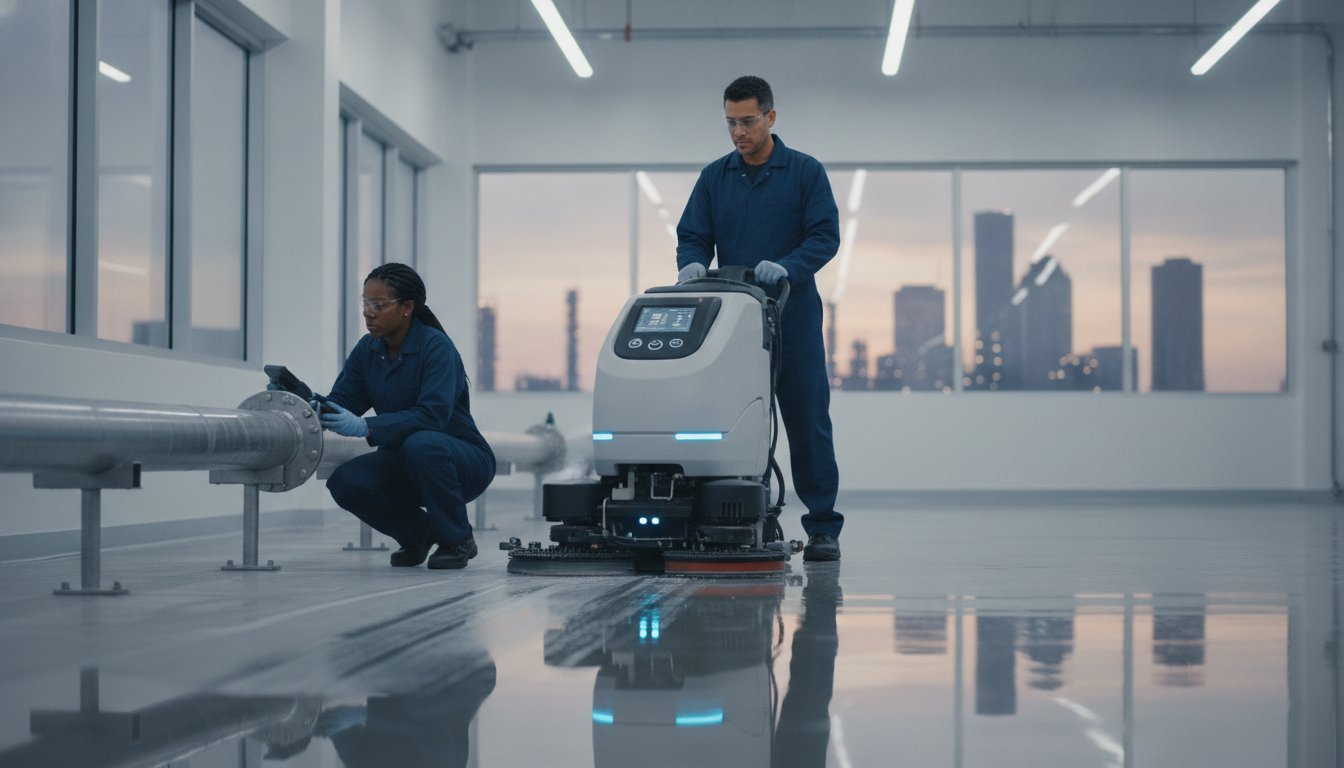
The equipment and PPE used in these settings also differ significantly. Industrial crews often require specialized respirators, puncture-resistant gloves, and high-visibility gear to operate safely alongside heavy machinery. This isn’t just about protection; it’s about compliance. In many Houston facilities, Day Porter Services provide a critical layer of safety by performing real-time hazard mitigation during active shifts. These professionals ensure that spills or debris are addressed immediately, preventing minor issues from escalating into major safety incidents. This proactive presence allows your team to focus on production while we manage the operational hygiene of the environment.
Chemical Safety and Material Compatibility
Selecting the correct cleaning agents is a matter of both safety and asset preservation. Industrial floor coatings, such as high-performance epoxies, can be easily damaged by the acidic or highly alkaline chemicals found in standard commercial cleaners. We prioritize pH-neutral solutions that preserve the integrity of these surfaces while effectively lifting grease. In shared employee spaces like locker rooms and cafeterias, the use of EPA-approved disinfectants is non-negotiable for preventing the spread of contaminants. Rigorous Safety Data Sheet (SDS) management ensures that every chemical on-site is documented, tracked, and used according to strict manufacturer and regulatory guidelines.
Specialized Training for High-Compliance Environments
Cleaning sensitive environments like Houston’s clean rooms and laboratories requires more than just a checklist. Technicians must undergo specific training to understand the protocols for air filtration, gowning, and cross-contamination prevention. Because many of these facilities handle proprietary data or sensitive materials, background checks and security clearances are standard requirements for all staff. For a deeper look at these technical requirements, consult our guide on industrial cleaning services. This level of specialization ensures that your facility remains safe, secure, and fully operational without compromising the integrity of your technical processes.
Implementing a Safety-First Cleaning Strategy for Houston Operations
Strategic oversight of industrial sanitation requires a shift from reactive maintenance to a proactive risk management framework. For project managers, the transition from a construction site to an operational facility is a high-liability period. Implementing a successful strategy for post-construction cleaning for industrial facilities houston involves five critical steps designed to eliminate hazards before they impact your workforce.
- Step 1: Conduct a comprehensive safety audit. Identify blind spots where construction debris or chemical residues linger. This baseline assessment ensures your starting point meets 2026 industrial hygiene standards.
- Step 2: Define a production-aligned scope. Your cleaning schedule must mirror your shift changes and production cycles. This prevents maintenance activities from becoming a safety hazard themselves.
- Step 3: Source specialized vendors. Prioritize partners with documented experience in Houston’s heavy industrial corridors, such as the Ship Channel or Baytown.
- Step 4: Establish a QA inspection schedule. Implement digital reporting and data-driven quality checks to maintain 24/7 audit-ready status.
- Step 5: Consolidate safety reporting. Use centralized data to identify recurring trends, such as specific zones prone to residue buildup, allowing for targeted mitigation.
Effective management ensures that your facility doesn’t just look clean; it functions safely. By treating cleaning as a core operational protocol, you protect your capital investment and your human resources simultaneously.
Auditing Your Current Cleaning Performance
Many facilities suffer from “accountability gaps” where cleaning responsibilities are poorly defined between vendors or shifts. These gaps are where safety risks, such as combustible dust or chemical cross-contamination, often reside. A rigorous audit should include friction-testing on high-traffic floors to evaluate slip resistance and residue levels. If your current vendor cannot provide documented proof of compliance with 2026 safety standards, your facility is at risk. Evaluating these metrics allows you to schedule a facility safety audit to bridge these gaps before an OSHA inspector arrives.
Building a Scalable Scope of Work
A scalable scope balances daily janitorial needs with the intensive requirements of periodic deep cleaning. This is particularly vital when integrating post-construction cleaning for industrial facilities houston into an active plant. High-compliance areas like breakrooms, restrooms, and loading bays require different protocols than the manufacturing floor. Partnering with a sophisticated janitorial company allows for real-time hazard mitigation. Their expertise ensures that the scope of work remains flexible enough to handle the dynamic needs of a Houston industrial operation while maintaining a constant focus on zero-incident performance.
Strategic Vendor Management: Enhancing Houston Facility Safety with NJC
Nationwide Janitorial Connect (NJC Management) operates as a high-level strategic partner, acting as a single-source solution for over 20 distinct facility services. This portfolio includes everything from specialized pressure washing and floor care to comprehensive post-construction cleaning for industrial facilities houston. For project managers overseeing large-scale developments, this consolidation is a necessity. Managing multiple specialized vendors is often a logistical nightmare that leads to inconsistent safety standards. By unifying these services under a single management framework, NJC Management ensures that every protocol is executed with the same level of professional magisterial precision.
Consolidated vendor management offers more than just operational ease; it provides a standardized safety culture. When the same partner manages your janitorial services, day porter needs, and quality assurance inspections, there’s no ambiguity regarding safety expectations. This cohesion is particularly valuable during the final phases of construction when the risk of residue-related accidents is at its peak. Standardized protocols across all services mean your facility remains compliant with OSHA and EPA regulations without requiring constant micromanagement from your internal team. This strategic alignment turns facility maintenance into a predictable, high-performance asset.
The Power of a Single Point of Contact
The accountability gap is a common failure point in industrial facility management. It occurs when responsibilities for safety-critical tasks, such as degreasing loading docks or removing combustible dust, fall between the cracks of different vendor contracts. Nationwide Janitorial Connect (NJC) eliminates this risk by providing a single point of contact for your entire facility portfolio. We take full responsibility for vetting every technician and ensuring they meet 2026 insurance and safety compliance standards before they set foot on your property. For managers seeking to optimize their oversight, NJC’s facility vendor management solutions offer a proven framework for scaling operations safely. This centralized model ensures that your safety culture is never compromised by vendor fragmentation.
Continuous Improvement Through Quality Inspections
Safety isn’t a static achievement; it requires continuous monitoring and data-driven adjustments. Nationwide Janitorial Connect’s (NJC’s) Quality Assurance Inspections are a proactive tool designed to identify hazards before they escalate into incidents. Our technicians use digital logs and site-specific checklists to document every cleaning phase, providing you with a transparent view of your facility’s hygiene status. This reporting allows NJC to optimize industrial cleaning schedules based on real-time production cycles and traffic patterns, ensuring resources are deployed where they’re needed most. Nationwide Janitorial Connect’s (NJC’s) commitment to Houston’s industrial safety standards in 2026 is reflected in our relentless pursuit of zero-incident environments through strategic oversight and measurable performance. This data-driven approach transforms facility maintenance from a cost center into a value-generating asset that protects your workforce and your reputation.
Consolidated invoicing further reduces the administrative friction that often plagues multi-location Houston firms. Processing a single, itemized invoice for 20+ services simplifies your accounting and provides a clear overview of your total facility investment. This transparency allows for better budget forecasting and ensures that your resources are being used efficiently to maintain the highest safety standards in the industry. By removing the burden of vendor coordination, we allow your leadership team to focus on core business objectives while we secure your operational environment.
Securing Operational Excellence in Houston’s Industrial Future
Maintaining a competitive edge in the Houston market requires more than just modern infrastructure; it demands a rigorous commitment to occupational hygiene. By prioritizing specialized post-construction cleaning for industrial facilities houston, you move beyond basic maintenance into a model of proactive risk management. We’ve established that targeting high-liability zones and implementing data-driven inspections ensures your facility remains audit-ready and safe for every shift. This strategic approach protects your capital investment while fostering a culture of safety that attracts top-tier talent.
NJC Management serves as your strategic partner, offering a single point of contact for over 20 facility solutions. Our specialized experience in high-compliance clean room and laboratory environments, paired with a rigorous Quality Assurance Inspection process, provides the stability your operations require. Don’t let administrative friction or inconsistent standards compromise your safety record or operational tempo. It’s time to consolidate your oversight and elevate your facility standards.
Request a Strategic Janitorial Management Quote for Your Houston Facility to align your maintenance strategy with your long-term business goals. Let’s build a safer, more efficient future for your workforce together.
Frequently Asked Questions
What is the difference between commercial and industrial cleaning for safety?
Industrial cleaning focuses on technical decontamination and hazard mitigation, while commercial cleaning primarily targets aesthetics and surface maintenance. Industrial environments involve heavy machinery, chemical residues, and high-risk zones like loading docks that require specialized equipment. Safety protocols in these spaces demand rigorous adherence to specific OSHA standards and the use of industrial-grade PPE to protect technicians and facility staff.
How often should a Houston manufacturing plant perform high-dusting for fire safety?
High-dusting should be performed at least quarterly in most industrial environments to prevent the accumulation of combustible dust. Facilities with high particulate output may require more frequent monthly inspections to manage risks effectively. Regular cleaning of rafters, HVAC systems, and joists is a critical requirement for mitigating ignition hazards and ensuring your facility remains compliant with local fire safety regulations.
Does OSHA have specific requirements for industrial floor cleanliness?
Yes, OSHA standard 29 CFR 1910.22 requires all walking-working surfaces to be kept in a clean, orderly, and sanitary condition. Floors must be maintained in a dry state wherever possible to prevent slip-and-fall incidents. Professional post-construction cleaning for industrial facilities houston ensures these standards are met immediately after project completion, protecting your operation from costly citations and preventable workplace injuries.
Can vendor consolidation actually improve workplace safety in Houston?
Consolidating vendors eliminates accountability gaps and ensures a standardized safety culture across all facility services. When a single strategic partner manages your janitorial, floor care, and pressure washing needs, they apply uniform protocols and safety benchmarks. This centralized oversight reduces the risk of miscommunication and ensures that safety-critical tasks are never overlooked by fragmented or uncoordinated service teams.
What are the most common safety hazards caused by poor industrial cleaning?
Slip-and-fall incidents, respiratory issues from particulate matter, and combustible dust explosions are the most prevalent hazards in neglected facilities. Chemical cross-contamination and bacterial growth in high-humidity zones also pose significant operational risks. Maintaining a rigorous, documented cleaning schedule prevents these issues from escalating into workplace accidents or long-term health liabilities that could compromise your workforce and your reputation.
How does Houston’s humidity affect industrial cleaning protocols?
High humidity levels accelerate the growth of mold and bacteria, necessitating more frequent disinfection and moisture control strategies. Moisture also causes certain industrial residues to become more viscous or reactive, making them harder to remove from porous concrete surfaces. Cleaning protocols in Southeast Texas must prioritize pH-neutral agents and anti-slip treatments to counteract these environmental factors and maintain a safe floor surface.
What specialized equipment is needed for industrial cleaning in 2026?
HEPA-filtered vacuums, industrial-grade pressure washers, and floor scrubbers with high-traction brushes are standard requirements for modern facilities. 2026 standards also emphasize the use of digital quality assurance logs and friction-testing devices to verify safety levels in real-time. Specialized PPE, including respirators and chemical-resistant gear, is mandatory for technicians operating in high-compliance industrial zones to ensure total regulatory alignment.
How do I choose between an in-house team and a managed facility solution?
Managed facility solutions offer superior scalability, specialized equipment, and reduced administrative burden compared to most in-house teams. Professional partners provide access to a full suite of services and rigorous quality inspections that are difficult to replicate with internal resources. Choosing a managed partner ensures your post-construction cleaning for industrial facilities houston is handled by experts with current regulatory knowledge and specialized training.