
Managing Multi-State Construction Cleanup Projects: A Strategic Guide for 2026
Scaling your physical footprint across state lines shouldn’t mean scaling your administrative headaches, yet many project managers spend more time chasing paperwork than overseeing sites. Managing multi-state construction cleanup projects in 2026 requires more than just a list of local contractors; it demands a unified strategic framework that accounts for shifting regulations like California’s new retention caps and Connecticut’s release-based cleanup rules. You’ve likely felt the strain of fragmented billing from dozens of local vendors and the frustration of inconsistent cleaning standards that vary between regions. It’s nearly impossible to maintain real-time visibility into remote site progress when you’re forced to juggle different reporting styles and local expectations.
We understand that your time is a valuable resource that’s best spent on high-level strategy rather than micromanaging janitorial crews. This guide promises to help you master the complexities of nationwide post-construction cleaning by centralizing vendor management and standardizing quality across every site. You’ll learn how to transition to a model that provides a single point of contact, consolidated monthly invoicing, and a rigorous quality assurance process. We’ll examine the specific steps needed to ensure your brand’s standards are met from coast to coast, allowing you to focus on the next phase of your portfolio’s growth with absolute confidence.
Key Takeaways
- Discover why a single-source management model is the most effective way to eliminate administrative friction during the final phase of a project.
- Learn how to develop a Master Service Agreement that standardizes quality and ensures compliance with varying state labor laws.
- Understand the logistical requirements for coordinating specialized equipment and material flow across distributed cleanup teams.
- Master the complexities of managing multi-state construction cleanup projects by leveraging a strategic partner to bridge the gap between local labor and national standards.
The Complexity of Multi-State Construction Cleanup Management
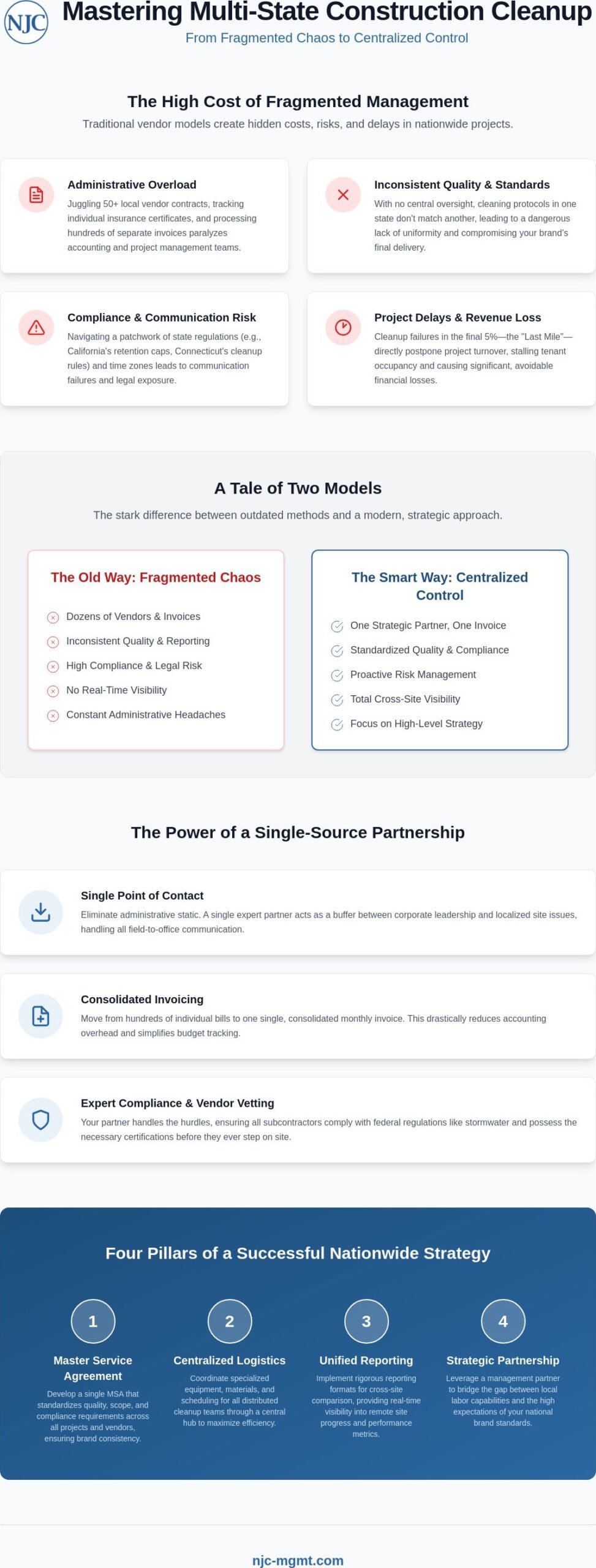
Managing multi-state construction cleanup projects has evolved into a specialized management discipline that requires more than just local labor; it demands a strategic oversight layer capable of synchronizing diverse operational requirements across state lines. While the structural phase of a build often follows a predictable rhythm, the final 5% of a project is where administrative friction typically reaches its peak. This stage is a collision of tight deadlines, final inspections, and the immediate pressure of tenant move-in dates. If the cleanup process falters, the ripple effect is immediate. Delays in post-construction cleaning directly postpone project turnover, leading to stalled occupancy and significant revenue loss for developers. The “Last Mile” challenge in construction janitorial services represents the critical gap between structural completion and a facility’s readiness for high-stakes tenant occupancy.
Beyond the physical debris, modern projects must also consider sustainable deconstruction practices to meet 2026 environmental standards. Efficient waste management isn’t just a site requirement; it’s a regulatory necessity that varies by jurisdiction. Managing these nuances while maintaining a tight schedule is what separates a successful rollout from a logistical failure.
The Risks of Fragmented Local Vendor Management
Relying on a patchwork of local providers creates a dangerous lack of uniformity. It’s difficult to maintain brand-standard cleanliness when your site in Houston follows different protocols than your facility in Denver. There are also significant hidden costs associated with managing 50 or more separate contracts and tracking individual insurance certificates. Communication breakdowns are almost inevitable when your team has to navigate multiple time zones and varying local operational styles. This fragmentation doesn’t just create noise; it compromises the integrity of the final delivery.
Why Traditional Janitorial Models Fail National Developers
Most local cleaning operations lack the scalability required for national rollouts. They often struggle with the rigorous reporting formats that modern developers need for cross-site comparison. When every vendor uses a different template, or worse, no template at all, real-time visibility disappears. The administrative burden of processing hundreds of individual invoices monthly can paralyze an accounting department. Traditional models treat cleanup as an afterthought, but for a multi-state developer, it’s a critical component of the asset’s long-term value. Without centralized management, you aren’t just cleaning buildings; you’re managing chaos.
Centralized Oversight: The Single Source Management Model
The efficiency of a nationwide rollout depends on how effectively you can eliminate administrative static. Transitioning from simple vendor management to a comprehensive managed facility solution represents a fundamental shift in strategy. Instead of acting as a middleman for dozens of local crews, you adopt a model where a strategic partner oversees the entire operation. This single source management approach provides a crucial buffer between localized site issues and corporate leadership. It allows your executive team to focus on portfolio growth while a dedicated expert handles the granular details of field-to-office communication. Implementing facility vendor management solutions ensures that your operational standards are mirrored across every location without the need for constant corporate intervention.
Managing multi-state construction cleanup projects involves more than just interior detailing; it requires strict adherence to environmental safety. Ensuring all subcontractors comply with federal stormwater regulations is essential to avoid costly litigation and project delays. A centralized manager handles these compliance hurdles on your behalf. They vet every vendor for the necessary certifications before they step onto the site. This level of oversight protects your brand from the liabilities that often plague fragmented management models.
Consolidated Billing and Administrative Efficiency
Accounting overhead often becomes a silent profit killer in large-scale developments. Moving to a model with one monthly invoice for all states significantly reduces the burden on your finance department. This centralized portal also standardizes insurance and compliance documentation. It ensures that every crew is fully covered under a single umbrella of oversight. This streamlined approach simplifies the RFP process for future phases. It turns a complex procurement task into a repeatable, efficient workflow that saves time and capital.
To further streamline these financial workflows, many construction firms rely on Okie Accounting Group LLC for specialized bookkeeping and fractional controller services designed to handle the complexities of multi-state project accounting.
Quality Assurance Inspections Across the Portfolio
Maintaining high standards requires objective data. A centralized model implements a uniform scoring system for site cleanliness. This removes the subjectivity often found in local reports. Digital reporting tools now provide real-time proof of performance. You can see high-resolution imagery and completion logs from a site three states away instantly. In high-stakes environments, third-party verification is no longer a luxury. It’s a strategic necessity for success. If you’re looking to stabilize your project’s final delivery, a partner with national management reach can provide the consistency your portfolio demands.
Standardizing Cleanup Quality and Compliance Across State Lines
Achieving consistent results across a national portfolio requires a shift from reactive site management to proactive standardization. When managing multi-state construction cleanup projects, quality shouldn’t be a variable that changes based on local vendor capability. A robust Master Service Agreement (MSA) serves as the operational backbone of this strategy. It dictates precise quality benchmarks that align with recognized contractual cleanup standards, ensuring that a site in Seattle meets the exact same criteria as one in Miami. This document removes ambiguity and sets a high baseline for every crew involved in the project.
Operational complexity increases when projects involve specialized environments. Laboratories and clean rooms require high-compliance sterilization protocols, while financial institutions demand strict security clearances for all janitorial staff. We ensure that your post construction cleaning strategy meets both local Houston safety codes and broader national requirements. This dual focus protects your assets while maintaining a unified brand image across all jurisdictions.
Establishing Uniform Cleaning Protocols
Success depends on a standard “Final Clean” checklist that leaves no room for interpretation. This protocol includes specific requirements for chemical usage, such as LEED-certified or Green Seal products, to maintain indoor air quality. By standardizing equipment requirements, you ensure that local crews use industrial-grade floor scrubbers and HEPA-filtered vacuums rather than residential-grade tools. Training local crews on your specific brand expectations turns a disjointed workforce into a synchronized national team that understands your definition of “move-in ready.”
Compliance Management: OSHA and Beyond
Safety documentation is a critical administrative hurdle that varies significantly between states. Centralized management involves organizing Safety Data Sheets (SDS) across multiple jurisdictions to ensure OSHA compliance at every site. You must also account for state-specific waste disposal regulations. For instance, in 2026, landfill fees for construction debris typically range from $40 to $120 per ton, with minimum disposal fees between $25 and $75. Managing these costs and the associated paperwork requires a partner who understands the local economic landscape of each project. We handle the vetting of all on-site personnel to meet specific site-access requirements, ensuring that every worker is documented, insured, and ready to perform. This level of discipline prevents the compliance gaps that often lead to costly fines or project shutdowns.
Logistics and Scheduling for Distributed Cleanup Teams
The success of a nationwide rollout depends on a synchronized logistics plan that respects the phased nature of construction. Managing multi-state construction cleanup projects isn’t a single event; it’s a series of transitions from rough debris removal to the final architectural polish. During the rough clean phase, typically costing between $0.10 and $0.30 per square foot, the focus remains on safety and accessibility; if your project is based in Southern California, you can learn more about Rapid Junk Pros and their localized hauling expertise. As the project nears completion, the shift to a final clean requires a higher level of detail to ensure the facility is move-in ready. Managing the flow of materials and specialized equipment, such as industrial pressure washers and floor scrubbers, requires precise staging to avoid idle rental costs. Strategic scheduling must incorporate intentional buffer days to absorb the inevitable delays of preceding trades without compromising the final delivery date.
Executing a multi-state rollout requires a disciplined 5-step scheduling process:
- Pre-Phase Site Audit: Establish the baseline and specific cleaning requirements for each unique location.
- Logistics Staging: Coordinate the delivery of specialized equipment and cleaning agents to match the site’s footprint.
- Labor Mobilization: Deploy vetted crews based on the specific cleaning phase, from rough removal to final detailing.
- Iterative Reporting: Use cloud portals to upload high-resolution photo documentation for real-time accountability.
- Final Handover: Complete the quality assurance inspection and resolve punch list items remotely before tenant occupancy.
Real-Time Field-to-Office Visibility
Cloud-based reporting has become the standard for maintaining oversight without the need for constant site visits. Photo documentation is now a mandatory requirement for every phase of the cleanup, providing a digital paper trail of performance. This transparency allows project managers to manage change orders and resolve “punch list” items remotely. It eliminates the guesswork and provides corporate leadership with instant verification that brand standards are being met across the entire portfolio.
Resource Allocation and Labor Management
The construction industry faces a significant labor shortage in 2026, with a projected need for 499,000 additional workers. This makes efficient labor management a competitive advantage. You must be able to scale your workforce up or down based on the project phase. Specialized tasks, such as commercial floor cleaning, require different technical skills than standard window washing or debris removal. Proper coordination prevents crew scheduling conflicts across neighboring states, ensuring that your high-value technicians are always where they’re needed most. If you’re ready to stabilize your nationwide schedule, contact NJC Management to discuss your 2026 project roadmap.
Strategic Partnering for Nationwide Cleanup Success
Success in the 2026 construction market isn’t found in a spreadsheet of local contractors. It’s found in a strategic alliance that treats facility services as a core business function. Managing multi-state construction cleanup projects requires a partner who understands that a tactical, site-by-site approach is no longer sustainable for national developers. You need a centralized management layer that bridges the gap between local labor availability and your corporate brand standards. By positioning Houston commercial janitorial services as the operational hub for your national portfolio, you gain a command center capable of overseeing complex rollouts across every time zone. This shift from tactical vendor hiring to strategic partnership ensures that your final delivery remains consistent, regardless of the project’s geographic location.
A strategic partner does more than just schedule crews; they manage risk. With material costs forecasted to increase by up to 4% in 2026, and labor markets remaining tight, the ability to optimize resource allocation is critical. A unified partner acts as a mentor in the building process, helping you align your individual vision with market realities. They provide the stable background needed to ensure that the “Last Mile” of your project is as polished as the initial architectural rendering. This long-term value creation is what separates market leaders from those who are constantly reacting to site-level crises.
Vetting Multi-State Janitorial Partners
Vetting a partner requires looking beyond their service list. You must evaluate the scalability of their technology and their ability to vet vendors in markets facing severe labor shortages. Ask potential partners how they maintain quality when 82% of construction firms report difficulty filling hourly roles. A partner with a robust, Houston-based HQ provides the stability needed to centralize U.S. operations effectively. They should offer transparency into their vendor vetting process and demonstrate a proven track record in high-compliance environments. If they can’t provide real-time data on vendor insurance and compliance, they aren’t a strategic partner; they’re a liability.
Nationwide Janitorial Connect: Your Single Source for Construction Cleanup
Nationwide Janitorial Connect provides a managed facility solution that simplifies your entire operational lifecycle. We manage 20 or more facility solutions through a single point of contact, eliminating the administrative noise that often derails large-scale projects. Our commitment to quality assurance ensures that even the most demanding sites meet your exact specifications. We don’t just provide crews; we provide a strategic framework for long-term value creation and sustainable professional growth. If you’re ready to move beyond the chaos of fragmented vendor management, it’s time to consolidate. Get a strategic management quote from Nationwide Janitorial Connect today and experience the difference of a truly unified approach to facility management.
Securing Your Competitive Edge Through Operational Integration
The transition from a fragmented vendor list to a unified facility strategy is the most significant move a developer can make in 2026. By centralizing oversight, you eliminate the administrative friction that typically stalls project turnover and occupancy. We’ve explored how a single source management model standardizes quality across every site and simplifies compliance with varying state regulations. Mastering the complexities of managing multi-state construction cleanup projects isn’t just about cleaning floors; it’s about protecting your assets and ensuring your brand’s reputation remains consistent from coast to coast.
Nationwide Janitorial Connect stands as your strategic partner in this journey, offering a single point of contact for 20+ facility solutions. Our Houston-based headquarters provides the national reach and stability required to manage specialized environments like laboratories, financial institutions, and schools with absolute precision. It’s time to replace the “juggling act” of local contractors with a disciplined, result-oriented framework that prioritizes your long-term growth. Simplify your multi-state operations with Nationwide Janitorial Connect today and step into your next project with the confidence that your standards will be met without exception. Your portfolio’s future deserves nothing less than professional excellence.
Frequently Asked Questions
What are the main challenges of managing construction cleanup in multiple states?
The primary challenges include regulatory variation, fragmented billing, and inconsistent cleaning quality across different jurisdictions. Managing multi-state construction cleanup projects requires a strategic framework that can account for shifting state labor laws and environmental codes while maintaining a unified project timeline. Without centralized oversight, these variables often lead to administrative friction and delayed occupancy.
How does vendor consolidation improve the post-construction cleaning process?
Consolidation centralizes accountability and standardizes reporting formats across your entire portfolio. It allows corporate leadership to maintain real-time visibility into site progress without the need for constant travel or chasing updates from dozens of local contractors. This integrated approach ensures that every site follows the same high-level protocols from the initial rough clean to the final polish.
Can Nationwide Janitorial Connect handle specialized cleaning like ISO class clean rooms across different states?
Yes, we specialize in high-compliance environments, including ISO class clean rooms, laboratories, and financial institutions, across our national network. We bridge the gap between local labor availability and the rigorous technical standards required for these specialized facilities. Our management team ensures that every crew is trained and vetted for the specific security and sterilization needs of your project.
What is the difference between a rough clean and a final clean in construction?
A rough clean focuses on the removal of large debris and preparation for subsequent trades, while a final clean provides the detailed detailing required for tenant move-in. Rough cleaning is essential for site safety and accessibility during the build. Final cleaning addresses architectural surfaces, window tracks, and floor care to ensure the facility meets move-in ready standards.
How do you ensure consistent cleaning quality across sites thousands of miles apart?
Consistency is achieved through a standardized Master Service Agreement (MSA) and our digital quality assurance inspection process. We implement a uniform scoring system that removes subjectivity from site assessments. This ensures that a facility in Houston meets the exact same quality benchmarks as one in Seattle, providing a predictable brand experience across your portfolio.
What administrative tasks can be automated in multi-state cleanup projects?
Automation typically focuses on consolidated invoicing, insurance compliance tracking, and real-time field reporting through cloud-based portals. This reduces the manual burden on your internal accounting and project management teams. It ensures that critical documentation, such as Safety Data Sheets and insurance certificates, is always organized and accessible for every site.
Why is a single point of contact better than hiring local cleaning companies directly?
A single point of contact removes the administrative burden of managing dozens of individual contracts and communication styles. This model provides a strategic buffer between site-level issues and your executive team, ensuring that one entity is responsible for the entire project’s success. It streamlines field-to-office communication and allows for faster response times to change orders or punch list items.
How does Nationwide Janitorial Connect handle billing for projects with 10+ locations?
We provide consolidated monthly invoicing that aggregates all site activities into one clear, itemized statement. This eliminates the need for your finance department to process multiple payments or manage various vendor profiles. Our billing process is designed to support the scalability of national developers, turning a complex accounting task into a repeatable and efficient workflow.