OSHA Compliance Cleaning Checklist for Houston Warehouses: A 2026 Strategic Guide
Is your current cleaning vendor a strategic asset or a $165,514 liability waiting to happen? With OSHA’s 2026 penalties for willful violations now exceeding six figures, the margin for error in facility maintenance has effectively vanished. You understand that in a high-velocity environment, a single neglected spill or poorly documented hazard can trigger an inspection that halts operations. Managing these risks is particularly complex when Houston’s humidity causes persistent mold and floor traction issues. Implementing a rigorous osha compliance cleaning checklist for warehouses houston is no longer just a housekeeping task; it’s a vital pillar of your legal and operational defense.
We’re here to help you master these sanitation standards and mitigate risk through a structured, Houston-specific management framework. You’ll gain access to an audit-ready checklist designed to standardize vendor performance and significantly reduce slip-and-fall incidents, which currently cause up to 27% of industrial downtime. This guide previews the essential 2026 regulatory updates, including the November HazCom deadlines, ensuring your facility remains a model of safety and professional excellence.
Key Takeaways
- Decipher the latest 2026 interpretations of OSHA sections 1910.22 and 1910.141 to protect your facility from escalating penalty structures and legal exposure.
- Deploy a comprehensive osha compliance cleaning checklist for warehouses houston to ensure every high-risk zone meets rigorous traction and sanitation standards.
- Identify and mitigate Houston-specific environmental risks, such as humidity-induced condensation on sealed concrete and industrial residue from the Ship Channel.
- Adopt a strategic management framework that consolidates vendor oversight and uses gap analysis to maintain audit-ready documentation at all times.
Understanding OSHA Cleaning Regulations for Houston Warehouses
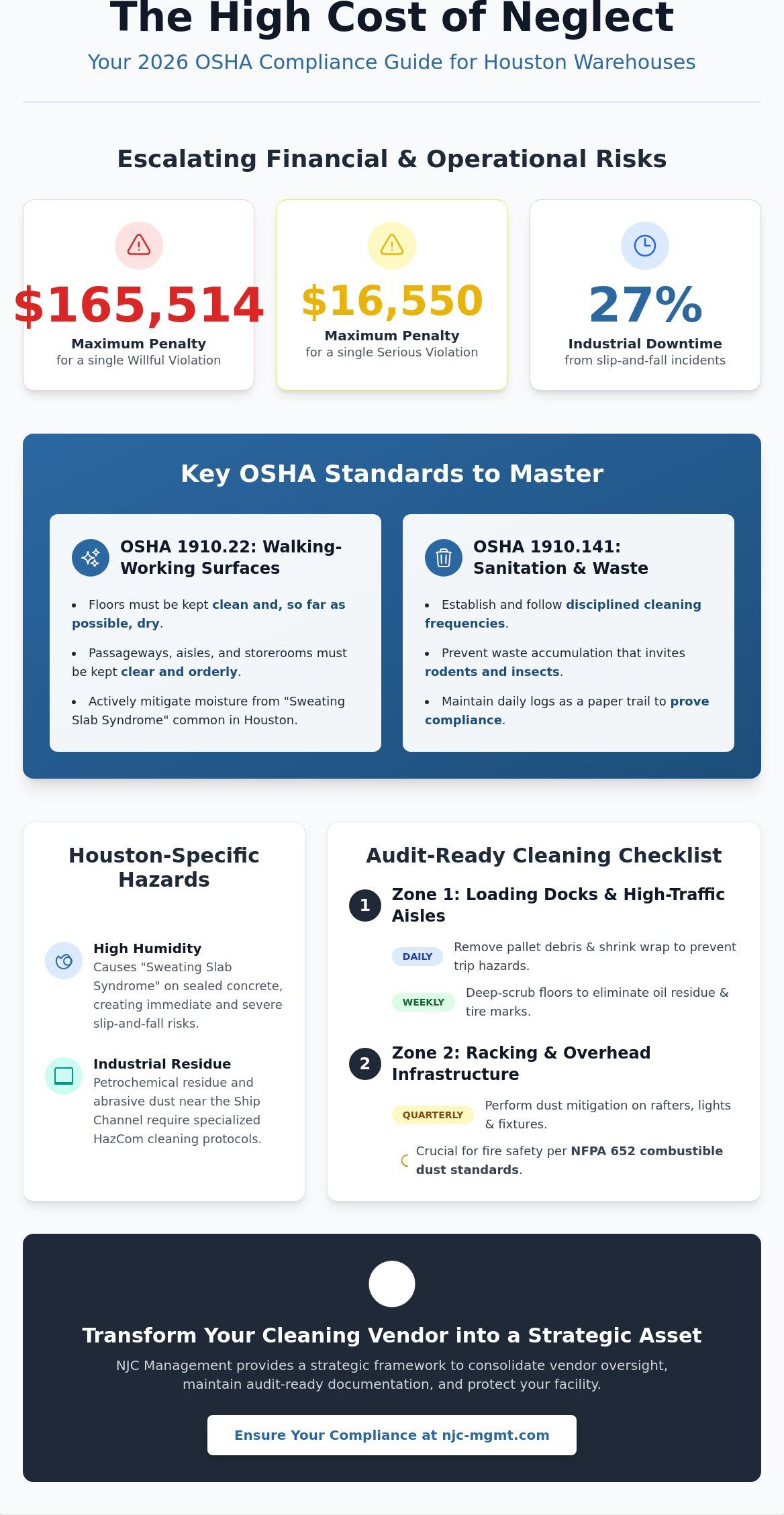
Regulatory oversight isn’t a suggestion; it’s a fiscal reality. In 2026, the Occupational Safety and Health Administration (OSHA) has intensified its focus on industrial housekeeping. For Houston operators, this means standardizing an osha compliance cleaning checklist for warehouses houston that accounts for regional environmental stressors. Serious violations now carry a maximum penalty of $16,550, while willful non-compliance can reach $165,514 per instance. These aren’t just numbers on a balance sheet. They represent the high cost of reactive management in an era where proactive safety is the expected standard.
Location dictates risk. Warehouses near the Houston Ship Channel face heavy petrochemical residue and abrasive dust that general janitorial services often miss. These contaminants aren’t just messy; they’re potential health hazards that fall under strict HazCom standards. Conversely, facilities in the Energy Corridor might prioritize high-tech logistics where floor traction is the primary safety metric. Your cleaning framework must adapt to these specific industrial profiles to remain audit-ready. A generic approach won’t suffice when an inspector evaluates your facility’s unique hazard profile.
OSHA 1910.22: Walking-Working Surfaces
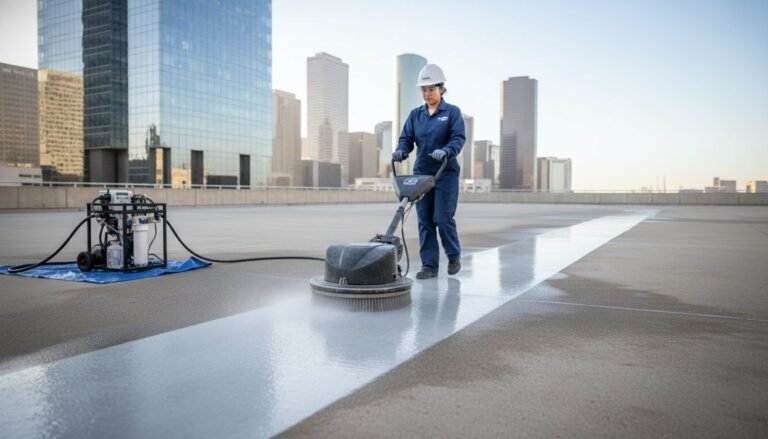
This standard requires every workroom floor to be maintained in a clean and, so far as possible, dry condition. It’s a tall order in Houston. High humidity often leads to “sweating slab syndrome,” where moisture collects on sealed concrete. This creates immediate slip-and-fall hazards, which cause up to 27% of industrial injuries. Your checklist must include specific protocols for moisture control and drainage. Beyond floors, all passageways and storerooms must remain orderly. Debris isn’t just an eyesore; it’s a documented safety violation that triggers immediate citations during a site visit. Maintaining clear aisles is a fundamental requirement for both safety and operational efficiency.
OSHA 1910.141: Sanitation and Waste Management
Sanitation is frequently the most cited yet overlooked warehouse violation. OSHA 1910.141 mandates that all places of employment be kept clean to the extent that the nature of the work allows. This isn’t vague. It requires disciplined cleaning frequencies for restrooms and break areas to prevent the entry of rodents and insects. Waste disposal is equally critical. You can’t allow hazardous accumulation or material that invites pest harborage. Consistency is your best defense. Maintaining a daily log of janitorial tasks provides the paper trail necessary to prove compliance during an unannounced inspection. Effective management means consolidating these tasks under a single layer of accountability to ensure no detail is missed.
The 2026 OSHA Compliance Cleaning Checklist
Compliance is a daily discipline, not a quarterly event. To maintain an audit-ready facility, your operations must shift from reactive cleaning to a structured management framework. This osha compliance cleaning checklist for warehouses houston categorizes tasks by risk level and frequency, ensuring that high-traffic zones receive the scrutiny they require. By following this protocol, you transform your cleaning schedule into a verifiable record of safety and regulatory adherence.
Zone 1: Loading Docks and High-Traffic Aisles
Loading docks are the frontline of warehouse safety. Daily removal of pallet debris and shrink wrap scraps is mandatory to prevent entanglement with forklift wheels and trip hazards for personnel. Weekly deep-scrubbing is necessary to eliminate forklift tire marks and oil residue, which can mask floor degradation or create slick patches. The “clean aisle” standard for 2026 compliance requires a completely unobstructed path that’s free of debris, moisture, and hazardous protrusions at all times. Maintaining this standard is a core component of OSHA’s Walking-Working Surfaces rule, which emphasizes that all passageways must be kept clear and in good repair.
Zone 2: Racking and Overhead Infrastructure
Overhead hazards are often invisible until an inspection occurs. Quarterly dust mitigation is essential for fire safety and alignment with NFPA 652 standards. Combustible dust on rafters and light fixtures can fuel flash fires, a risk OSHA inspectors evaluate with increasing frequency. Additionally, cleaning light fixtures is vital to maintain mandatory foot-candle levels for safe operation. You must also verify that storage remains orderly; cluttered racking isn’t just an efficiency drain, it’s a falling object hazard that violates 29 CFR 1910.176(c).
Zone 3: Employee Facilities and Sanitation
Sanitation logs for restrooms and breakrooms provide a critical audit trail. Beyond basic aesthetics, you must sanitize high-touch surfaces daily to reduce absenteeism and cross-contamination. Per the HazCom 2026 updates, all secondary cleaning containers must be properly labeled by the November 20, 2026 deadline. This includes updating workplace programs and training for all substances. Integrating professional Industrial Cleaning Services in Houston into your master schedule ensures these high-compliance tasks are handled with professional precision. For those seeking to streamline these complex requirements, NJC Management offers the specialized expertise needed to consolidate vendor oversight and maintain rigorous documentation standards.
Floor care remains the most scrutinized element of any inspection. Your checklist should include monthly traction testing to verify the static coefficient of friction on all walking surfaces. Houston’s humidity often complicates this, requiring specific degreasing agents that leave no residue. Documenting these tests, alongside your daily and weekly tasks, creates a comprehensive defense against potential citations and workplace injuries.
Houston-Specific Environmental Hazards and OSHA Risk
Houston’s climate acts as a constant antagonist to warehouse safety. While federal guidelines provide a baseline, they don’t account for the Gulf Coast’s pervasive humidity or the specific chemical residues found near the Houston Ship Channel. Managing these variables requires more than a standard custodial approach. It demands a strategic understanding of how regional environmental factors translate into specific OSHA citations. Your osha compliance cleaning checklist for warehouses houston must evolve beyond simple aesthetics to address the invisible risks inherent to our geography.
Humidity and Floor Traction Management
Humidity is the primary driver of “sweating slab syndrome” in Texas. When the dew point rises, moisture condenses on sealed concrete, creating a microfilm of water that’s often invisible to the naked eye. In environments where humidity regularly exceeds 90%, standard mopping is often counterproductive as it introduces additional moisture without ensuring rapid evaporation. To maintain compliance with OSHA’s general requirements for walking-working surfaces, you must employ specialized floor surfactants that break surface tension and promote faster drying. Documenting these dry times and the use of industrial dehumidification is essential to mitigate slip-and-fall liability during an audit.
Industrial Contaminants in the Houston Market
Location dictates the type of contaminants your facility will face. Warehouses near the Ship Channel often deal with heavy petrochemical residue and oily particulates that can degrade floor coatings and create fire hazards. Conversely, facilities in the Energy Corridor may struggle with fine metallic or chemical dust from nearby manufacturing hubs. These aren’t just cleaning challenges; they’re HazCom violations if not managed correctly. Strategic use of professional Commercial Floor Cleaning in Houston ensures that these building-specific contaminants are neutralized before they compromise your safety record.
Mold and mildew prevention is another critical focus for non-climate-controlled distribution centers. OSHA views mold as a sanitation issue under 1910.141, especially when it threatens employee health or compromises structural integrity. Post-storm cleanup protocols are equally vital. Following a significant weather event, OSHA’s stance on emergency sanitation requires immediate remediation to prevent pest harborage and hazardous accumulations. Your management framework should include pre-approved pressure washing and disinfection protocols to restore operations quickly while maintaining a defensible compliance posture.
Implementing the Checklist: A Strategic Management Approach
Execution defines the line between a compliant facility and a significant liability. To move from theory to operational excellence, you must integrate your osha compliance cleaning checklist for warehouses houston into a broader management strategy. This isn’t just about mopping floors; it’s about building a defensible record of care. A structured approach ensures that every sanitation task serves a regulatory purpose and that your documentation is always audit-ready.
Start by conducting a thorough gap analysis. Compare your current cleaning performance directly against 2026 OSHA codes to identify where documentation is thin or where high-risk zones, like loading docks, are neglected. Once these gaps are identified, consolidate specialized tasks under a single management layer. Managing five different vendors for floor care, window washing, and day porter services creates blind spots that inspectors will eventually find. Establishing a digital audit trail is the next critical step. Paper logs are easily lost or damaged; digital tracking provides instant, timestamped proof of every completed task.
The Pitfalls of Multi-Vendor Management
Fragmented facility care is a primary cause of compliance failure. When separate companies handle different cleaning tasks, accountability vanishes. One vendor might leave a chemical container unlabeled, while another ignores a debris pile in a shared aisle. The administrative burden of tracking separate insurance documents and safety certifications for multiple entities is immense. Modern operations are turning to Facility Vendor Management Solutions to eliminate these gaps and centralize oversight under a strategic partner who understands the high stakes of industrial safety.
Quality Assurance and Documentation
OSHA inspectors don’t care if a floor “looks clean.” They care if it’s safe and if you have the data to prove it. Moving to data-driven inspections allows you to identify trends, such as recurring moisture issues or debris accumulation, before they become violations. Standardizing your reporting formats ensures that when an inspector asks for documentation, you can present a professional, organized history of compliance. Aligning with the right Houston Commercial Janitorial Services ensures that every person on your floor follows the same rigorous protocols, from PPE usage to the November 2026 HazCom labeling updates.
To maintain this standard, implement a Quality Assurance (QA) inspection cycle that includes monthly traction testing and quarterly reviews of vendor compliance documentation. This proactive stance prevents the “compliance drift” that often happens in busy distribution centers. If you’re ready to transform your facility oversight and reduce your risk profile, contact NJC Management to implement a strategic, high-compliance cleaning framework tailored specifically for the Houston market.
Why NJC Management is the Strategic Partner for Houston Warehouses
Regulatory compliance in 2026 requires more than a cleaning crew; it requires a management layer capable of synthesizing complex OSHA standards with daily operational reality. Nationwide Janitorial Connect serves as this essential bridge. We provide single-source accountability for over 20 facility solutions, including specialized floor care, pressure washing, and janitorial services. By consolidating these functions, we eliminate the communication gaps that lead to failed inspections. Maintaining a rigorous osha compliance cleaning checklist for warehouses houston becomes an automated part of your facility strategy rather than a source of administrative friction.
Our approach centers on professional magistery and measurable results. We understand that local facilities face unique pressures, from the petrochemical residues to the unrelenting environmental stressors discussed in earlier sections. We don’t just source vendors; we manage them through a lens of risk mitigation and long-term value creation. This localized Houston focus, backed by a nationwide network of vetted professionals, ensures your facility operates at an elite level of safety and cleanliness.
The NJC Advantage: Beyond Traditional Janitorial
We act as a strategic partner to mitigate your regulatory and financial risk. Our 2026 vetting process ensures every vendor in our network is fully literate in current OSHA standards, specifically the updated HazCom requirements and heat-illness prevention protocols. We’ve seen the impact of this high-compliance approach firsthand. By standardizing floor maintenance and traction testing, we’ve helped partners achieve documented safety improvements and a marked reduction in workplace injuries. This isn’t just about passing an audit; it’s about protecting your human capital and your bottom line.
Consolidate Your Facility Operations Today
The transition from a fragmented multi-vendor model to a single point of contact is designed for minimal disruption and maximum impact. We handle the heavy lifting of tracking insurance, safety certifications, and performance KPIs across all service lines. This consolidation provides several key benefits:
- Consolidated Reporting: One dashboard for all facility tasks and compliance documentation.
- Unified Billing: Simplified financial oversight with a single monthly invoice.
- Quality Assurance: Regular, data-driven inspections that move beyond “looks clean” to “is compliant.”
Our management layer pays for itself through increased operational efficiency and the prevention of high-dollar OSHA fines. If you’re ready to elevate your facility’s standards, Request a Strategic Janitorial Management Quote for Your Houston Warehouse. Let us transform your compliance requirements into a competitive advantage.
Secure Your Operational Future with Strategic Compliance
Maintaining a high-compliance facility in the Houston market demands more than just effort; it requires a disciplined, data-driven framework. We’ve established that 2026 OSHA standards prioritize consistent documentation and the mitigation of region-specific hazards like sweating slab syndrome and industrial particulates. Utilizing a robust osha compliance cleaning checklist for warehouses houston is the first step toward institutionalizing safety and protecting your organization from escalating penalty structures.
NJC Management provides the strategic oversight needed to transform these regulatory burdens into streamlined operational assets. We offer specialized industrial and clean room expertise, ensuring that even the most sensitive environments remain audit-ready. By acting as your single point of contact for over 20 facility services, we eliminate the blind spots inherent in multi-vendor management. Our model provides consolidated billing and rigorous quality assurance inspections, giving you total visibility into your facility’s performance.
Streamline Your Warehouse Compliance with NJC Management
Success in the industrial sector is built on stability and foresight. Take the initiative today to solidify your facility’s compliance posture and ensure a safer, more efficient future for your entire operation.
Frequently Asked Questions
What are the most common OSHA cleaning violations for Houston warehouses?
The most frequent citations involve failures in Hazard Communication (HazCom) and the maintenance of walking-working surfaces. In the Houston industrial sector, inspectors focus heavily on the accumulation of petrochemical residues and moisture-related slip hazards. Implementing a comprehensive osha compliance cleaning checklist for warehouses houston helps your team systematically address these high-risk areas, ensuring that debris and contaminants are removed before they result in a serious violation or workplace injury.
How often should warehouse floors be professionally scrubbed for OSHA compliance?
While federal standards don’t dictate a specific hourly frequency, they mandate that floors remain in a clean and dry condition. For high-volume distribution hubs, professional scrubbing is typically required on a weekly basis to remove forklift tire marks and degrease high-traffic aisles. Loading docks and staging areas may require more frequent attention to prevent the buildup of pallet debris and shrink wrap, which are common trip hazards identified during audits.
Does OSHA require a written cleaning schedule for industrial facilities?
OSHA regulations don’t explicitly require a written cleaning schedule, but they do require proof that your facility is maintained in a sanitary condition. A written log serves as your primary defense during an inspection, providing a verifiable history of your safety protocols. Without documented proof of your cleaning frequencies and traction testing, you’re essentially relying on an inspector’s subjective opinion of your facility’s cleanliness, which increases your legal exposure.
How does Houston humidity affect OSHA floor safety standards?
High humidity in the Gulf Coast leads to “sweating slab syndrome,” where moisture condenses on sealed concrete surfaces. This violates OSHA’s requirement for floors to be maintained in a dry condition whenever possible. To remain compliant, Houston warehouse managers must implement specialized drainage protocols and use floor surfactants that break surface tension. Documenting these humidity-specific interventions demonstrates to inspectors that you’re proactively managing regional environmental risks that general cleaning services often overlook.
What is the difference between general cleaning and OSHA-compliant sanitation?
General cleaning is primarily concerned with the aesthetic appearance of a facility. In contrast, OSHA-compliant sanitation is a risk-management process that focuses on hazard elimination and legal documentation. Compliant sanitation includes specific tasks like combustible dust mitigation, traction coefficient testing, and the maintenance of an audit-ready Safety Data Sheet (SDS) library. It requires a level of specialized industrial knowledge that standard janitorial services typically don’t possess, particularly regarding chemical labeling and PPE usage.
Can facility vendor management help reduce OSHA fines?
Facility vendor management significantly reduces the risk of fines by closing the accountability gaps inherent in multi-vendor environments. When separate crews handle different tasks, documentation often becomes fragmented or lost. A unified osha compliance cleaning checklist for warehouses houston ensures every specialized vendor operates under a single standard of excellence. This consolidation allows for timestamped digital audit trails and consistent quality assurance inspections that prove your facility’s commitment to federal safety mandates.
What documentation do I need to show an OSHA inspector regarding cleaning?
You must be prepared to present timestamped janitorial logs, an updated library of Safety Data Sheets (SDS), and records of employee training on chemical hazards. Additionally, inspectors may ask for proof of regular floor traction testing and your written hazard communication program. Since the 2026 HazCom updates, it’s critical that your documentation reflects the most recent labeling requirements for all secondary cleaning containers and mixtures used within your facility.
How do I manage combustible dust cleaning without interrupting warehouse operations?
Managing combustible dust requires the use of specialized, explosion-proof HEPA vacuums that prevent fine particulates from becoming airborne. To avoid interrupting your production line, these high-surface cleaning tasks should be scheduled during shift changes or planned maintenance windows. By coordinating with a strategic management partner, you can ensure that rafters, light fixtures, and HVAC ducts are cleaned without halting your operations, maintaining both fire safety compliance and warehouse productivity.