Terminal Cleaning Services in Houston: A Strategic 2026 Facility Manager’s Guide
A single oversight in high-compliance sanitation can jeopardize a $500 million healthcare expansion or ground an entire international wing at George Bush Intercontinental Airport. For facility managers, the stakes in 2026 have reached a critical threshold. You’re likely balancing the zero-tolerance infection control standards of the Texas Medical Center with the relentless 24/7 operational demands of Houston’s aviation hubs. Securing reliable terminal cleaning services houston is no longer just a maintenance task; it’s a high-level risk management strategy. We recognize that vetting vendors for specialized badging and FAA-level security clearance is often a bottleneck that compromises your operational efficiency.
This guide provides a strategic framework to master these complexities and ensure 100% compliance with Joint Commission and FAA regulations. You’ll learn how to implement precision protocols that target a 15% reduction in infection rates while boosting passenger satisfaction scores. We’ll outline how to consolidate your vendor management through a single, accountable point of contact to eliminate the friction of multiple contracts. This approach transforms your facility’s hygiene from a hidden liability into a measurable business asset that supports long-term growth.
Key Takeaways
- Understand the dual requirements of Houston’s high-stakes sectors, from surgical suite sterilization to high-traffic aviation hub maintenance.
- Master the rigorous disinfection protocols required to maintain compliance with Joint Commission and CDC guidelines within the Texas Medical Center.
- Optimize 24/7 operations at IAH and Hobby terminals by implementing the “Continuous Cycle” model for seamless, round-the-clock facility cleanliness.
- Establish a strategic Quality Assurance (QA) framework to validate that your terminal cleaning services houston deliver measurable, high-compliance results.
- Discover the operational advantages of vendor consolidation for streamlining management across complex, multi-site Houston facility systems.
Defining Terminal Cleaning in Houston’s High-Stakes Sectors
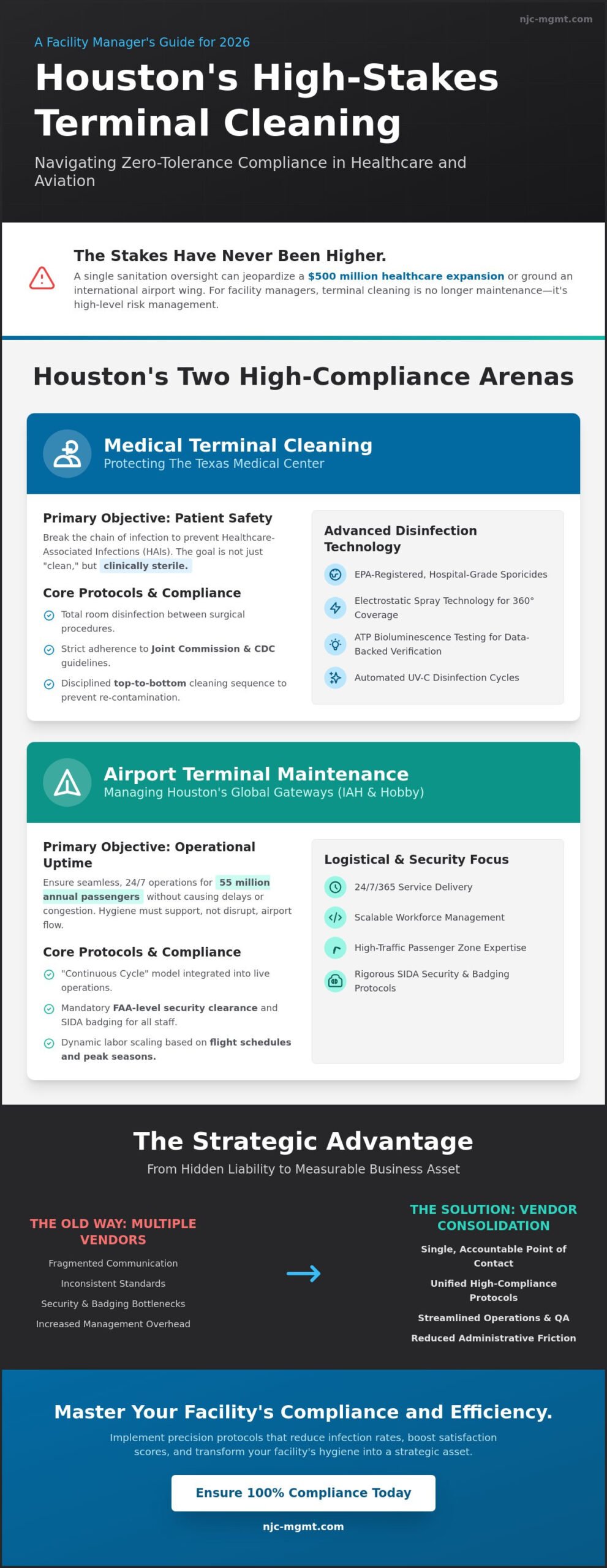
Houston’s economic landscape operates on two massive pillars: the Texas Medical Center and its international aviation hubs. For facility managers, Terminal cleaning represents a specialized decontamination process that goes far beyond routine janitorial tasks. The demand for specialized terminal cleaning services houston has surged as these hubs expand their infrastructure. In 2026, the definition has bifurcated into two distinct, high-stakes disciplines. One focuses on surgical sterilization within the 1,345-acre Texas Medical Center, while the other addresses the relentless passenger flow at George Bush Intercontinental (IAH) and William P. Hobby Airport.
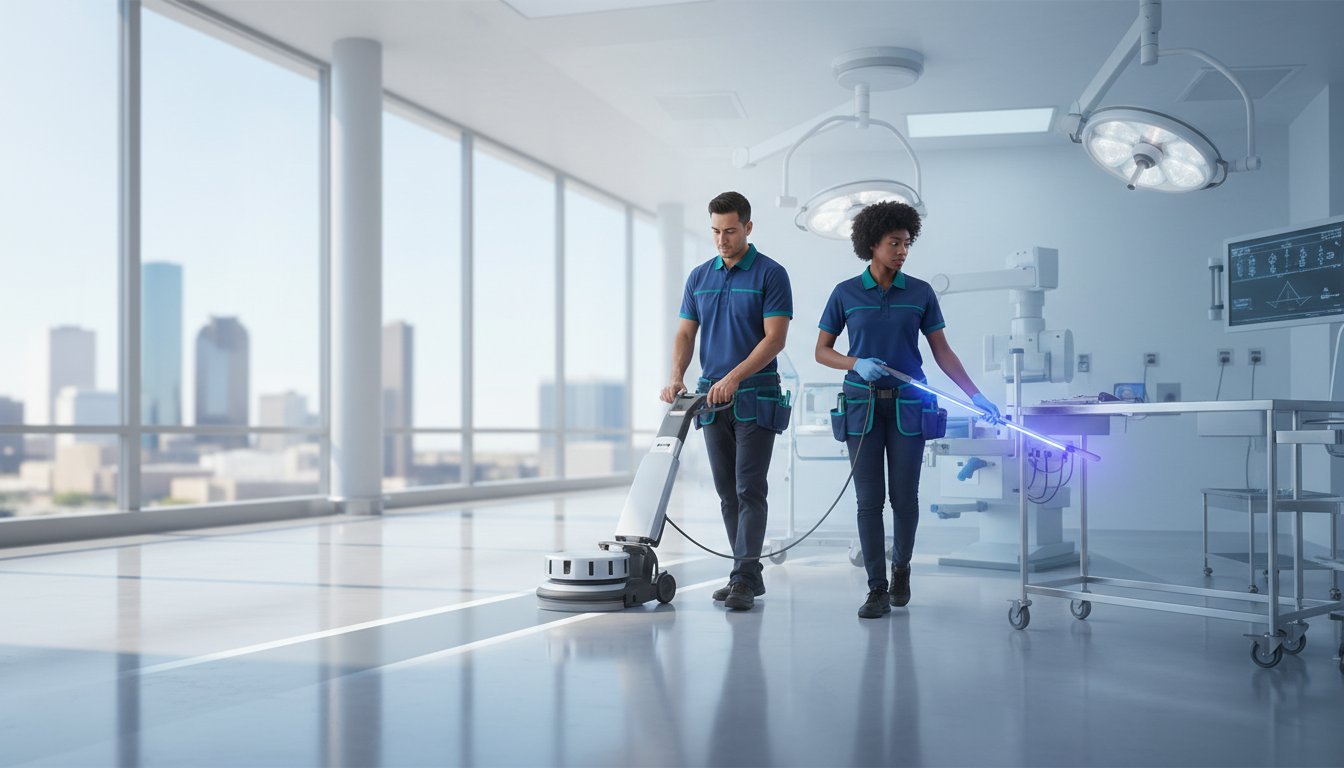
Providing terminal cleaning services houston requires a deep understanding of the gap between “visibly clean” and “clinically sterile.” While a lobby might look spotless after a standard sweep, a terminal environment demands the total eradication of pathogens. By 2026, infection control standards have shifted toward real-time ATP testing and automated UV-C disinfection cycles to meet rigorous municipal and federal compliance. Facility managers now prioritize data-backed cleanliness over visual perception. This transition ensures that high-traffic zones remain safe for both vulnerable patients and global travelers.
Terminal Cleaning in Healthcare: The Gold Standard
Within Houston’s 60+ medical institutions, the operating room is the highest-priority zone. The primary objective is breaking the chain of infection to prevent Healthcare-Associated Infections (HAIs), which cost the US healthcare system billions annually. Medical terminal cleaning is the total disinfection of a room between patients. This process involves stripping the room of all portable equipment, disinfecting every surface from ceiling to floor, and ensuring zero cross-contamination for the next surgical procedure. It’s a meticulous, multi-step protocol that uses EPA-approved sporicides to eliminate the most resilient pathogens found in clinical settings.
Terminal Cleaning in Aviation: 24/7 Operational Excellence
Aviation terminal cleaning at IAH and Hobby involves managing a 24-hour cycle of 55 million annual passengers. These environments don’t close, so cleaning protocols must integrate into live operations without causing flight delays or passenger congestion. Managing these facilities requires a workforce with specific credentials. Every team member must hold SIDA (Security Identification Display Area) badges and clear rigorous background checks to operate in secure zones. Success here isn’t just about hygiene; it’s about maintaining the 100% uptime required for Houston’s global connectivity. It’s a logistical challenge that demands a strategic partner capable of scaling labor based on flight schedules and peak travel seasons.
Medical Terminal Cleaning: Protecting the Texas Medical Center
The Texas Medical Center operates as a global epicenter for healthcare innovation. In this high-stakes environment, standard sanitation falls short. Professional terminal cleaning services houston must meet the rigorous 2026 standards set by the CDC and The Joint Commission to ensure patient safety. These protocols focus on eliminating healthcare-associated infections (HAIs) through total sterilization of surgical suites between cases or at the conclusion of the daily schedule.
Effective disinfection relies on advanced technology rather than just elbow grease. We utilize EPA-registered, hospital-grade disinfectants paired with electrostatic spray technology. This method ensures 360-degree coverage on irregular surfaces, reaching areas manual wiping often misses. It’s a strategic necessity for maintaining sterile environments in Houston’s top-tier hospitals and outpatient clinics. This precision-based approach minimizes downtime and maximizes room turnover efficiency.
The Anatomy of a Surgical Terminal Clean
A true terminal clean follows a disciplined, top-to-bottom sequence. Teams start with ceiling-mounted equipment and work downward to floor-to-wall junctions. This prevents re-contaminating lower surfaces during the process. We differentiate between high-touch surfaces, like light switches and door handles, and high-risk zones, such as the operating table itself. To verify results, we use ATP bioluminescence testing. This provides immediate, quantitative data on microbial levels, moving beyond visual inspections to scientific proof of cleanliness.
- Ceiling to Floor: Systematic cleaning of vents, lights, and walls.
- Equipment Sterilization: Detailed cleaning of monitors, carts, and surgical stands.
- Verification: Objective ATP testing to confirm a 99.9% reduction in pathogens.
Staff Training and Houston Healthcare Compliance
Compliance isn’t optional. It’s the foundation of medical facility management. Staff must undergo specialized training for bloodborne pathogens and hazardous waste handling according to OSHA standards. We maintain meticulous digital logs for every room serviced. These records are vital during hospital audits and surprise inspections by regulatory bodies. Accuracy in documentation is just as important as the cleaning itself.
Managing this level of precision requires a partner who understands that healthcare environments are unique. While standard industrial cleaning services in Houston provide essential maintenance for warehouses and plants, medical terminal cleaning demands a higher tier of specialized oversight. Every technician functions as a critical link in the patient care chain. For facility managers looking to elevate their sterilization strategy, consulting with a strategic management firm ensures these high-compliance standards are met without compromise.
Airport Terminal Maintenance: Managing Houston’s Gateway
Houston’s aviation hubs, George Bush Intercontinental (IAH) and William P. Hobby (HOU), serve as the primary first impression for millions of annual visitors. George Bush Intercontinental alone processed 46.1 million passengers in 2023, a significant volume that demands a sophisticated “Continuous Cycle” maintenance model. Maintaining these facilities requires 24/7/365 rotating shifts that never leave a terminal unattended. This isn’t just about aesthetics. It’s a strategic component of reputation management for Houston’s $15 billion tourism and business travel sector.
Effective terminal cleaning services houston must balance two distinct operational tracks. First, crews execute scheduled deep cleaning during low-traffic windows, typically between 11:00 PM and 4:00 AM. Second, they provide rapid-response management for spills and debris in high-traffic concourses. Facility managers recognize that a single neglected spill in a crowded terminal can lead to safety hazards and negative social media exposure within minutes. Success in this environment depends on precision and a proactive rather than reactive stance.
Security and Access: The Badging Hurdle
The logistical complexity of airport maintenance begins long before a mop touches the floor. Every staff member must pass rigorous TSA and Houston Airport System (HAS) background checks to obtain SIDA (Security Identification Display Area) badges. This vetting process typically takes 14 to 21 days, requiring contractors to maintain a deep bench of pre-cleared personnel. Managing airside versus landside crews is a distinct challenge. Equipment movement is equally restricted; every floor buffer and vacuum must pass through security checkpoints, necessitating specialized logistics plans to ensure tools are where they’re needed without compromising airport safety protocols.
Aviation-Specific Cleaning Zones
Cleanliness standards vary across different airport zones, each with its own pressure points:
- Gate Areas and Restrooms: These require high-frequency sanitation programs. Restrooms in high-traffic hubs like Terminal C at IAH often require 15-minute refresh cycles during peak flight banks.
- Ticketing and Security: These zones experience heavy soil loads from outdoor tracking. Sanitation must be maximized during morning peaks when passenger density is highest.
- Baggage Claim and Concourses: Floor care strategies here focus on durability. High-gloss finishes must withstand constant foot traffic and heavy luggage carts.
Strategic facility management ensures that terminal cleaning services houston providers use hospital-grade disinfectants that meet FAA and local health guidelines. By focusing on these specific zones, managers maintain a sterile, welcoming environment that reflects Houston’s status as a premier global destination.
The Facility Manager’s Guide to Compliance and Quality Assurance
Facility managers often ask how they can verify that a space meets clinical standards after the crew leaves. Trust isn’t a management strategy. By 2026, terminal cleaning services houston must rely on data-driven verification rather than visual inspections alone. ATP bioluminescence testing provides a numerical value for surface contamination in seconds. This eliminates guesswork. High-performing terminal cleaning services houston use real-time dashboards to upload these test results instantly. This creates a transparent audit trail that protects the facility from liability.
Houston’s life sciences corridor and the Texas Medical Center require strict adherence to ISO 14644-1 standards. For Class 5 to Class 8 clean rooms, air particle counts and surface bioburden must be documented with every shift. Strategic Quality Assurance (QA) frameworks now integrate IoT sensors that monitor foot traffic and humidity levels. These variables directly affect microbial growth. When these metrics deviate from the baseline, the system triggers an immediate cleaning alert. This proactive approach ensures compliance remains constant, not just periodic.
KPIs for Terminal Cleaning Success
Success looks different depending on your sector. In Houston’s medical facilities, the primary metric is the reduction of Healthcare-Associated Infections (HAIs). Documentation must show a 99.9% reduction in pathogens like C. diff according to 2025 CDC guidelines. In aviation hubs like IAH, passenger satisfaction scores (NPS) correlate directly with perceived cleanliness. Key performance indicators for 2026 include:
- Response times: 2026 standards require a 60-minute onsite arrival for emergency biohazard incidents.
- Audit trails: Digital logs must be immutable and timestamped for 2026 compliance audits.
- Chemical Efficacy: Verification that disinfectants meet EPA List N requirements for specific regional pathogens.
Vetting Specialized Vendors in Houston
Selecting a partner is a high-stakes decision. You aren’t just buying labor; you’re buying risk mitigation. Choosing the right janitorial company in Houston requires a compliance-first mindset. This means verifying GBAC STAR accreditation and ensuring the vendor carries at least $5 million in pollution and professional liability coverage. You should evaluate their training protocols for bloodborne pathogens and chemical handling. Ask for their 2025 safety record and EMR rating. A vendor’s ability to provide real-time reporting is no longer a luxury; it’s a requirement for modern facility management.
Secure your facility’s reputation with a data-backed cleaning strategy. Contact NJC Management for a strategic facility assessment.
Managed Solutions: Consolidating Houston Terminal Services
Fragmented cleaning contracts create operational blind spots that modern facility managers can’t afford. NJC Management provides a single-source management layer designed for the complexities of Houston’s healthcare and industrial sectors. We don’t just hire cleaners. We engineer a system that aligns with your specific KPIs. For multi-hospital systems or multi-terminal logistics hubs, managing a dozen different vendors leads to friction, inconsistent results, and wasted hours. Consolidation eliminates these gaps. By 2026, Harris County businesses are projected to prioritize consolidated billing to reduce administrative overhead by significant margins. This shift moves your organization away from managing “hired help” and toward a high-level strategic partnership.
Reducing Risk through Single-Point Accountability
When a terminal room fails a bio-burden test, you need answers, not excuses. Single-point accountability means one phone call solves the problem. NJC takes the lead in sourcing, vetting, and managing specialized vendors for terminal cleaning services houston, ensuring every contractor meets 2026 safety protocols. Integrating facility vendor management solutions into your next budget cycle ensures that your compliance documentation is always audit-ready. We handle the vetting and performance monitoring so you can focus on core operations. This approach eliminates the “vendor finger-pointing” that often plagues large-scale facility maintenance.
The Future of Houston Facility Management
Scalability defines the next era of Houston’s infrastructure. Whether you’re expanding across the Medical Center or scaling logistics near the port, your standards must remain uniform across every square foot. We use analytics to optimize cleaning schedules, moving from reactive cycles to predictive maintenance. This data-driven approach ensures your facility remains operational 24/7. It’s about building a resilient environment that supports long-term growth and protects your brand’s reputation. We provide the stability you need in a fast-moving market.
Success in 2026 requires a partner who understands that cleaning is a clinical necessity, not a commodity. Partner with NJC Management for your Houston terminal cleaning needs to implement a sophisticated, management-led solution that drives value and ensures safety across your entire portfolio.
Future-Proofing Your Houston Facility Operations
Managing high-traffic environments in 2026 requires more than just standard maintenance; it demands a strategic partnership. Houston’s facility managers face unique pressures within the Texas Medical Center and the city’s international aviation hubs. Success depends on moving away from fragmented vendors. By consolidating 20+ facility solutions into a single point of contact, you eliminate operational friction and administrative lag. Real-time quality assurance data now serves as the non-negotiable baseline for industry compliance. High-performance terminal cleaning services houston provide the safety and reliability that local industry leaders expect. You don’t have to navigate these complexities alone. Streamlined billing and specialized management protocols ensure your facility remains a benchmark of excellence. It’s time to secure your site’s future with a partner who understands the scale of your ambition. Your facility represents the gateway to the city, and its condition reflects your commitment to excellence. Let’s build a standard that others will follow for years to come.
Request a Strategic Terminal Cleaning Management Quote for Your Houston Facility
Frequently Asked Questions
What is the specific definition of terminal cleaning for Houston hospitals?
Terminal cleaning in Houston hospitals is the exhaustive disinfection process performed after a patient discharge to eliminate all pathogens from a clinical environment. It follows CDC guidelines for environmental infection control requiring every surface, from ceiling vents to floor corners, be treated with EPA-registered disinfectants. This procedure ensures the room is safe for the next occupant by removing multidrug-resistant organisms. It’s a vital step in maintaining high safety ratings for local healthcare facilities.
How does terminal cleaning differ from standard commercial janitorial services?
Terminal cleaning focuses on clinical sterilization rather than the aesthetic maintenance found in standard commercial janitorial services. While daily janitorial work targets high-touch points and floor care, terminal cleaning requires 100% surface contact with hospital-grade sporicidals. It’s a strategic operation designed to break the chain of infection in high-risk zones. Our teams treat every square inch of the environment to ensure total decontamination and patient safety.
What security clearances are required for cleaning staff at IAH or Hobby airports?
Cleaning staff at George Bush Intercontinental (IAH) and William P. Hobby Airport must obtain a Security Identification Display Area (SIDA) badge. This process involves a 10 year fingerprint-based criminal history records check and a TSA-mandated Security Threat Assessment under Title 49 CFR Part 1542. Personnel must clear these federal requirements before they’re granted unescorted access to restricted airport zones. We ensure all our team members maintain active clearances for these high-security environments.
How often should a medical operating suite undergo a full terminal clean?
A medical operating suite requires a full terminal clean once every 24 hour period, typically at the end of the daily surgical schedule. The Association of periOperative Registered Nurses (AORN) also mandates an immediate terminal clean if a procedure involved a patient with a known communicable disease. Regular adherence to these cycles maintains the sterile field necessary for patient safety. It’s an essential protocol for any high-volume Houston surgical center to prevent cross-contamination.
Can NJC Management handle terminal cleaning for laboratories and clean rooms?
NJC Management provides specialized terminal cleaning services houston for laboratories and clean rooms requiring ISO 14644-1 compliance. Our teams use HEPA-filtered vacuums and non-shedding microfibers to maintain specific particle counts within your controlled environment. We align our protocols with your facility’s specific clean room classification to ensure zero contamination during the process. This precision protects your research integrity and prevents costly experimental failures in sensitive lab settings.
What are the cost-saving benefits of consolidating cleaning vendors in Houston?
Consolidating cleaning vendors reduces administrative overhead by an average of 15% through streamlined procurement and management. You eliminate the friction of managing multiple contracts and disparate billing cycles that complicate your budget. This strategic move allows facility managers to leverage volume and improve service consistency across their entire Houston portfolio. It’s a proven method to increase operational efficiency without sacrificing the quality of your facility’s hygiene or safety standards.
Does NJC Management provide consolidated invoicing for multi-location facilities?
NJC Management offers consolidated invoicing to simplify financial reporting for clients with multi-location portfolios. We provide a single, transparent digital statement that breaks down costs by site while allowing for one central payment. This approach saves your accounting department approximately 10 hours of processing time per month. It’s part of our commitment to being a strategic partner that respects your time and internal resources while providing elite service.
How is quality verified in high-stakes terminal cleaning environments?
Quality is verified through ATP bioluminescence testing, which provides an objective measurement of microbial presence in seconds. We use these data-driven metrics alongside 50 point digital inspection checklists to confirm every room meets safety standards. This rigorous verification process ensures that our terminal cleaning services houston deliver measurable results that pass any regulatory audit. We don’t guess about cleanliness; we provide the data to prove your facility is safe for use.