Data Center Cleaning Services in Houston: A Strategic 2026 Facility Manager’s Guide
In 2026, a single microscopic contaminant in a Houston facility is no longer just a maintenance oversight; it’s a strategic threat to a market projected to reach 946.99 megawatts by 2032. You’ve likely realized that standard janitorial crews lack the technical precision to meet the 2025 ISO 14644-1 Class 8 standards now mandated by hardware leaders like NVIDIA and Cisco. Managing dozens of maintenance invoices while worrying about particulate-led downtime is an inefficient use of your facility’s resources.
We understand that your goal is absolute resilience through simplified management. This guide explores how to protect your mission-critical infrastructure using specialized data center cleaning services houston while consolidating your vendor stack into a single, audit-ready point of contact. You’ll discover the specific protocols required to combat Houston’s humidity-driven mold risks and the managed strategies that ensure your facility remains compliant, efficient, and entirely downtime-free.
Key Takeaways
- Understand how Houston’s unique environmental factors, such as high humidity and industrial particulates, necessitate specialized decontamination over standard janitorial maintenance.
- Identify the technical requirements of ISO 14644-1 standards to ensure your server rooms meet the 2026 compliance mandates set by major hardware manufacturers.
- Learn why professional data center cleaning services houston prioritize top-down methodologies and subfloor plenum cleaning to protect cooling airflows and mission-critical hardware.
- Discover the operational advantages of consolidating specialized maintenance under a managed facility partner to eliminate billing fragmentation and vendor vetting delays.
- Establish a robust disaster recovery framework with 24/7 emergency response capabilities to maintain zero-downtime resilience in high-risk industrial climates.
The Critical Stakes of Data Center Hygiene in Houston’s Industrial Climate
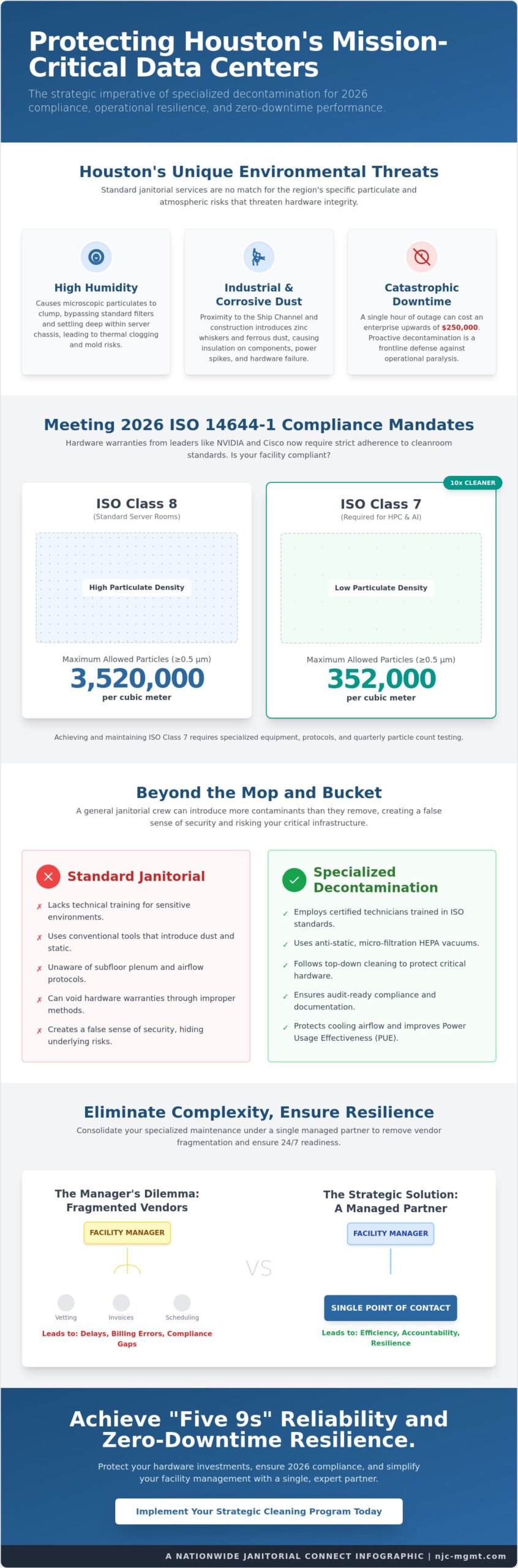
Data center cleaning isn’t a luxury; it’s a specialized decontamination process designed for mission-critical IT environments. In Houston, the stakes are exceptionally high. The city’s high humidity levels don’t just affect comfort. They fundamentally alter how data center environmental controls manage airflow. Moisture causes microscopic particulates to clump together. These heavy clusters often bypass standard filtration systems and settle deep within server chassis. Once inside, they create a sticky layer that’s nearly impossible for standard airflow to dislodge.
Proximity to the Ship Channel and the relentless commercial construction across the metro area introduces a cocktail of corrosive dust and industrial grit. These “invisible” contaminants lead to thermal clogging. When dust coats sensitive components, it acts as an insulator. Fans spin faster to compensate, power consumption spikes, and hardware eventually fails. Utilizing professional data center cleaning services houston is the only way to mitigate these regional risks. It’s about protecting the 154 megawatts of capacity currently powering the city’s digital economy.
Houston’s Environmental Challenges for Mission-Critical Facilities
The Energy Corridor and nearby industrial zones present unique particulate profiles that standard filters can’t handle alone. Ambient air quality in these hubs necessitates advanced HEPA filtration protocols to prevent zinc whiskers and ferrous dust from entering the white space. For Houston’s primary sectors, such as Aerospace and Healthcare, the cost of downtime is staggering. Industry data from early 2026 suggests that a single hour of outage can cost an enterprise upwards of $250,000. Precision cleaning isn’t just about aesthetics; it’s a frontline defense against operational paralysis.
The ROI of Professional Decontamination
Smart facility managers view decontamination as a strategic investment rather than a line-item expense. Proactive cleaning costs a fraction of a catastrophic server failure or an emergency disaster recovery event. Beyond hardware longevity, clean environments directly improve Power Usage Effectiveness (PUE) by allowing cooling systems to operate at peak efficiency without fighting through clogged heat sinks. Maintaining a clean facility is the only way to achieve the “five 9s” of reliability, which is defined as maintaining 99.999% uptime through rigorous environmental management and technical precision.
Technical Standards and ISO Classifications for Data Center Cleaning
Technical excellence defines the boundary between a resilient facility and one prone to cascading failure. In 2026, adhering to the updated ISO 14644-1 standards is no longer a suggestion; it’s a requirement for hardware warranty compliance. Most Houston server rooms operate under ISO Class 8, which permits up to 3,520,000 particles (≥0.5 µm) per cubic meter. However, the rapid expansion of high-performance computing (HPC) and AI-driven tenants often necessitates a shift to ISO Class 7. This higher standard requires a tenfold reduction in particulate matter, allowing only 352,000 particles per cubic meter. Achieving this level of precision is why specialized data center cleaning services houston are essential for modern infrastructure management.
ASHRAE TC 9.9 guidelines further refine these requirements by focusing on thermal and particulate health. These guidelines ensure that gaseous contaminants don’t lead to chemical de-plating on circuit boards. This technical framework aligns with broader Clean Air Act standards regarding indoor air quality and environmental controls. General janitorial staff lack the training to navigate these complexities. They often use tools that introduce more contaminants than they remove, creating a false sense of security that ends when a server rack overheats due to microscopic debris.
Understanding ISO 14644-1 Particulate Limits
In 2026, Houston facility managers must conduct particle count testing at least quarterly to maintain audit-ready status. Maintaining ISO Class 8 requires strict adherence to the limit of 3,520,000 particles at 0.5 µm, while Class 7 environments must stay below 352,000. Successful audits demand comprehensive documentation, including particle counter calibration certificates and timestamped decontamination logs. Strategic managers often find that partnering with a managed solution provider simplifies the complexity of these technical audits by providing centralized reporting and quality assurance.
Specialized Equipment: HEPA vs. ULPA Vacuums
Standard commercial vacuums are a liability in a mission-critical zone. Their filtration systems are often porous enough to re-release micro-particles back into the airflow, where they settle on heat sinks. Data center cleaning services houston utilize true HEPA filtration, which guarantees 99.97% efficiency at 0.3 microns. In high-compliance zones, ULPA vacuums offer 99.999% efficiency. Beyond filtration, technicians use anti-static (ESD) cleaning agents and non-linting wipes. These specialized materials prevent electrostatic discharge while ensuring that the cleaning process itself doesn’t leave behind fibers that could clog sensitive cooling intakes.
Beyond the Mop: Specialized Cleaning Zones and Protocols
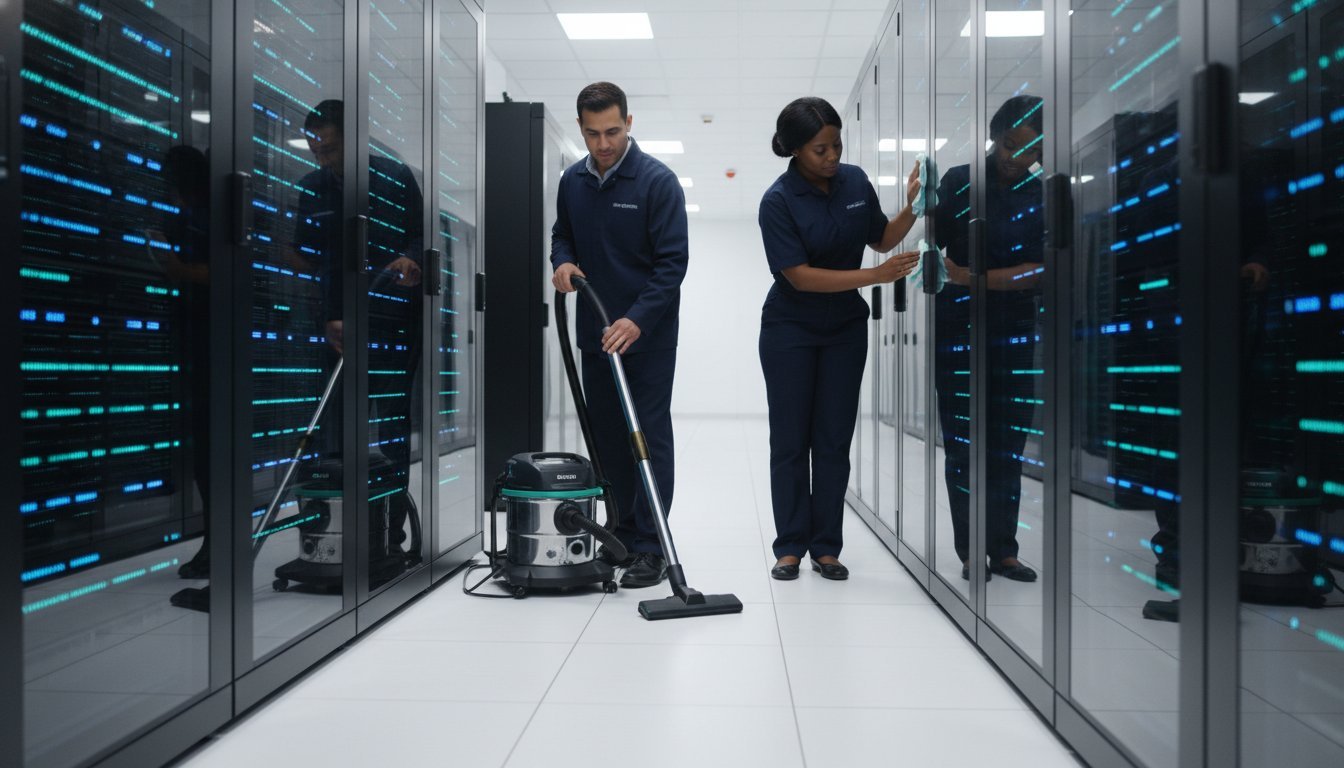
Precision in a mission-critical environment requires a strategic sequence of operations. Professional data center cleaning services houston follow a strict “Top-Down” methodology to ensure total decontamination. This protocol dictates that technicians clean overhead cable trays, lighting fixtures, and the tops of server cabinets before addressing the floor. Gravity dictates that particulates dislodged during overhead work will settle below. If you reverse this order, you’re simply re-contaminating your workspace. It’s a waste of resources that modern facility managers can’t afford.
Server rack and cabinet detailing involves a delicate balance of technical skill and situational awareness. Technicians must navigate live, high-density equipment without disrupting sensitive connections or triggering thermal alarms. This isn’t a task for generalists. It demands a deep understanding of airflow dynamics and the specific vulnerabilities of high-speed hardware. By May 2026, the rise of AI-driven liquid cooling systems has only increased the complexity of these internal rack protocols.
Subfloor and Plenum Decontamination
The subfloor plenum serves as the lungs of your data center. This pressurized space distributes cold air to your hardware, but it also acts as a reservoir for heavy particulates. Over time, dust accumulates in cable runs and air dams, which can clog under-floor cooling airflows and force fans to work harder. Our protocols involve detailed vacuuming with HEPA-filtered equipment that captures 99.97% of micro-particles. We also emphasize sealing concrete subfloors. Unsealed concrete undergoes “dusting” as it ages, releasing microscopic silica into the airflow. Sealing these surfaces is now a standard requirement for maintaining ISO Class 7 and 8 compliance in Houston’s industrial zones.
Internal Server and Rack Cleaning Protocols
Cleaning perforated floor tiles is about maintaining the exact CFM (Cubic Feet per Minute) required for thermal stability. Technicians use specialized non-linting wipes and anti-static solutions to clear these tiles without introducing new fibers. Safety training is paramount here. Working near sensitive fiber optics requires a steady hand; even a minor structural vibration can cause signal loss. For facilities that house both data halls and manufacturing spaces, integrating industrial cleaning services in Houston ensures a cohesive maintenance strategy across all technical zones.
Finally, we must address zinc whisker remediation. These microscopic metal filaments grow from older galvanized steel floor tiles, particularly in facilities built before 2015. They’re conductive and can break off into the airflow, causing catastrophic short circuits on motherboards. Identifying and removing these filaments requires high-intensity lighting and micro-vacuuming techniques that only specialized data center cleaning services houston can provide.
The Manager’s Dilemma: Direct Vendors vs. Managed Facility Solutions
Choosing a local janitorial crew for a high-density server environment is a gamble with your facility’s uptime. While general commercial cleaning rates in Houston range from $0.08 to $0.20 per square foot, these figures reflect surface-level maintenance, not technical decontamination. The hidden costs of managing direct vendors often outweigh any perceived savings. Sourcing, vetting, and tracking insurance for multiple specialized teams creates an administrative bottleneck. This is where “Janitorial Fragmentation” occurs. Different crews often use incompatible chemicals or varying protocols, leading to a breakdown in facility-wide quality standards.
A single-source partner like NJC Management eliminates this friction. We provide a unified approach across all your Houston locations, ensuring that the precision required for data center cleaning services houston is maintained without exception. Our role as a strategic partner allows you to focus on scaling your infrastructure while we handle the operational minutiae. Explore how NJC Management’s strategic oversight can streamline your facility operations today.
Consolidating Houston Janitorial Vendors
Managing 20+ different maintenance invoices is an inefficient use of a facility manager’s time. By utilizing facility vendor management solutions, you reduce administrative overhead and gain a single point of accountability. This consolidation transforms a chaotic vendor list into a streamlined strategic asset. NJC acts as a quality assurance buffer between the client and the technician, ensuring every service meets our rigorous standards before it reaches your desk.
Vetting for Mission-Critical Compliance
Data center technicians require more than just a standard background check; they need technical certifications and a deep understanding of static control. Managing Certificates of Insurance (COI) for high-value environments is another critical layer of risk mitigation. If a vendor’s coverage lapses, your facility is exposed to significant liability. Professional data center cleaning services houston must maintain specialized policies that reflect the value of the hardware they protect. For a deeper dive into selecting a partner that understands these stakes, read our guide on choosing the right janitorial company in Houston.
Implementing a Strategic Cleaning Program with NJC Management
NJC Management operates as more than a service provider. We are your strategic partner in infrastructure resilience. Our Houston-based approach centers on a rigorous cycle of sourcing, quality assurance, and transparent reporting. This model moves your facility away from a reactive cleaning schedule toward a proactive facility health program. In a market where 28.5 megawatts of new capacity are under construction as of early 2026, maintaining this strategic edge is vital for long-term value creation and investor confidence.
Disaster recovery is a core pillar of our management framework. Houston’s industrial environment and volatile weather patterns demand a 24/7 emergency response capability. Whether it’s post-storm moisture remediation or accidental particulate contamination, our teams are ready to deploy specialized equipment instantly. This responsiveness ensures that data center cleaning services houston remain a constant shield against downtime, regardless of external environmental shifts or industrial accidents near the Ship Channel.
Complexity is the enemy of efficiency. We transform your fragmented facility maintenance into a single, predictable line item. Consolidated billing doesn’t just simplify your accounting; it provides a holistic view of your facility’s operational health. You gain the clarity needed to make data-driven decisions about your infrastructure without the noise of multiple vendor communications. We handle the vetting, the compliance tracking, and the quality control, leaving you to focus on your core mission-critical objectives.
The NJC Quality Assurance Process
Every project concludes with a multi-point inspection designed to verify ISO 14644-1 compliance. We don’t rely on visual checks alone. Our partners utilize calibrated particle counters to ensure your white space meets the specific particulate limits required by your hardware warranties. Your dedicated account manager serves as your single point of contact, managing the technical teams and documentation so you don’t have to. For a practical look at this model in action, review our commercial cleaning case study detailing successful multi-site management in the Houston metro area.
Next Steps: Requesting a Managed Solution Quote
Transitioning to a managed program begins with a comprehensive site assessment. We evaluate your current particulate levels, airflow efficiency, and facility traffic to build a custom protocol. Frequency isn’t one-size-fits-all. Some high-density zones require quarterly deep cleans, while others may only need bi-annual subfloor plenum work. This tailored approach ensures you aren’t overpaying for unnecessary services while maintaining absolute compliance. Contact Nationwide Janitorial Connect for a consolidated Houston facility management quote and secure your infrastructure’s future today. Professional data center cleaning services houston are the foundation of your facility’s long-term five 9s reliability.
Future-Proofing Houston’s Mission-Critical Infrastructure
Resilience in 2026 requires moving beyond reactive maintenance toward a strategic facility health program. Houston’s high-growth market, projected to reach 946.99 megawatts by 2032, leaves no room for the particulate-led downtime caused by industrial dust or high humidity. You’ve seen how technical precision and ISO compliance protect your hardware investment while managed oversight eliminates the chaos of vendor fragmentation. Leveraging specialized data center cleaning services houston ensures your facility remains audit-ready and operationally sound at all times.
NJC Management provides the stability you need in a dynamic industrial climate. As a Houston-headquartered strategic partner, we offer managed oversight for 20+ facility solutions and specialized compliance for ISO Class 1-9 environments. Don’t let administrative overhead dilute your focus on infrastructure growth. It’s time to consolidate your vendor stack and secure a single point of accountability for your entire facility. Request a Strategic Managed Facility Quote for Your Houston Data Center to begin your transition to a streamlined, high-performance maintenance strategy. Your mission-critical assets deserve nothing less than absolute precision.
Frequently Asked Questions
How often should a data center in Houston be cleaned?
Most facilities require professional decontamination at least quarterly to maintain ISO Class 8 compliance. Houston’s unique environmental triggers, such as heavy particulate loads from the Ship Channel and high humidity, often necessitate more frequent attention to subfloor plenums. A bi-annual deep clean serves as the minimum baseline for lower-traffic environments. This cadence ensures that cooling systems remain unobstructed and energy efficiency targets are met without fail.
What is the difference between general janitorial and data center cleaning?
Technical data center cleaning services houston focus on microscopic decontamination rather than surface-level aesthetics. General janitorial crews use standard vacuums that re-release micro-particles back into the air. Specialized technicians use true HEPA-filtered vacuums with 99.97% efficiency and anti-static agents to eliminate contaminants without risking electrostatic discharge. It is a strategic process designed to protect high-value IT assets, not just maintain a clean appearance.
Can cleaning be performed while the data center is live?
Professional decontamination is performed while the facility remains live and operational. Technicians use non-conductive tools and follow strict safety protocols to avoid structural vibrations or accidental cable disconnections. This ensures zero downtime during the cleaning process. Specialized teams are trained to navigate high-density server racks without triggering thermal alarms or disrupting the sensitive fiber optic connections that power your enterprise operations.
What is ISO 14644-1 and why does it matter for my Houston facility?
ISO 14644-1 is the primary international standard for classifying air cleanliness in controlled environments. For Houston facilities, maintaining ISO Class 8 or Class 7 is now a requirement for hardware warranty compliance from manufacturers like NVIDIA and Cisco. This standard limits the number of allowable particles per cubic meter. Regular testing and documentation ensure your facility remains audit-ready and meets the 2025 revised technical benchmarks for mission-critical air quality.
What are zinc whiskers and how do you remove them?
Zinc whiskers are microscopic, conductive metal filaments that grow from older galvanized steel floor tiles. They break off into the airflow and cause catastrophic short circuits on motherboards. Removal requires high-intensity lighting to identify the filaments and micro-vacuuming with HEPA filtration to capture them. This specialized remediation is essential for any facility built before the 2015 industry shift away from certain galvanized coatings on raised floor systems.
How does NJC Management vet its technical cleaning vendors?
NJC Management utilizes a multi-layered vetting process that includes background checks, technical certification verification, and rigorous COI management. We ensure every technician understands the risks of working in a mission-critical environment. By acting as a quality assurance buffer, we verify that every vendor meets our exclusive standards for precision. This strategic oversight eliminates the risk of janitorial fragmentation across your entire Houston facility portfolio.
Do you provide post-construction cleaning for new Houston data centers?
We provide specialized post-construction decontamination for new developments, including the 28.5 megawatts of capacity currently under construction in Houston. This process involves deep detail cleaning to remove heavy construction dust before hardware deployment. Rates for this level of precision in 2026 range from $0.25 to $0.60 per square foot for deep detail cleans. It is a vital step to ensure your new facility enters service at ISO Class 7 or 8 standards.
Can you consolidate my data center cleaning with other janitorial needs?
Consolidation is a core benefit of our managed facility solutions. We turn complex maintenance needs into a single, predictable line item by managing 20+ different facility services under one contract with Nationwide Janitorial Connect. This approach reduces administrative overhead and ensures consistent quality across your entire Houston footprint. You gain a single point of contact for everything from technical data center cleaning to standard office janitorial needs.