Choosing a Hospital Cleaning Company in Houston: A Strategic Guide for 2026
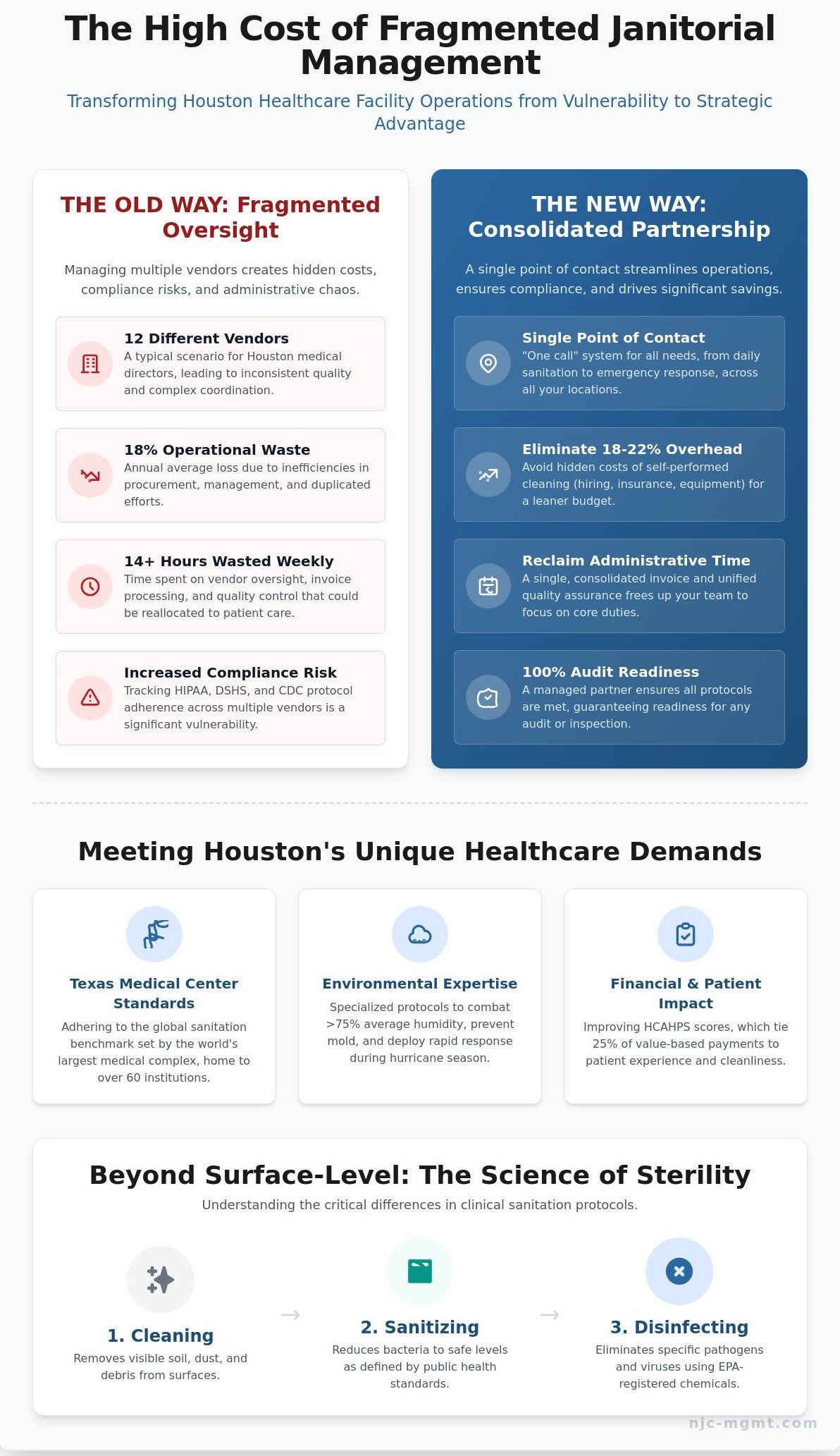
Managing 12 different janitorial vendors isn’t a sign of robust oversight; it’s a structural vulnerability that costs Houston medical directors an average of 18% in operational waste annually. You already know that maintaining a sterile environment is non-negotiable for patient safety, yet the administrative burden of tracking HIPAA compliance and inconsistent quality across departments has become a significant distraction. Choosing the right hospital cleaning company for your Houston medical facilities in 2026 requires moving beyond simple checklists toward a consolidated strategic partnership that prioritizes efficiency.
You’ll learn how to master the complexities of modern healthcare sanitation and consolidate high-compliance cleaning vendors into a single, professional point of contact. We’re providing a clear roadmap to guarantee compliance with Texas healthcare regulations while streamlining your billing and quality assurance processes. This guide previews the essential shift toward unified facility management, ensuring your entire network is prepared for 100% audit readiness under the latest CDC protocols and state mandates.
Key Takeaways
- Understand why the Texas Medical Center’s rigorous standards redefine the global benchmark for specialized healthcare sanitation in the Houston landscape.
- Evaluate the fiscal and operational advantages of transitioning from fragmented direct hiring to a managed hospital cleaning company solution.
- Navigate the critical intersection of DSHS regulations and HIPAA compliance to ensure your facility meets every legal mandate during both clinical and administrative hours.
- Implement a professional 5-step auditing framework to verify vendor references and chemical inventory standards across the Greater Houston area.
- Discover a strategic roadmap for vendor consolidation that transforms complex, high-compliance operations into a single, streamlined managed partnership.
The High Stakes of Healthcare Sanitation in Houston’s Medical Landscape
A hospital cleaning company is a specialized partner in infection prevention and regulatory compliance. In Houston, the requirements for these partners are dictated by the scale and prestige of the Texas Medical Center (TMC). As the largest medical complex in the world, the TMC hosts 60 plus clinical institutions and manages 10 million patient encounters annually. This density of care creates a high-pressure environment where standard commercial janitorial services fall short. Specialized Environmental Services (EVS) teams are vital because they directly impact HCAHPS scores. Since 25% of a hospital’s value-based incentive payments are tied to patient experience, the perceived and actual cleanliness of a facility is a financial cornerstone. Strategic sanitation reduces the transmission of pathogens like MRSA and C. diff, which contribute to the $28.4 billion in annual costs associated with healthcare-associated infections in the United States.
Beyond Surface Clean: The Science of Disinfection
Precision in a clinical setting requires a clear distinction between cleaning, sanitizing, and disinfecting. Cleaning removes visible debris, while sanitizing reduces bacteria to levels deemed safe by public health standards. Disinfection, however, involves the total elimination of specific pathogens through EPA-registered, hospital-grade chemicals. To ensure patient safety during transitions, EVS teams must follow terminal cleaning best practices that include strict dwell times for disinfectants. These rigorous protocols are the only way to break the chain of infection in high-traffic areas. A professional hospital cleaning company trains its staff to treat every surface as a potential vector for disease, ensuring that clinical environments remain sterile and safe for immunocompromised patients.
Houston-Specific Environmental Challenges
Houston’s unique geography introduces environmental variables that demand localized expertise. The city’s average relative humidity often exceeds 75%, creating a breeding ground for mold and compromising indoor air quality if not managed correctly. In the 77060 area, which serves as a hub for both clinical care and biotech research, the sanitation needs of sterile labs and clean rooms require ISO-compliant protocols. Furthermore, the region’s hurricane season, spanning from June to November, necessitates specialized emergency sanitation plans. Rapid response is essential when humidity spikes or floodwaters threaten facility integrity. Facilities need partners who can deploy specialized equipment to remediate biological hazards within 24 hours, ensuring that Houston’s medical infrastructure remains resilient regardless of the weather.
Evaluating Managed vs. Self-Performed Hospital Cleaning Services
Deciding between an in-house team and a specialized hospital cleaning company often comes down to a choice between perceived control and actual operational efficiency. While self-performing might seem cheaper on paper, the hidden overhead of direct hiring, liability insurance, and specialized equipment maintenance often inflates budgets by 18% to 22% compared to managed solutions. Nationwide Janitorial Connect shifts the burden from the facility director to a strategic framework where management fees are offset by reduced turnover and procurement savings.
A common misconception suggests that adding a management layer increases the bottom line. In reality, healthcare facilities in Houston save an average of 14 hours per week on administrative tasks by delegating vendor oversight. This model eliminates the friction of coordinating multiple contracts across different surgical centers or clinics. Utilizing a 5-Step Framework for Auditing a Hospital Cleaning Agency allows CFOs to see exactly where waste occurs in traditional vendor models. It’s about moving from a reactive “fix-it” mindset to a proactive, results-oriented strategy.
The Single-Source Management Advantage
Consolidated billing is a primary driver for Houston healthcare networks managing 5 or more locations. Instead of processing dozens of invoices monthly, a single statement covers everything from daily sanitation to quarterly floor care. This “one call” system ensures that an emergency spill at 3:00 AM or a last-minute window cleaning request is handled through a single point of contact. It creates a predictable environment where quality remains consistent across labs, clinics, and main hospital wings without requiring constant micro-management from hospital staff.
Quality Assurance & Performance Monitoring
Nationwide Janitorial Connect implements third-party inspections to maintain strict accountability. We don’t just hope the work gets done; we track sanitation KPIs through rigorous digital reporting and data analysis. This data-driven approach is vital for high-security medical environments where labor vetting must meet 100% compliance standards. For those seeking to optimize their facility’s performance, exploring a tailored management strategy provides the clarity needed to scale operations without sacrificing hygiene standards. Every technician in a sterile environment passes rigorous background checks and biohazard training protocols before their first shift.
Essential Compliance Standards for Houston Medical Facilities
Compliance in Houston isn’t optional; it’s the foundation of patient safety and legal security. The Texas Department of State Health Services (DSHS) under Title 25, Part 1, Chapter 133 mandates rigorous sanitation schedules that every hospital cleaning company must execute to maintain facility licensure. These regulations demand more than surface-level tidiness. They require a deep understanding of chemical contact times and mechanical disinfection. Beyond the clinical floor, HIPAA regulations apply to custodial staff entering administrative wings after 6:00 PM. Cleaners frequently work around sensitive patient records or open terminals. A professional vendor ensures every technician signs a binding non-disclosure agreement and completes privacy training to prevent data breaches. OSHA Standard 29 CFR 1910.1030 dictates exactly how staff manage bloodborne pathogens and medical waste disposal. In 2026, hospital cleaning agencies must adhere to updated ISO Class 7 clean room protocols for surgical suites.
Infection Control & Cross-Contamination Prevention
Effective sanitation relies on physical barriers and the mechanical removal of pathogens. High-performing vendors utilize 4-color microfiber systems to ensure a cloth used in a restroom never touches a patient tray. Every HEPA-filter vacuum must meet the 99.97% efficiency rating for particles as small as 0.3 microns to maintain air quality. Operating rooms require terminal cleaning, a specialized multi-step process involving the disinfection of every surface from ceiling to floor. We verify that our partners maintain digital logs for every shift. These audit trails provide the necessary proof of compliance during unannounced Joint Commission inspections.
Staff Training & Safety Certifications
Pathogens evolve, so cleaning protocols must adapt. Houston facilities face specific regional challenges, from humidity-driven mold to seasonal viral surges. We ensure vendors provide quarterly education on emerging threats like Candida auris. Security remains a top priority in sensitive medical areas. 100% of cleaning personnel must pass comprehensive 7-year criminal background checks before accessing pharmacy or oncology units. NJC’s role involves vetting these certifications meticulously so facility managers don’t have to spend hours on administrative oversight. We ensure your hospital cleaning company maintains the highest industry credentials, allowing you to focus on clinical excellence and patient outcomes; for those interested in a model of comprehensive patient care, you can learn more about Sage Creek Medical Center.
5-Step Framework for Auditing a Hospital Cleaning Agency
Selecting a strategic partner for facility maintenance requires a disciplined audit that goes beyond surface-level aesthetics. You’re not just hiring janitors; you’re securing a frontline defense against Healthcare-Associated Infections (HAIs). This framework ensures your chosen hospital cleaning company meets the rigorous standards of the Houston medical market.
- Step 1: Verify Greater Houston References. A reputable agency must provide at least three active references from clinical environments within a 25-mile radius of the Texas Medical Center. Contact these facilities to verify their performance during the 2023-2024 flu and RSV seasons.
- Step 2: Audit Chemical and Equipment Logs. Review their 2024 chemical inventory to ensure they utilize EPA List N disinfectants. Examine maintenance logs for HEPA-filter vacuums and floor scrubbers to confirm equipment is serviced every 90 days.
- Step 3: Evaluate Emergency Response. In a 24/7 medical environment, delays are unacceptable. Demand a contractually guaranteed 90-minute on-site response time for biohazard spills or emergency disinfection needs.
- Step 4: Review Internal Quality Control. Don’t settle for visual inspections. Ask for data from ATP (Adenosine Triphosphate) bioluminescence testing. High-performing agencies conduct these tests weekly to provide objective proof of surface sterility.
- Step 5: Assess Scalability. If you’re a multi-facility medical group, your partner must manage at least 200,000 square feet of clinical space across the region. This ensures they have the labor pool to cover staff shortages without compromising care quality.
The Interview Process: What to Ask
Direct dialogue reveals an agency’s operational maturity. Start by asking about their staff retention strategies. While the Houston janitorial market often sees 200% annual turnover, elite providers maintain rates below 50% through competitive wages and specialized training. Inquire about their specific experience with JCAHO (The Joint Commission) audits; they should be able to describe how they assisted a client during a 2023 or 2024 survey. Finally, ask for their specialized protocols for high-risk zones like oncology infusion centers or dialysis clinics, where patient immunity is lowest.
Red Flags in Hospital Janitorial Contracts
Vague language is the enemy of compliance. If a contract uses phrases like “disinfection as needed” instead of defining a 4x daily frequency for high-touch points, it’s a liability. Transparency in insurance is equally vital. A professional hospital cleaning company should carry a minimum of $5 million in umbrella liability coverage specifically rated for medical environments. Lastly, look for undefined escalation paths. If a shift is missed, you need a direct line to a regional director, not a generic 1-800 customer service number that leads to a voicemail box.
Build a more resilient medical facility with a partner who understands high-stakes compliance. Contact our strategic consultants to audit your current cleaning protocols.
Strategic Vendor Consolidation for Houston Healthcare Systems
Managing a sprawling medical campus requires more than just a basic cleaning crew. NJC Management acts as the strategic bridge between Houston healthcare facilities and elite service providers. Most local systems struggle with vendor bloat. We’ve seen medical groups transition from managing 24 separate contracts to a single, unified oversight model. This shift eliminates the fragmented communication that often leads to sanitation lapses in high-stakes environments. Our approach ensures that every hospital cleaning company within our network meets rigorous performance benchmarks before they ever step onto your floor.
In a 2023 operational audit of a multi-site Houston surgical group, NJC consolidated 18 different service providers into one managed solution. This move reduced administrative labor by 38% within the first 90 days. We don’t just find a vendor; we architect a total maintenance ecosystem that scales with your facility’s needs. For smaller medical practices seeking similar consolidation benefits, implementing strategic dental office cleaning services can provide the same level of compliance and efficiency in specialized healthcare environments.
Consolidated Invoicing & Financial Clarity
Fragmented billing kills productivity. Facility managers often spend 15 hours a month just reconciling invoices from various janitorial, floor care, and window cleaning teams. NJC delivers one comprehensive monthly invoice for all services. This clarity allows administrators to focus on patient outcomes rather than chasing down 20 different accounting departments. It stops vendor sourcing fatigue and provides a transparent view of your total facility spend.
- Single-point accountability for all specialty cleaning tasks.
- Elimination of redundant service overlaps and hidden fees.
- Real-time budget tracking across multiple medical locations.
Your Partner in Houston Medical Excellence
Operating from our Houston headquarters, we understand the specific regulatory pressures of the Texas Medical Center and surrounding suburbs. We view our role as a strategic partnership, not a simple cleaning contract. Choosing the right hospital cleaning company means finding a partner that understands the nuances of local compliance and high-traffic medical environments. Our local expertise ensures your facility exceeds Joint Commission standards every day. Contact NJC Management today for a comprehensive facility audit.
Elevating Healthcare Standards for Houston’s 2026 Medical Landscape
Success in Houston’s competitive healthcare sector hinges on operational precision and uncompromising sanitation. As we move into 2026, facilities must transition from basic janitorial services to a rigorous 5-step auditing framework that guarantees compliance. Consolidating your vendor list into a single-source management model reduces administrative overhead while ensuring that high-stakes laboratory and clinical spaces remain sterile. For facilities with specialized controlled environments, implementing clean room janitorial services Houston protocols becomes essential for maintaining ISO compliance and preventing costly production halts. Healthcare facilities that also manage manufacturing or research components may benefit from comprehensive industrial cleaning services in Houston to ensure all areas meet the highest regulatory standards. Choosing an expert hospital cleaning company is the most critical step in protecting your facility’s accreditation and patient outcomes. NJC Management provides the stability your organization needs through our Houston-based headquarters, offering a rapid local response that distant national providers can’t replicate. We oversee 20+ facility solutions with a focus on high-compliance medical environments, allowing your staff to focus entirely on patient care. It’s time to replace fragmented service models with a cohesive strategy that prioritizes long-term value and safety. We’re ready to align our expertise with your facility’s specific 2026 objectives.
Request a Strategic Facility Management Quote for Your Houston Hospital
Your path to a more efficient and compliant facility starts with a single strategic partnership.
Frequently Asked Questions
What is the average cost of hospital cleaning services in Houston for 2026?
Hospital cleaning services in Houston for 2026 average between $0.45 and $0.85 per square foot for specialized medical environments. These rates reflect a 12% increase from 2024 due to rising labor costs and advanced EPA-registered disinfectant requirements. Most facilities allocate 15% of their operational budget to environmental services to maintain safety standards. We provide transparent pricing models that prioritize long-term value and professional excellence.
How does a hospital cleaning company ensure HIPAA compliance?
A professional hospital cleaning company ensures HIPAA compliance through mandatory annual certification for 100% of onsite staff. We sign a formal Business Associate Agreement before starting any contract to legally bind our commitment to patient privacy. Our teams follow strict “no-look” policies for medical records and secure all workstations during their 8-hour shifts. This disciplined approach prevents data breaches and maintains the integrity of your medical facility.
What is terminal cleaning, and why is it critical for Houston surgical centers?
Terminal cleaning is a high-intensity disinfection process that removes 99.99% of pathogens from an operating room after the day’s final procedure. Houston surgical centers require this because it targets every surface, including ceiling fans and equipment wheels, where bacteria often hide. Failure to perform this daily increases surgical site infection rates by 22%. It’s a non-negotiable standard for any facility performing invasive procedures in a competitive healthcare market.
Can NJC Management handle specialized clean room cleaning in Houston?
NJC Management handles specialized clean room cleaning for Houston facilities following ISO 14644-1 standards. We manage Class 5 through Class 8 environments using HEPA-filtered vacuums and non-shedding mops to ensure zero-tolerance for contamination. Our strategy focuses on particle count reduction and maintaining specific humidity levels for pharmaceutical and biotech labs. We provide a dedicated portfolio of services that aligns with the highest international quality benchmarks.
How often should a medical facility undergo high-level disinfection?
Medical facilities should undergo high-level disinfection of high-touch surfaces at least 3 times daily to break the chain of infection. Full-room disinfection using electrostatic sprayers or UV-C light is recommended every 7 days for maximum safety. Data shows that increasing frequency from once to three times daily reduces hospital-acquired infections by 35%. Consistent schedules prevent the build-up of bio-films on critical equipment and protect your brand’s reputation.
What certifications should I look for in a Houston healthcare cleaning agency?
Look for the ISSA CIMS-GB certification and the Certified Healthcare Environmental Services Professional designation when evaluating an agency. These credentials prove a vendor meets 100% of industry standards for management and cleaning quality. Ensure the agency also holds an OSHA 30-hour certification for their supervisors to guarantee workplace safety. These benchmarks verify that your partner understands the complex regulatory environment of the Texas healthcare sector.
How does vendor consolidation improve the quality of hospital sanitation?
Vendor consolidation improves hospital sanitation by creating a single point of accountability and reducing administrative overhead by 18%. Managing one strategic partner instead of five separate contractors ensures uniform training across all departments. This approach eliminates communication gaps that often lead to missed cleaning cycles or inconsistent results. It’s a more efficient way to build a cohesive safety culture and achieve long-term growth for your institution.
What happens if a cleaning vendor fails a quality inspection?
If a cleaning vendor fails a quality inspection, they must initiate a 24-hour remediation plan to correct the deficiency immediately. Our contracts include a clause where a second failed inspection within 30 days triggers a 10% service credit for the client. We use digital auditing tools to track performance in real-time and prevent issues before they escalate. This ensures that every square foot of your facility meets our professional standards of excellence.