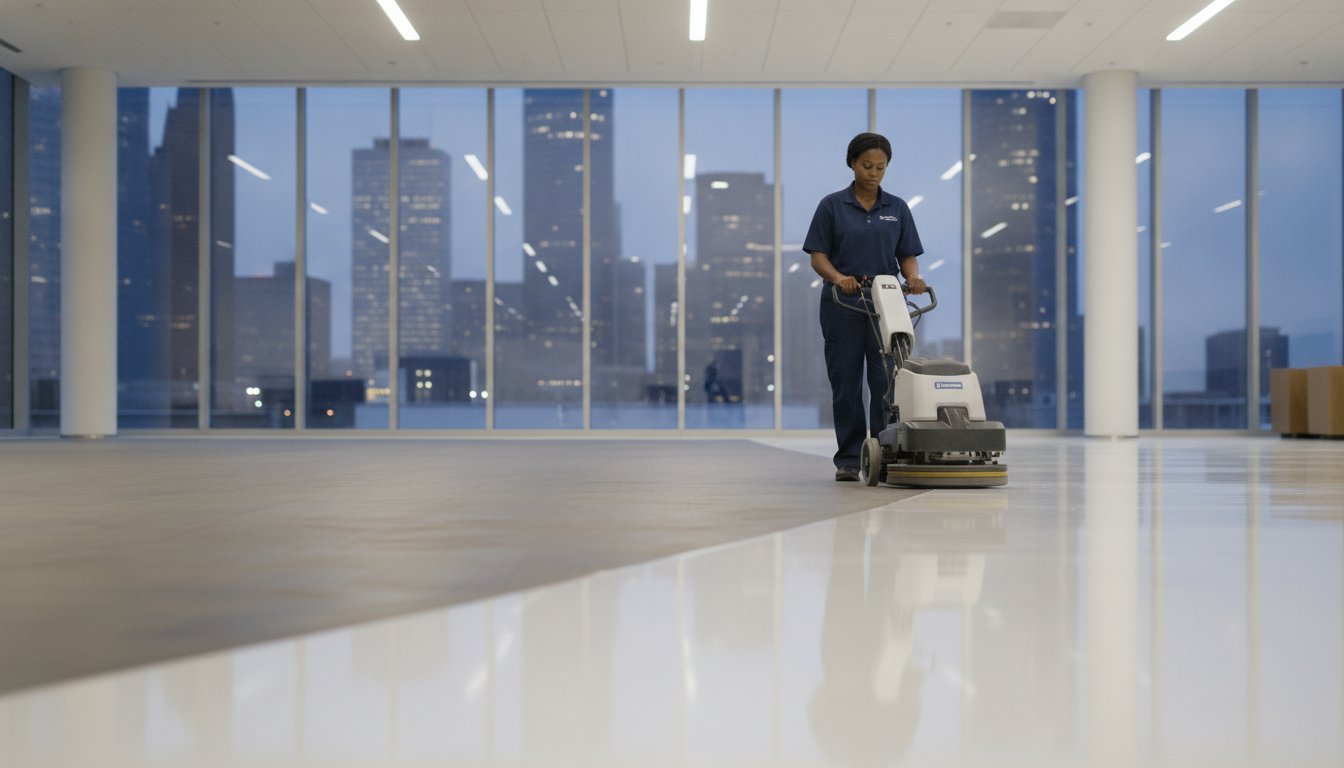
Commercial Floor Stripping and Waxing: The Houston Facility Manager’s Strategic Guide
A single slip-and-fall premises liability claim averages between $20,000 and $50,000. In Houston, this financial risk is often exacerbated by environmental factors like high humidity and industrial residues that compromise surface safety. Professional commercial floor stripping and waxing shouldn’t be a reactive chore that disrupts your business operations. It’s a strategic investment in asset longevity and corporate image.
We understand the frustration of inconsistent quality from vendors and the premature degradation of expensive flooring. You’re looking for a partner who treats your facility with the same discipline you bring to your business. This guide helps you master the technical and strategic aspects of floor restoration to protect your assets and your brand. We’ll explore how to establish a predictable maintenance schedule, consolidate billing for multiple locations, and ensure a high-gloss finish that resists scuffs. You’ll learn how to implement a management layer that handles vendor vetting so you can focus on high-level facility goals.
Key Takeaways
- Learn why professional floor care is a critical asset protection strategy that prevents permanent moisture and grit damage to your facility’s underlying substrate.
- Discover the technical precision required for commercial floor stripping and waxing to eliminate unsightly buildup and ensure a durable, high-gloss finish.
- Understand how Houston’s unique environmental factors and specific flooring materials like LVP or linoleum dictate your chemical selection and maintenance protocols.
- Explore how a centralized vendor management solution can eliminate the logistical burden of coordinating multiple cleaning crews across diverse property portfolios.
- Identify the operational advantages of a managed quality assurance approach over traditional crew-only services to ensure consistent brand standards.
The Strategic Importance of Commercial Floor Stripping and Waxing
Commercial floor stripping and waxing is a precise restorative process designed to strip away layers of oxidized, soiled finish and replace them with high-performance polymers. For a Houston facility manager, this isn’t a routine janitorial task. It’s a critical asset management strategy. Neglecting this cycle allows grit and moisture to penetrate the porous surface of materials like Vinyl composition tile (VCT), leading to permanent structural damage that no amount of mopping can fix.
In high-stakes environments such as medical clinics or financial institutions, the condition of the floor serves as a silent brand ambassador. A dull, yellowed finish suggests neglect. Conversely, a pristine, high-gloss surface projects an image of hygiene and professional excellence. While yellowing is a sign of wear on a floor, you can discover Nicholas Wells Antiques to see how this vibrant hue is celebrated in the world of rare furniture and design. This visual standard is particularly vital in the competitive Houston commercial real estate market, where first impressions often dictate leasing success. When floors look neglected, clients subconsciously question the quality of the services provided within those walls.
Asset Preservation vs. Aesthetic Appeal
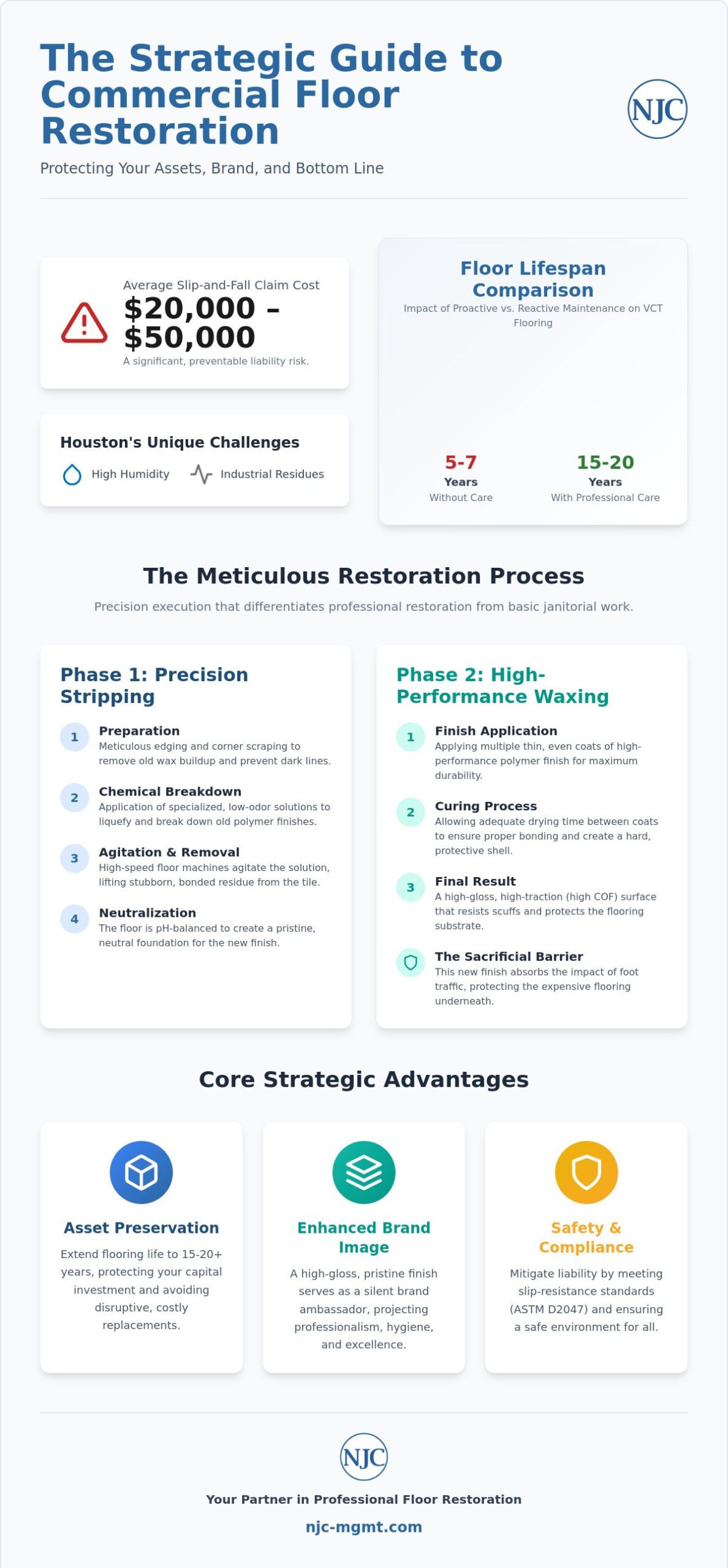
Strategic floor care extends the life of your facility’s infrastructure. Properly maintained VCT flooring can last between 15 and 20 years. Without regular restoration cycles, that same material may fail in as little as 5 to 7 years. This represents a significant capital expenditure risk that most budgets can’t easily absorb. Regular waxing creates a sacrificial barrier that absorbs the impact of high-traffic footwear. This prevents deep-seated scuffs and scratches from reaching the substrate. Protecting these high-traffic zones ensures you aren’t forced into a premature, costly floor replacement that disrupts your primary business operations. It’s about moving from reactive cleaning to a proactive appearance management program.
Safety and Compliance Standards
Beyond the visual and structural benefits, professional floor care is a matter of legal and operational safety. Maintaining a high Coefficient of Friction (COF) is essential for meeting slip-resistance standards like ASTM D2047. In environments like daycare centers and schools, these standards aren’t optional. They’re a core component of your compliance profile.
A single slip-and-fall premises liability claim averages between $20,000 and $50,000. Professional-grade finishes are engineered to provide traction even in Houston’s humid climate, where ambient moisture and petrochemical residues can settle on indoor surfaces. By prioritizing commercial floor stripping and waxing, you mitigate these high-cost liabilities while ensuring a safe environment for employees and visitors. Managing these risks requires a sophisticated approach to vendor vetting, ensuring that every technician understands the nuances of chemical application and safety compliance.
The Technical Process: Precision Stripping and High-Performance Waxing
Precision in commercial floor stripping and waxing differentiates a professional restoration from a basic janitorial task. The process begins with meticulous preparation. Technicians must perform detailed edging and corner scraping to prevent the unsightly dark lines known as “wax buildup.” These accumulations often occur when previous crews simply mop over corners without removing old layers. Proper execution requires a disciplined approach to every square inch of the facility.
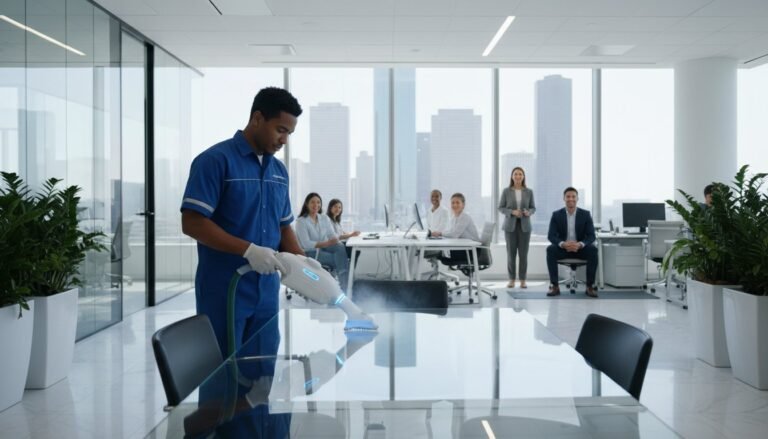
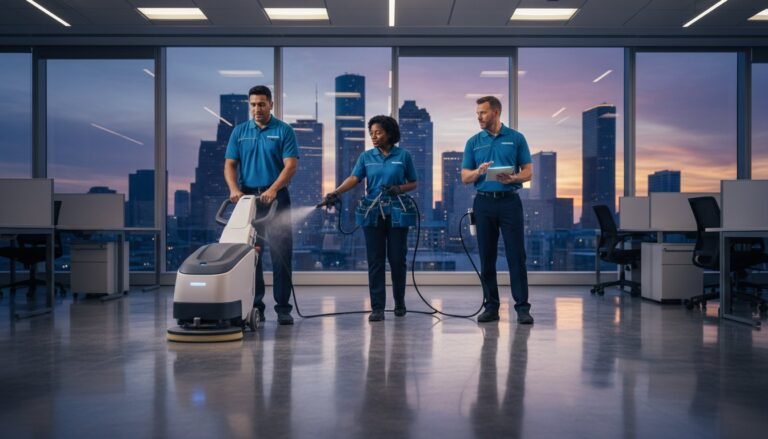
After preparation, the floor undergoes a chemical breakdown. This phase uses specialized solutions to liquefy existing polymers. In a busy Houston office or medical clinic, using low-odor chemicals is essential to maintain indoor air quality and prevent business disruption. High-speed floor machines then agitate the solution, lifting stubborn residue that has bonded with the tile over time. We ensure the process aligns with OSHA safety requirements for floors, keeping walking-working surfaces clean and orderly even during the most intensive stripping phases.
Stripping: Removing the Past
The goal of stripping is to return the floor to its original, porous state. If any trace of old wax remains, it can cause the new finish to “yellow” or peel prematurely. Technicians must be relentless in their removal of petrochemical residues and pollutants common in Houston’s industrial environment. Once the old finish is gone, the critical step of neutralization begins. Strippers are highly alkaline; if the floor isn’t pH-balanced with a neutralizing solution, the new wax won’t bond. This chemical failure is a primary reason why DIY or low-budget floor projects fail within weeks.
Waxing: Building the Future
Applying the new finish requires a strategic choice regarding solids content. Most facility managers must choose between an 18% and a 25% solids finish.
- 18% Solids: Often easier to apply but requires more frequent burnishing to maintain a shine.
- 25% Solids: Provides a thicker, more durable sacrificial layer that stands up to heavy foot traffic and resists scuffs.
Multiple thin coats are superior to a few thick ones. Each layer must dry completely to ensure proper cross-linking of the polymers. This patience results in the “wet look” shine that characterizes high-end commercial spaces. It’s important to distinguish this from “burnishing,” which is a maintenance step using high-speed buffers to restore shine to existing wax. Stripping and waxing is the foundational reset that makes burnishing effective. For managers handling diverse portfolios, implementing strategic floor care management ensures these technical standards remain consistent across all locations without the need for micro-management.
Material Compatibility and Houston’s Environmental Factors
Success in commercial floor stripping and waxing depends on the technician’s ability to adapt to specific substrates and external variables. Houston facility managers face a unique challenge: the Gulf Coast climate. High relative humidity, often exceeding 70%, directly impacts how chemicals interact with flooring materials. Ignoring these factors leads to failed finishes and wasted budgets. A professional approach requires matching the chemical profile to the floor type while accounting for local atmospheric conditions.
Vinyl Composition Tile remains the gold standard for traditional maintenance programs. It’s durable and porous enough to bond effectively with high-solids wax. However, Luxury Vinyl Plank (LVP) requires a different strategy. Many LVP products feature factory-applied coatings that don’t require waxing; applying standard finish to these can lead to adhesion failure. Linoleum presents its own risks. It’s an organic material that requires specialized pH-neutral strippers. Using highly alkaline solutions on linoleum causes “burning,” a permanent discoloration that ruins the aesthetic and structural integrity of the floor.
Flooring Substrates and Their Needs
Specialized environments like laboratories and financial institutions require even more precision. Clean rooms necessitate low-VOC, non-shedding finishes to maintain high-compliance standards. For terrazzo or sealed concrete, the decision to wax versus polish depends on the desired slip resistance and maintenance budget. Regardless of the material, following established workplace safety precautions ensures that chemical exposure and slip risks are managed professionally throughout the process. This is especially critical in medical offices where patient safety is the primary metric of success.
The Humidity Challenge in Houston
Moisture is the enemy of a clear, durable floor finish. When humidity levels are high, moisture can become trapped between layers of wax. This results in “clouding” or “blushing,” where the floor looks milky instead of transparent. To combat this, strategic scheduling is vital. Overnight service is often preferred because external temperatures are lower and building occupancy is minimal, allowing for better environmental control. This timing also allows for the extended curing periods necessary when the air is thick with Gulf moisture.
Airflow management is the final technical hurdle. During the waxing process, the facility’s HVAC system must be set to ‘on’ rather than ‘auto’ to ensure continuous dehumidification and airflow. This keeps the air moving and helps the water in the wax evaporate at a predictable rate. Proper curing is the only way to achieve that “wet look” shine while ensuring the sacrificial layer is hard enough to resist Houston’s industrial grit. Without this environmental control, even the best 25% solids wax won’t bond correctly, leading to scuffs and peeling within weeks of application.
Managing Floor Care Across Multiple Facilities
Managing a portfolio of Houston properties requires more than just scheduling a cleaning crew. It demands a sophisticated approach to vendor oversight. The hidden costs of juggling multiple vendors across different zip codes often manifest in inconsistent results and administrative fatigue. One site might receive a high-solids finish while another gets a budget-grade application. This lack of uniformity erodes your brand image. Implementing a facility vendor management solution eliminates these discrepancies by centralizing control and standardizing expectations.
Consolidated billing is a major operational advantage for the modern facility manager. Instead of processing dozens of individual invoices from various floor care specialists, you receive a single, transparent statement. This simplifies accounts payable and allows for accurate budgetary forecasting across your entire portfolio. When you standardize your commercial floor stripping and waxing protocols, you ensure that every facility meets the same high-gloss, slip-resistant standards regardless of its location in the Greater Houston area.
The Single Point of Contact Model
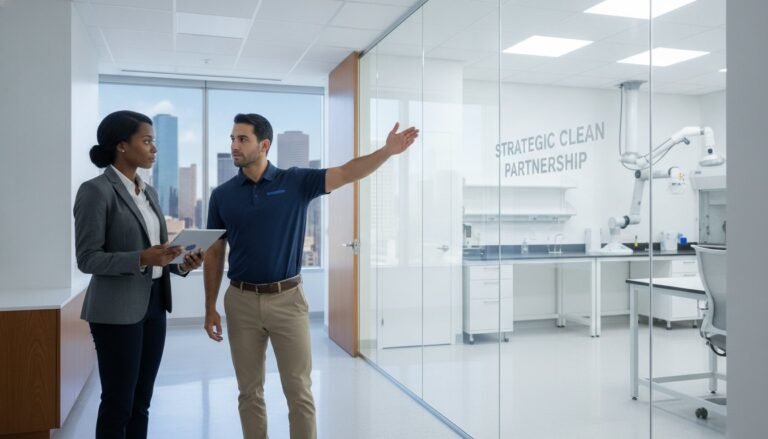
Efficiency is the primary driver of the single point of contact model. You don’t have to spend hours vetting local vendors or reviewing insurance certificates. Nationwide Janitorial Connect acts as the management layer, handling the sourcing and quality assurance inspections on your behalf. This ensures that every technician working on your floors has been rigorously vetted for technical proficiency and safety compliance. We provide the oversight that traditional crew-only services lack, giving you a strategic partner rather than just another service provider. This model guarantees that the quality of work remains high even when you can’t be on-site to inspect it yourself.
Developing a Maintenance Calendar
A predictable maintenance frequency is essential for asset longevity. High-traffic retail spaces might require semi-annual attention, while corporate offices often thrive on an annual cycle. Coordinating these efforts with other essential tasks, such as commercial carpet cleaning, ensures a holistic approach to facility care. This integrated scheduling prevents the “clean floor, dirty carpet” contrast that can make a facility look uncoordinated.
Proactive scheduling also allows you to distinguish between a full strip and wax and a more economical “top-scrub and recoat.” A top-scrub removes only the top layer of soiled finish, making it an ideal interim solution for maintaining shine without the full cost of a total restoration. By mapping out a year-long calendar, you avoid the chaos of emergency service calls and ensure your floors are always in peak condition. If you’re ready to streamline your operations, explore how Nationwide Janitorial Connect can manage your multi-site floor care with professional precision.
Nationwide Janitorial Connect: Your Partner in Professional Floor Restoration
Nationwide Janitorial Connect represents the evolution of facility maintenance. Traditional crew-only services often lack the strategic oversight required to maintain high-value assets across diverse portfolios. Our managed approach shifts the burden of quality assurance from the facility manager to our specialized project leads. We vet every Houston-based specialist through a rigorous process. This ensures they possess the technical skill for precise commercial floor stripping and waxing and the reliability required for high-stakes environments. You aren’t just hiring a crew; you’re securing a strategic partner.
Beyond execution, we provide a layer of real-time quality assurance. Post-service inspections aren’t an afterthought. They’re a standard protocol to ensure every square foot meets your brand’s specific aesthetic and safety requirements. This level of discipline is why we are a trusted partner for financial institutions and medical offices where compliance and discretion are non-negotiable. By integrating these specialized tasks into a comprehensive commercial janitorial service plan, you achieve a seamless operational flow. This protects both your budget and your reputation.
The Nationwide Janitorial Connect Advantage for Facility Managers
Our project management model respects the unique rhythms of your business. Whether you manage a boutique medical suite or a sprawling industrial complex—a sector where international leaders often partner with industrial robotics suppliers UAE to modernize operations—our solutions scale to meet your specific square footage and traffic volume. We understand the operational constraints of high-security environments. Our teams are trained to work within strict access protocols, providing the stability and professional elegance your facility deserves. You get the expertise of local specialists with the accountability of a professional management firm. This structure ensures that time, your most valuable resource, is managed responsibly.
Getting Started with a Managed Floor Program
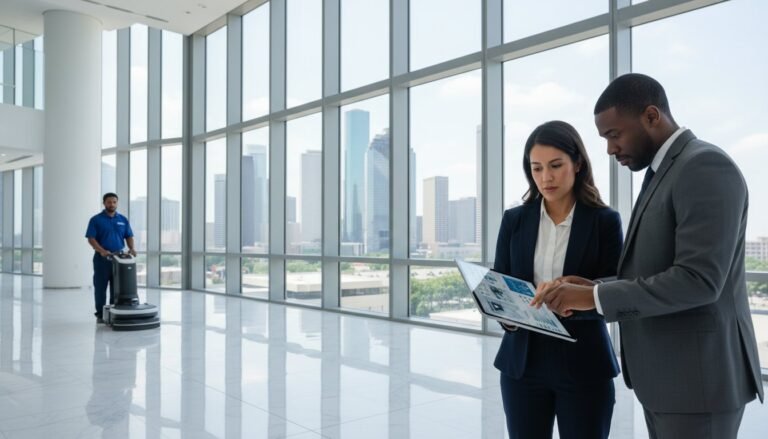
A successful restoration begins with a clear understanding of your facility’s current state. We provide comprehensive site assessments to identify material needs and environmental risks unique to the Houston area. This allows us to customize a floor care plan that aligns with your specific industry compliance standards and budgetary cycles. We move beyond case-by-case solutions to create a sustainable professional roadmap for your facility. Don’t leave your facility’s first impression to chance. Contact Nationwide Janitorial Connect today for a strategic floor care consultation. We help you transition from reactive cleaning to a future-focused appearance management program.
Elevating Your Facility’s Operational Standards
Mastering commercial floor care requires balancing technical precision with strategic vendor oversight. As established, high-performance commercial floor stripping and waxing is more than an aesthetic upgrade; it’s a critical defense against the unique environmental pressures of the Houston climate. By addressing material compatibility and humidity-controlled curing, you ensure your facility maintains its structural integrity and a pristine professional image.
Nationwide Janitorial Connect provides the management layer necessary to scale these standards across your entire property portfolio. We offer consolidated billing for multi-property managers and specialized compliance expertise for the medical and financial sectors. With a single point of contact for over 20 facility solutions, we eliminate the administrative friction of vendor sourcing while maintaining rigorous quality assurance across every square foot of your operation.
Ready to transition from reactive cleaning to a future-focused appearance management program? Request a Managed Floor Care Quote for Your Houston Facility to begin your partnership with a team that prioritizes asset longevity and brand excellence. Let’s secure the long-term value of your facility’s assets today.
Frequently Asked Questions
How long does it take for floor wax to dry in a humid climate like Houston?
In Houston’s 70% plus relative humidity, each coat typically requires 45 to 60 minutes of drying time. Without active HVAC airflow, this period can extend significantly. It’s essential to ensure the previous layer is completely tack-free before proceeding to prevent clouding. Most professional applications involve 4 to 5 coats, meaning a full project requires several hours of dedicated curing time under controlled atmospheric conditions.
What is the difference between floor stripping and floor burnishing?
Floor stripping is the restorative process of removing old, soiled finish down to the substrate. In contrast, burnishing is a maintenance task using a high-speed buffer to restore the shine of existing wax. While burnishing improves aesthetics, it cannot fix deep-seated scratches or yellowing. Only a full commercial floor stripping and waxing cycle can reset the floor’s appearance and provide a fresh sacrificial barrier for the underlying material.
How many coats of wax should be applied to a commercial VCT floor?
Most commercial VCT floors require 4 to 5 coats of high-solids finish to ensure maximum durability and a deep gloss. The first two coats act as a sealer, while subsequent layers provide the sacrificial barrier against foot traffic. High-traffic areas in medical clinics or retail spaces often benefit from an additional fifth coat to extend the time between full restoration cycles and improve scuff resistance.
Can you strip and wax luxury vinyl plank (LVP) or laminate floors?
Standard stripping and waxing are generally not recommended for Luxury Vinyl Plank (LVP) or laminate floors. These materials often feature a factory-applied wear layer that does not bond well with traditional floor wax. Applying wax to these surfaces can lead to peeling and adhesion failure. Instead, these floors require specialized pH-neutral cleaners and periodic deep scrubbing rather than a traditional restorative wax program.
How often should a high-traffic retail space be stripped and waxed?
High-traffic retail environments typically require a full strip and wax every 6 to 12 months. The exact frequency depends on daily foot traffic volume and the effectiveness of interim maintenance like daily mopping and weekly burnishing. Implementing a “top-scrub and recoat” every quarter can often delay the need for a full restoration while maintaining the desired high-gloss appearance for your brand image.
Is floor stripping and waxing necessary for sealed concrete floors?
No, sealed concrete floors require a different maintenance protocol than VCT. While concrete can be waxed, it’s more common to use high-performance topical sealers or a mechanical polishing process. Waxing concrete often creates a high-maintenance cycle that isn’t necessary for the material. For industrial spaces, we recommend specialized densifiers and sealers that provide slip resistance without the need for periodic stripping and waxing cycles.
What should I do to prepare my office before the floor crew arrives?
Preparation is key to an efficient service. You should clear all movable furniture, including chairs, trash cans, and floor mats, from the target area. Technicians need an unobstructed surface to ensure uniform chemical application and precise edging. We also recommend notifying security and adjusting HVAC settings to remain ‘on’ during the service to assist with the curing process in our humid climate.
How does consolidated billing work for multi-site floor maintenance?
Consolidated billing streamlines your accounts payable by aggregating services for all your Houston properties into a single monthly invoice. Instead of managing separate vendors and payment schedules for each location, you receive one transparent statement. This model reduces administrative overhead and provides a clear overview of your total facility spend, making it easier to forecast budgets for large-scale commercial floor stripping and waxing projects across your entire portfolio.