
Multi-Campus School Cleaning Management: A Strategic 2026 Guide for Educational Leaders
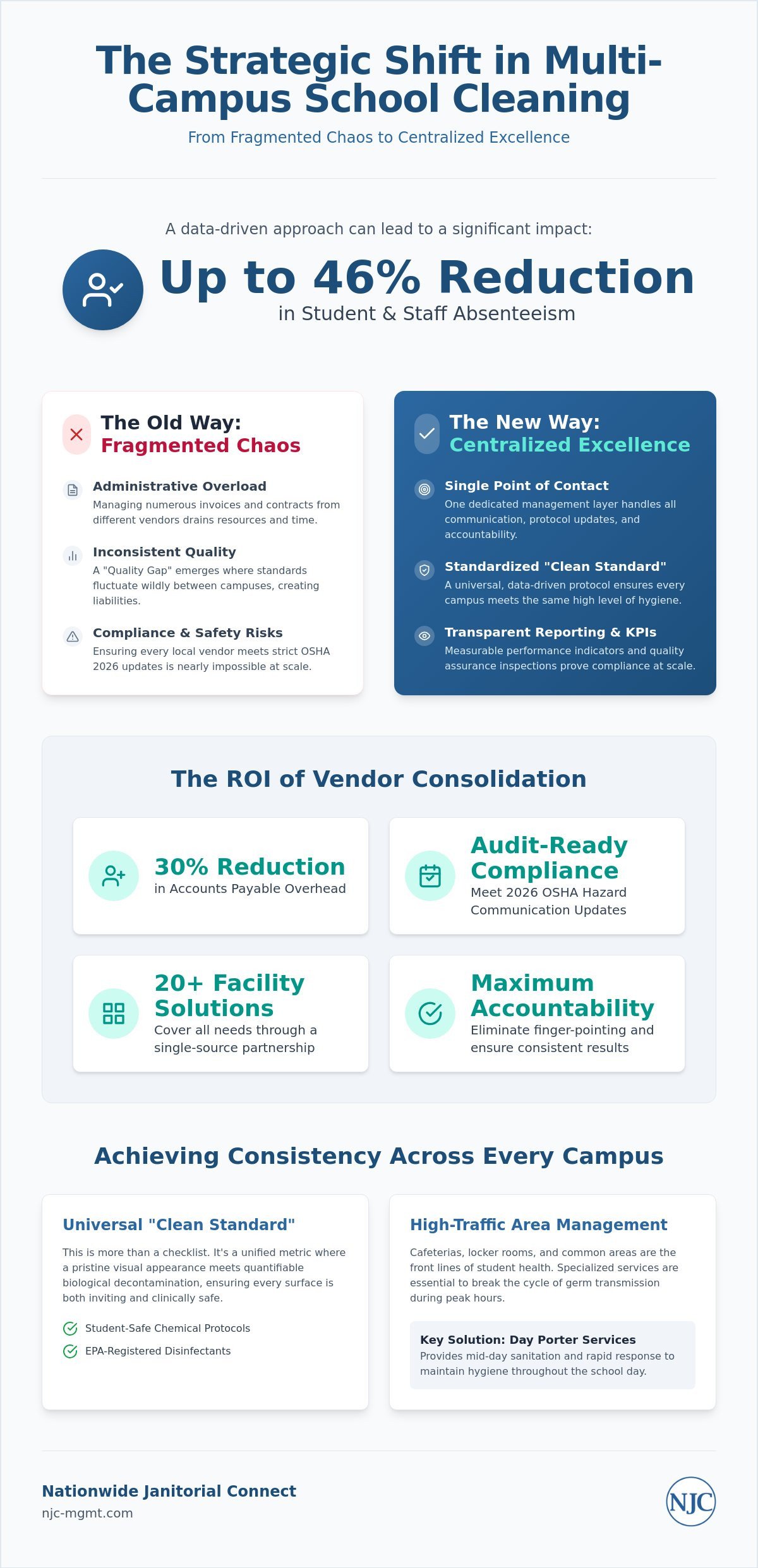
Did you know that a data-driven approach to facility cleanliness can reduce student and staff absenteeism by as much as 46%? For educational leaders managing a network of buildings, achieving this outcome often feels secondary to the sheer administrative weight of the task. You’re likely dealing with the friction of fragmented vendor contracts, fluctuating quality between locations, and the urgent pressure to meet 2026 OSHA Hazard Communication updates before the November deadline. It’s a complex landscape where a single oversight in one building can compromise the reputation of your entire district.
We understand that your time is a finite resource. This guide offers a strategic blueprint for multi-campus school cleaning management that replaces chaos with consistency. You’ll learn how to consolidate your facility solutions into a single point of contact, standardize health protocols across every square foot, and implement transparent reporting that proves compliance at scale. We’ll examine the shift from labor-focused cleaning to management-led excellence, ensuring your campuses remain safe, professional, and audit-ready throughout the academic year.
Key Takeaways
- Transition from fragmented local contracts to a centralized management model to eliminate hidden administrative costs as your network scales.
- Define a universal “Clean Standard” and deploy specialized Day Porter Services to ensure consistent hygiene in high-traffic campus zones.
- Streamline your operations through strategic multi-campus school cleaning management to achieve up to a 30% reduction in accounts payable overhead.
- Build a unified facility framework by identifying district-wide needs and establishing measurable KPIs for every building in your portfolio.
- Shift to a single-source partnership that provides over 20 facility solutions through one dedicated point of contact for maximum accountability.
The Complexity of Multi-Campus School Cleaning Management in 2026
Managing one school is a tactical task. Managing a network is a strategic challenge. Most traditional janitorial models collapse during expansion because they lack the infrastructure to handle scale. This is where multi-campus school cleaning management becomes a necessity rather than an option. When leadership attempts to replicate a single-building success across five or ten locations using local, independent crews, they often encounter a “Quality Gap.” Standards vary. Response times lag. The result is a fragmented portfolio where some buildings shine while others become liabilities.
Modern schools are no longer simple environments. High-performance gyms, STEM laboratories, and specialized clean rooms require more than general upkeep. They demand technical expertise found in specific sectors of the commercial cleaning industry. Without a unified management layer, ensuring that every crew understands these nuances is nearly impossible. Scaling your network shouldn’t mean scaling your headaches.
The Administrative Burden of Vendor Fragmentation
Vendor fragmentation is an invisible drain on school resources. If a facility manager tracks ten different invoices from ten different companies, they aren’t managing facilities; they’re managing paperwork. Communication breakdowns are inevitable. When a protocol changes at the district level, relaying that to ten independent owners creates a lag that puts student health at risk. This fragmentation also complicates risk management. Vetting protocols and insurance certificates for a dozen small vendors takes hours that leadership doesn’t have. A single point of failure at one campus can ripple through the entire district’s reputation.
Regulatory Compliance and Safety at Scale
Compliance is the most critical pillar of multi-campus school cleaning management. As of 2026, educational leaders must navigate strict OSHA Hazard Communication updates. Every campus must align with new labeling and training requirements by November 20, 2026, or face significant penalties. Consistency is the only way to avoid these risks. Standardized Quality Assurance Inspections ensure that chemical safety standards are identical in a Pre-K classroom and a high school chemistry lab. This unified approach protects the district from liability and ensures that every student, regardless of their specific campus, enters a medical-grade environment. It’s about building a culture of safety that transcends individual buildings.
Standardizing Educational Cleaning Protocols Across Every Location
Consistency is the primary metric of success for multi-campus school cleaning management. Without a centralized set of protocols, your network is only as strong as its weakest link. Establishing a universal “Clean Standard” ensures that a parent walking into an elementary school on the west side of the district experiences the same level of hygiene and professionalism as they would at the high school downtown. This isn’t just about appearances. It’s about creating a predictable, safe environment where the focus remains on pedagogy rather than pathogens.
A true Clean Standard represents a unified metric where visual pristine appearance meets quantifiable biological decontamination, ensuring every surface is both aesthetically inviting and clinically safe for student interaction. To achieve this, leadership must move beyond vague “scope of work” documents and toward rigorous, data-driven specifications. This includes implementing student-safe chemical protocols as a non-negotiable requirement. Using EPA-registered disinfectants and following best practices for healthier learning environments ensures that your sanitation efforts don’t introduce harmful VOCs or allergens into the classroom.
High-Traffic Area Management
Managing cafeterias, locker rooms, and shared common areas requires more than a nightly sweep. These zones are the front lines of student health. Integrating Day Porter Services provides the mid-day sanitation necessary to break the cycle of germ transmission during peak hours. By focusing on high-touch surfaces like door handles, water fountains, and shared desks, you can significantly reduce student absenteeism. Leveraging smart sensors and real-time reporting allows your management team to monitor performance and adjust schedules based on actual facility usage rather than arbitrary timelines.
Specialized Environment Needs
Every campus has unique zones that require specialized attention. School laboratories and clean room environments demand specific protocols to protect sensitive equipment and maintain safety standards. Likewise, long-term floor care and carpet maintenance shouldn’t be reactive. Standardizing these services across your network prevents premature wear and ensures a professional image. Restroom sanitation, perhaps the most scrutinized aspect of school facility management, must be uniform. When every crew follows the same rigorous disinfection steps, you eliminate the variability that leads to complaints. If you’re looking to elevate your network’s current baseline, a comprehensive facility needs assessment is the first step toward district-wide consistency.
Strategic multi-campus school cleaning management relies on this level of granular detail. It transforms janitorial work from a background chore into a measurable pillar of institutional excellence. By unifying your protocols, you protect your students, your staff, and your long-term facility investment.
The ROI of Janitorial Vendor Consolidation for School Districts
Financial efficiency in educational operations is often buried under a mountain of administrative friction. Transitioning to a unified model for multi-campus school cleaning management shifts the focus from managing individual cleaners to overseeing a high-performance system. The true return on investment isn’t found in cutting corners on labor. It’s found in the radical simplification of your supply chain. When you replace a dozen local contracts with one strategic partner, you reclaim the most valuable resource your leadership team has: time.
Beyond daily sanitation, consolidation allows for the protection of high-value school assets. Implementing standardized Floor Care & Maintenance across every campus ensures that your district’s capital investments, from gymnasium hardwoods to laboratory tiling, receive consistent protection. This proactive approach extends the lifecycle of your facilities and prevents the costly, premature replacements that typically arise from neglected or inconsistent maintenance schedules.
Streamlining Accounts Payable
Managing 20 or more vendors across a district creates an unsustainable administrative burden. Each vendor brings a separate invoice, a different billing cycle, and a unique process for dispute resolution. Consolidating these facility solutions into a single monthly invoice can reduce accounts payable overhead by up to 30%. This efficiency gain comes from eliminating redundant data entry and the hours spent verifying disparate service charges. Centralized billing provides district leadership with a clear, real-time view of the total janitorial spend, making financial forecasting more accurate and budget tracking effortless.
Strategic Vendor Sourcing
A management-led model provides a strategic advantage in sourcing specialized labor. Vetting local Houston vendors for high-compliance educational environments is a rigorous process that shouldn’t fall on a facility manager’s shoulders. A single-source partner maintains a bench of pre-vetted crews ready for any scenario. Whether you need 24/7 availability for emergency maintenance or specialized teams for Post-Construction Cleanup following a campus renovation, the management layer handles the logistics. This ensures that every person entering your buildings meets the district’s specific safety and quality standards without requiring individual oversight for every new project. It’s about building a resilient infrastructure that responds instantly to your needs.
Implementing a Unified Facility Solutions Framework
Transitioning from a fragmented vendor list to a managed system isn’t merely an administrative change; it’s a strategic migration. Most educational networks struggle during this phase because they attempt to layer new expectations over old, broken habits. A unified framework for multi-campus school cleaning management succeeds only when it prioritizes results over activity. It requires moving away from the “checklist” mentality and toward a model of continuous, data-driven improvement. This transition ensures that district leadership maintains oversight without getting lost in the tactical weeds of daily operations.
The first step in this process is establishing clear key performance indicators (KPIs) that apply to every building in your portfolio. These metrics shouldn’t just track whether a floor was mopped, but rather the biological safety and longevity of the facility assets. By defining success through measurable data, you create an environment where accountability is built into the contract. This shift allows school heads to focus on their primary mission: education, while the management team handles the complexities of facility maintenance.
Phase 1: Assessment and Baseline
You can’t manage what you haven’t measured. This phase begins with a comprehensive audit of current cleaning schedules and vendor performance. We identify “problem areas” that consistently fail internal inspections or generate staff complaints. This isn’t just about trash removal. It’s an evaluation of the physical condition of existing floor and window surfaces to determine where deferred maintenance has caused damage. Establishing this baseline allows us to allocate resources where they’re needed most, ensuring that the highest-traffic zones receive the intensity of care they require.
Phase 2: Integration and Oversight
Once the baseline is set, we move into the integration of vendors into a centralized quality assurance platform. This technology eliminates the communication lag that plagues fragmented systems. On-site leads receive training on standardized school cleaning protocols to ensure that “clean” means the same thing at every campus. We then launch a single-source communication channel. This ensures that facility managers have one point of contact for every need, from routine janitorial work to emergency pressure washing. This loop creates a closed-circuit system where issues are reported, tracked, and resolved before they impact the student experience.
Building a resilient facility framework is the only way to protect your district’s reputation and budget. If you’re ready to move beyond fragmented labor and toward a strategic partnership, consult with NJC Management to design your unified facility solutions framework. Strategic management is the difference between a building that simply exists and one that thrives.
Why NJC Management is the Strategic Partner for Houston Educational Networks
NJC Management isn’t just a service provider; we’re a strategic layer between your district’s vision and the reality of facility maintenance. Our Houston-based team understands the specific pressures of the local educational landscape. We know that a private school in the Heights has different operational demands than a high-volume daycare center or a financial institution’s training campus. By centralizing multi-campus school cleaning management, we remove the friction of vendor oversight. You gain a partner that speaks the language of long-term value creation and portfolio stability.
Our approach centers on proactive Quality Assurance Inspections. We don’t wait for a school head to report a dusty vent or an unsanitized restroom. Instead, our management team conducts rigorous, documented audits that go beyond surface-level aesthetics. We verify compliance with the 2026 safety standards mentioned earlier, ensuring that every campus in your network meets the same medical-grade hygiene requirements. This level of scrutiny protects your students, your staff, and your institutional reputation. It’s about maintaining a standard that’s beyond reproach.
The NJC Single-Source Advantage
The Single-Source model is our signature contribution to educational excellence. We act as your strategic mentor, vetting every crew to ensure they meet the non-negotiable safety standards of a school environment. You no longer need to manage separate contracts for janitorial services, window cleaning, and pressure washing. We consolidate over 20 facility solutions under one roof. This integration ensures that specialized tasks, such as Laboratory & Clean Room Cleaning or post-construction cleanup, are executed by professionals who already understand your district’s specific protocols. We handle the sourcing, the vetting, and the management so you don’t have to. This unified oversight ensures that multi-campus school cleaning management is a seamless part of your operations rather than a constant source of administrative strain.
Ready to Simplify Your Campus Management?
Leadership is about focus. When you’re bogged down by fragmented invoices and inconsistent cleaning quality, you aren’t focusing on student outcomes. NJC Management reduces that noise. We provide the stability of consolidated billing and the transparency of unified reporting. It’s time to move toward a model where facility management supports, rather than hinders, your mission. We’re ready to help you achieve the consistency your network deserves. Request a consultation for your Houston-area school network to see how we can transform your operations. We’ll help you design a management strategy that scales with your ambition and protects your budget.
Request a Janitorial Management Quote for Your Multi-Campus Network to begin your transition to a centralized, professional framework that prioritizes health, safety, and operational elegance.
Securing the Future of Your Educational Network
Effective leadership in 2026 requires a transition from reactive maintenance to a proactive, unified strategy. We’ve explored how vendor consolidation and standardized protocols eliminate the quality gaps that often plague growing school districts. By implementing a centralized framework, you don’t just improve hygiene. You protect your long-term facility assets and reclaim your administrative time for more critical academic initiatives.
Strategic multi-campus school cleaning management is the foundation of a safe, high-performance learning environment. NJC Management provides the bridge between your vision and operational reality. We offer a single point of contact for over 20 facility solutions, supported by consolidated monthly invoicing and specialized school cleaning protocols that meet the highest regulatory standards. Our Quality Assurance Inspections ensure that every building in your network reflects the same professional excellence.
Partner with NJC for Strategic Multi-Campus Management to transform your facilities into a measurable asset for your community. Your campuses deserve a standard of care that reflects the excellence of your educational mission.
Frequently Asked Questions
What are the benefits of multi-campus cleaning management vs. individual contracts?
Multi-campus management provides a single point of accountability and uniform standards that individual contracts lack. While local crews might excel in isolation, they often operate under disparate protocols. A managed system synchronizes every location, ensuring that a district-wide safety update is implemented simultaneously rather than campus by campus. This structural alignment reduces the risk of compliance gaps and simplifies communication for facility directors.
How does consolidated billing work for school districts with multiple locations?
Consolidated billing aggregates every service, from routine janitorial work to window cleaning, into one monthly invoice. Instead of processing dozens of disparate payments, your accounts payable team handles a single transaction. This system clarifies budget tracking by providing a comprehensive view of total expenditure across all sites. It eliminates the administrative friction of managing multiple vendor terms and significantly reduces the likelihood of duplicate billing errors.
Can a management company ensure consistent safety protocols across different campuses?
A management partner enforces a universal “Clean Standard” by training all vendors on the same health and safety benchmarks. Strategic multi-campus school cleaning management involves deploying standardized chemical lists and safety procedures that every crew must follow. This ensures that student-safe protocols are identical at every location. We use centralized reporting to verify that these non-negotiable requirements are met, protecting the district from the liability of inconsistent practices.
What specialized cleaning services are essential for educational facilities in 2026?
Essential services in 2026 include medical-grade disinfection, specialized laboratory cleaning, and proactive indoor air quality maintenance. High-traffic educational environments require more than basic upkeep; they need specialized floor care and day porter services to manage mid-day sanitation needs. These services focus on high-touch surface decontamination and biological safety, which are critical for reducing student absenteeism and meeting updated regulatory requirements for 2026.
How do you vet cleaning vendors for school-safe environments in Houston?
Vetting Houston vendors requires a rigorous verification of background checks, insurance compliance, and specialized training for educational settings. We prioritize crews with documented experience in high-compliance environments, such as daycares or clean rooms. Our process ensures that every individual entering your facility is pre-vetted for school-safe operations. This relieves district leadership from the burden of individual vendor oversight while maintaining a high baseline of security and professionalism.
Is it more cost-effective to use a facility management layer for school cleaning?
Utilizing a management layer is more cost-effective because it reduces administrative overhead and leverages volume pricing. By consolidating multi-campus school cleaning management into one strategic partnership, school districts can achieve significant savings through increased operational efficiency. The management layer eliminates the hidden costs of vendor fragmentation, such as the time spent on multiple contract negotiations and dispute resolutions. For institutions that need help navigating these complex administrative requirements, Dynamic Contracts Consultants LLC provides expert proposal and grant writing services to streamline the process. It transforms janitorial spend into a predictable, optimized investment.
What role do Quality Assurance Inspections play in school janitorial services?
Quality Assurance Inspections provide the data-driven evidence needed to confirm that every campus meets the district’s cleanliness benchmarks. These inspections move beyond visual checks to include quantifiable metrics of sanitation and safety. They ensure that performance remains consistent over time, preventing the gradual decline in quality that often occurs with unmanaged vendors. Regular audits provide leadership with transparent reporting, confirming that the high-standard environment promised is actually being delivered.
How does NJC Management handle emergency cleaning needs across multiple sites?
NJC Management utilizes a “Single Source” model to rapidly deploy specialized crews for emergency needs across multiple sites. Whether you require immediate pressure washing after a storm or post-construction cleanup following a renovation, our centralized communication loop ensures a swift response. This system eliminates the need for facility managers to hunt for available vendors during a crisis. We maintain a bench of pre-vetted partners ready to act, ensuring your campuses remain operational without delay.