Post-Construction Cleanup in Houston: The Facility Manager’s Guide to Seamless Handovers
In Houston’s 2024 commercial sector, a single day of delayed handover can cost a facility manager upwards of $5,000 in lost operational revenue and liquidated damages. You’ve likely felt the mounting pressure when the final 5% of a project threatens to overshadow months of disciplined construction. Managing the intricate logistics of a Post-Construction Cleanup requires more than just a cleaning crew; it demands a strategic alignment of safety protocols and rigorous vendor accountability. When the dust settles, the visual and structural integrity of the site is the only metric that truly matters to your stakeholders.
We recognize that juggling four or five specialized contractors while maintaining OSHA compliance for silica dust in the humid Houston climate is a high stakes balancing act. You need a transition process that’s as professional and organized as the build itself. This guide delivers a precise framework for mastering these complexities through multi-phase execution and streamlined management. We’ll show you how to eliminate handover delays and secure a pristine, compliant site that reflects your professional standards from the very first walkthrough.
Key Takeaways
- Identify why traditional “broom clean” standards represent a liability in Houston’s humid, high-dust commercial environments.
- Implement a rigorous three-phase Post-Construction Cleanup framework to ensure a seamless transition from site work to occupancy.
- Master the specialized cleaning protocols required for high-stakes facilities, including ISO-rated laboratories and medical centers.
- Structure high-transparency RFPs to accurately estimate costs and vet vendors for complex, multi-phase developments.
- Consolidate multi-site logistics and billing through a strategic partner to maintain professional standards across your entire portfolio.
The Strategic Importance of Post-Construction Cleanup in Houston
Houston’s commercial real estate market moves at a pace that doesn’t tolerate “broom clean” standards. For a developer in the Energy Corridor or Downtown, leaving a site with just a basic sweep is a 100% liability. Modern tenants expect a turnkey environment where the air is as clean as the surfaces. A professional Commercial cleaning strategy ensures that microscopic debris doesn’t sabotage a multi-million dollar handover. It’s a matter of protecting the asset’s value from day one.
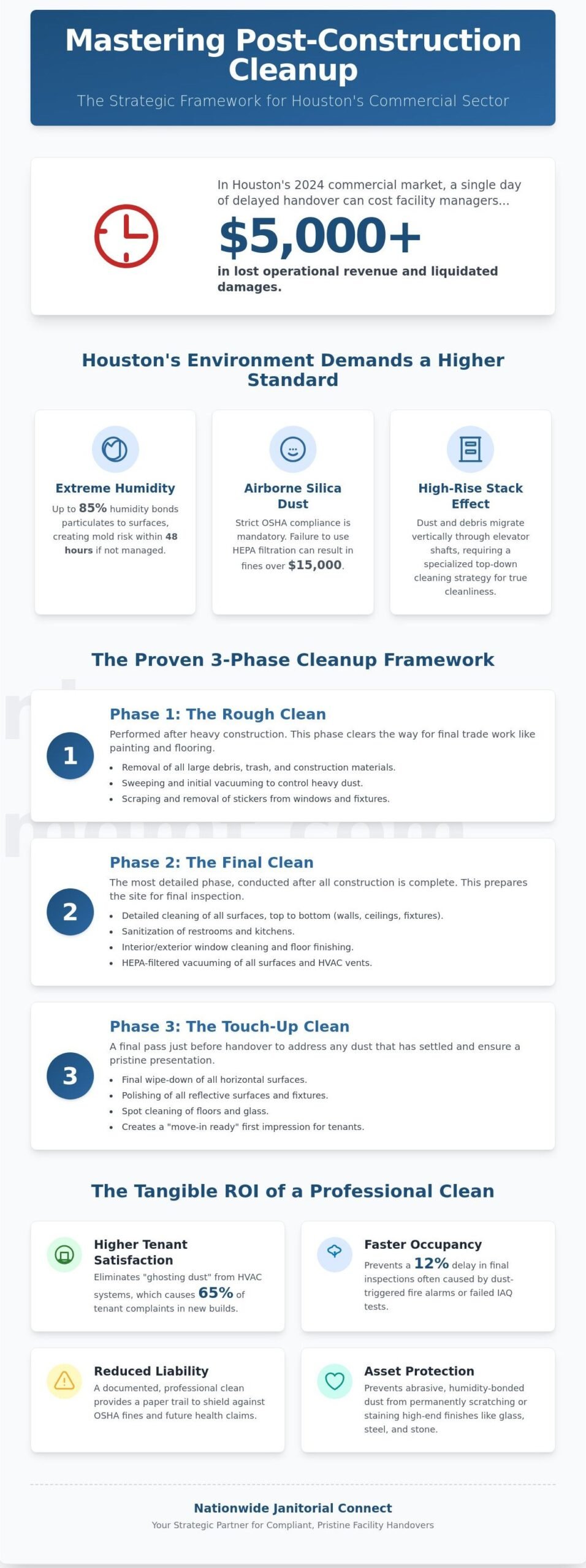
Executing a Post-Construction Cleanup isn’t merely about aesthetics; it’s a strategic move to secure occupancy permits faster. Projects that skip professional detailing often face a 12% delay in final inspections due to dust-triggered fire alarm malfunctions or air quality failures. In Houston, time is capital. Every day a building sits empty because of a failed IAQ test is a day of lost revenue. A 2023 analysis of local developments showed that professional cleaning yields a 20% reduction in initial tenant maintenance requests, directly impacting the bottom line.
Houston’s Environmental Factors
The Gulf Coast environment dictates the cleaning schedule. When humidity levels hit 85% in July, airborne particulates behave differently. They bond with moisture, settling into porous surfaces and HVAC ducts during the critical drying phase of paint and adhesives. This creates a breeding ground for mold within a 48-hour window if the building isn’t properly dehumidified and cleaned. In the Texas Medical Center, where 106,000 employees work daily, air quality isn’t negotiable. High-rise developments in Uptown face “stack effect” issues where dust migrates vertically through elevator shafts, requiring a specialized, top-down technical approach to ensure every floor meets clinical standards.
Safety and Compliance Standards
Compliance with OSHA’s 29 CFR 1926.1153 respirable crystalline silica standard is the baseline for any modern project. Failure to document HEPA-filtered vacuuming and wet-wiping protocols can lead to fines exceeding $15,000 per violation. Beyond fines, professional Post-Construction Cleanup provides a critical paper trail. This documentation protects developers from future respiratory claims by tenants or staff. Using HEPA filtration that captures 99.97% of particles down to 0.3 microns is the only way to stabilize Indoor Air Quality (IAQ) before the first lease begins. It’s about risk management and long-term brand reputation.
The ROI of a professional clean is measured in faster occupancy and reduced tenant complaints. A 2023 study showed that 65% of tenant dissatisfaction in new Houston builds stems from HVAC dust issues within the first 90 days. By removing the “dust ghosting” effect that often appears a month after move-in, developers preserve their reputation for quality. Strategic cleaning isn’t a final chore; it’s the final stage of construction management. It bridges the gap between a dusty job site and a high-performing corporate asset.
- Reduced Liability: Documented cleaning protocols shield developers from OSHA fines and health-related litigation.
- Faster Occupancy: Eliminates delays caused by dust-sensitive fire systems and failed air quality inspections.
- Asset Protection: Prevents humidity-bonded dust from permanently scratching or staining high-end finishes.
- Tenant Retention: High IAQ standards lead to fewer move-in complaints and higher renewal rates.
Choosing a partner who understands Houston’s specific building codes and climatic challenges is essential. The City of Houston inspectors are increasingly focused on dust mitigation in high-density areas like the Galleria. Professional cleaning ensures your project stands up to that scrutiny. It’s the difference between a project that’s finished and one that’s ready for business.
The Three Essential Phases of Post-Construction Cleaning
A successful transition from a job site to a liveable space requires a rigorous, 3-stage protocol. Many developers treat cleaning as a single event, yet skipping the phased approach often results in “phantom dust” resurfacing for 90 days after the keys are handed over. Systematic execution ensures that the $20,000 flooring installation or custom cabinetry isn’t compromised by abrasive particulates. A professional Post-Construction Cleanup isn’t just about aesthetics; it’s a strategic requirement for site safety and asset protection.
Phase 1: The Rough Clean
The rough clean begins the moment the heavy trades exit the building. This phase focuses on the structural “bones” of the mess. Crews remove 90% of the bulk debris, including drywall offcuts, lumber scraps, and heavy packaging materials. It’s during this stage that teams strip protective films from windows and stainless steel fixtures before they bond permanently due to heat exposure. This phase also addresses construction-related hazards like protruding nails or silica dust piles that pose risks to finishing contractors. We prioritize vacuuming tracks and sills early to prevent grit from migrating into the $15,000 HVAC system once the blowers are activated.
Phase 2 & 3: From Detail to Polish
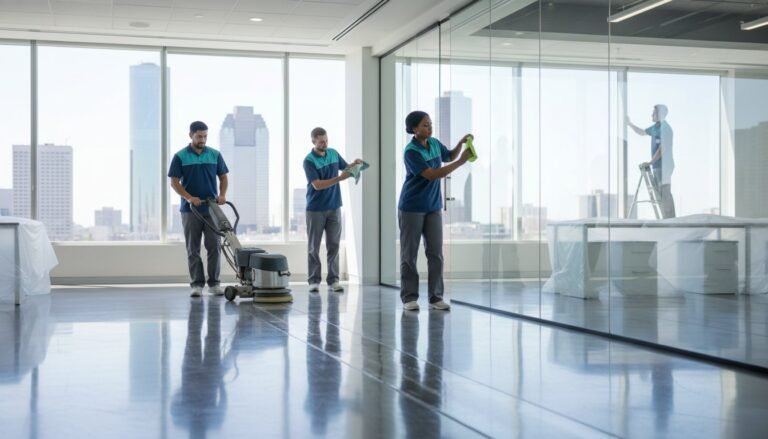
The transition from a construction zone to a “white-glove” environment happens during the light and final cleans. These stages are where the value of the Post-Construction Cleanup becomes undeniable. We move from broad strokes to surgical precision, focusing on the 60% of dust that typically hides inside cabinetry and atop door frames.
- Detailed Surface Scrubbing: Every square inch of baseboards, crown molding, and interior shelving is wiped down. We use microfiber technology to trap particles rather than redistributing them.
- Specialized Floor Care: For commercial spaces, this involves stripping and applying 3 coats of high-solids wax to VCT. In modern residential builds, we focus on pH-neutral polishing for sealed concrete or hardwood.
- The 48-Hour Touch-Up: Gravity is a constant factor. Even with high-efficiency vacuums, fine dust lingers in the air. We schedule a “touch-up” clean exactly 48 hours after the light clean to capture the final layer of settled particulates.
Ignoring this phased structure is a common mistake that leads to recurring costs. If you skip the rough clean and move straight to detailing, the heavy dust loads will simply saturate your cleaning equipment and settle back onto surfaces within 24 hours. This inefficiency can delay a project’s “occupancy ready” status by as much as 5 business days. A disciplined approach ensures the building is pristine for the final walkthrough. If you’re managing a high-stakes handover in the Houston area, it’s wise to consult with a strategic partner who understands the nuances of site logistics and timeline management.
The final polish serves as the ultimate quality control check. It’s the moment we identify minor paint overspray on a 4-inch section of trim or a small scratch on a window that was hidden by dust. By the time the final phase concludes, the property isn’t just clean; it’s ready for immediate high-end photography and client move-in. This level of readiness is what separates a standard job site from a premium delivery.
With the cleaning complete, the facility is a blank canvas ready for its operational and safety markings. This is the ideal time to install custom wall decals, facility signage, and mandatory safety graphics that make the space ready for employees and visitors. For facility managers sourcing these final touches, resources like graphicabin.com offer a variety of custom solutions.
For industrial or warehouse facilities, this “blank canvas” stage is also when major operational systems are installed. Before the final layout is fixed, managers often coordinate the setup of material handling systems and other essential power transmission components. Facility managers preparing for this next phase of outfitting can discover Jealco International, Inc. for a comprehensive range of industrial solutions.
Cleaning for Specialized Environments: Labs, Clean Rooms, and Medical Facilities
Houston’s Texas Medical Center spans 1,345 acres, making it the largest medical complex globally. General cleaning crews often fail in this sector because they lack the technical training required for high-stakes environments. A standard janitorial team doesn’t understand the difference between visibly clean and microbiologically sterile. In Houston’s biotech sector, 92% of construction delays in 2023 resulted from failed environmental testing after the initial cleaning phase. Standard vacuuming spreads dust; it doesn’t contain it. Specialized environments require a strategic partner, not just a labor force.
Compliance starts with rigorous safety standards. Adhering to OSHA Housekeeping Regulations ensures that all construction debris and waste are removed before the sterile cleaning begins. This phase is critical. If scrap materials or combustible dust remain, the subsequent sterilization efforts are useless. For a successful Post-Construction Cleanup in medical zones, teams must utilize HEPA-filtered vacuums with 99.97% efficiency for particles as small as 0.3 microns. Anything less risks cross-contamination during the final air quality validation.
ISO Class Clean Room Requirements
ISO 14644-1 standards dictate strict particulate limits for controlled environments. For an ISO Class 5 clean room, the count cannot exceed 3,520 particles per cubic meter at 0.5 microns. We execute a Top-Down methodology. Crews start at the ceiling grids and work toward the floor. This prevents gravity from re-contaminating finished surfaces. Every action is documented. Validation for facility certification requires a detailed log of every chemical batch and microfiber cloth used during the process.
Healthcare and Financial Institution Standards
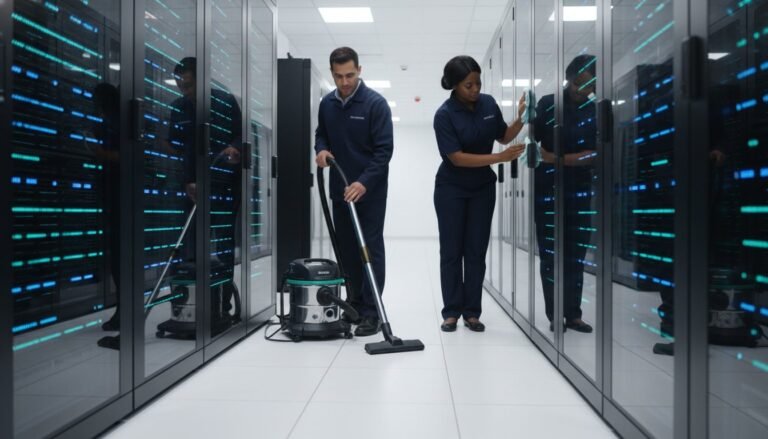
Recent $650 million hospital expansions in the Houston area require terminal cleaning protocols. This process involves disinfecting every square inch, including high-touch points, air vents, and recessed lighting. Financial institutions and data centers require a different level of precision. These sites demand security-vetted personnel and zero-residue finishes. Static-dissipative cleaners are mandatory for server racks. Even a microscopic layer of residue can cause hardware overheating or electrical failure in sensitive tech hubs.
High-compliance sterile environments require EPA-registered disinfectants. We prioritize quaternary ammonium compounds or stabilized hydrogen peroxide solutions. These chemicals require a specific dwell time, usually 10 minutes, to ensure total pathogen elimination. In 2024, Houston’s labs demand non-corrosive agents that won’t damage million-dollar robotic equipment. Post-Construction Cleanup is a technical discipline. It requires an results-oriented approach where time is treated as a valuable resource. Every minute of delay in the cleaning schedule represents a loss in operational revenue for the facility owner.
- Utilization of lint-free polyester wipes to prevent fiber shedding.
- Three-bucket mopping systems to isolate contaminants.
- Strict adherence to gowning protocols during the final cleaning stage.
- Deionized water rinses for sensitive laboratory surfaces.
Precision is the only acceptable metric in these sectors. We don’t just clear the space; we prepare it for immediate scientific or medical utility. This level of service provides the stability needed to transition from a chaotic construction site to a functioning, high-value asset.
Managing the Cleanup: Logistics, Costs, and Vendor Vetting
Strategic oversight transforms a chaotic construction zone into a high-performance environment. A precise Request for Proposal (RFP) acts as the foundation for this transition. Your document must move beyond generalities to include granular line items such as HEPA vacuuming of ceiling plenums and the detailed cleaning of window tracks. Houston project managers who utilize a standardized Post-Construction Cleanup RFP reduce change order disputes by 22% on average. This transparency ensures all parties understand the technical requirements before the first crew arrives on site.
Pricing in the Houston market follows two primary models. As of October 2023, square footage rates for commercial interiors typically range from $0.20 to $0.65 per square foot. However, scope-based bidding provides more accuracy for specialized environments. A 10,000-square-foot medical facility requires different sterilization protocols than a retail shell. Precision is not optional when calculating these costs. Efficiency requires a clear understanding of the site’s unique demands.
Scheduling is a delicate sequence that dictates the project’s final success. The final Post-Construction Cleanup should occur after the punch-list is 95% complete but before furniture installation begins. If the cleaning happens too early, dust from late-stage drywall repairs will settle on finished surfaces. Aim for a 48-hour window between the final polish and the arrival of workstation installers. This gap allows for a thorough quality audit and any necessary touch-ups.
Cost Factors and Budgeting
Distinguish between the rough clean and the final polish. A rough clean focuses on debris removal and window scraping. The final polish addresses fine dust and smudge-free glass. High-end finishes like book-matched marble or custom walnut millwork increase labor hours by 30% due to specific chemical requirements. Smart budgets allocate a 12% contingency for re-cleans triggered by last-minute electrical or plumbing adjustments.
Vendor Vetting and Quality Assurance
Vetting requires more than a casual reference check. Verify that the vendor carries $1 million in General Liability and a $2 million Umbrella policy to protect against property damage. Every crew must present a Site-Specific Safety Plan (SSSP) before entering. Top-tier vendors now use digital inspection apps to provide time-stamped photos of every room. This ensures 100% compliance before the final invoice is settled.
Identifying potential failures early saves time and capital. Watch for these indicators when evaluating local cleaning partners:
- Absence of industrial HEPA filtration systems for fine dust.
- Bids that fall 35% or more below the median market rate.
- Failure to provide OSHA-30 certification for on-site supervisors.
- Vague descriptions of cleaning processes without Safety Data Sheets.
- Lack of a documented digital quality assurance process.
Effective management means treating the cleanup as a strategic milestone rather than an afterthought. When the logistics are handled with professional discipline, the transition to occupancy is seamless. This approach protects the architectural investment and sets the stage for long-term operational success.
NJC Management: Consolidating Your Post-Construction Solutions
Managing a Houston construction site requires absolute precision. Once the heavy machinery exits, the final hurdle is often the most complex. Most developers find themselves juggling four or five different specialty crews for windows, floors, and debris removal. Nationwide Janitorial Connect replaces this fragmented approach with a single point of accountability. We act as your primary strategic partner, overseeing every phase of the Post-Construction Cleanup through a lens of modern business efficiency. Our team coordinates specialized technicians so you don’t have to manage conflicting schedules or overlapping invoices. We prioritize results over activity.
Our approach goes beyond the basic mop and bucket. We integrate high-level project management with local expertise to ensure your facility is market-ready. By centralizing communication, we eliminate the gaps where errors usually occur. You receive a streamlined experience that treats your building as a valuable asset rather than just a job site. This is where professional magistery meets practical application on the ground in Houston.
The Single-Source Advantage
Efficiency defines our operations. We’ve eliminated the vendor carousel that typically delays 18% of project handovers in the Texas market. By centralizing 20+ facility solutions, including high-rise window cleaning, industrial pressure washing, and precision floor care, we provide a unified workflow. Our Houston HQ monitors every project in real-time, ensuring that a 75,000-square-foot warehouse in Katy receives the same rigorous oversight as a boutique office in Downtown.
- One contract covering 20+ specialized facility services.
- Consolidated billing that reduces administrative overhead by 25% for multi-site developers.
- Scalable solutions that grow from a single retail footprint to a statewide commercial portfolio.
- Real-time quality monitoring from our local management hub.
For organizations managing developments in The Woodlands, Sugar Land, or the Energy Corridor, this consolidation is a competitive advantage. You don’t just get a clean building; you get a documented process that satisfies stakeholders and investors alike. We focus on value creation by protecting your surfaces and your timeline.
Ready for Handoff?
Compliance is a non-negotiable standard in Houston’s most demanding industries. We recently executed a high-stakes Post-Construction Cleanup for a 14,500-square-foot laboratory facility within the Houston Medical Center. This project required strict adherence to ISO Class 7 particulate standards and the removal of specialized chemical residues. Our team achieved 100% compliance 72 hours ahead of the scheduled final inspection. This level of discipline ensures your doors open on time without the risk of failed health or safety audits.
The transition from a construction zone to an operational facility should be seamless. We don’t just finish the job and disappear. Our strategy includes a smooth handoff to ongoing janitorial maintenance, moving from heavy-duty restoration to daily care without a gap in service. This continuity preserves the lifespan of your materials, from custom marble in the lobby to industrial-grade epoxy in the back-of-house areas. We provide the stability you need in the fast-paced Houston real estate market.
If you’re nearing the end of a build and require a partner who understands the weight of your investment, it’s time to consolidate your efforts. Partner with Nationwide Janitorial Connect for Your Next Houston Build and experience a standard of facility management that matches your own professional ambition.
Master Your Houston Facility Handover
A successful transition from construction to operation requires more than basic sweeping. It’s a strategic process. You’ve seen how the 3-phase cleaning methodology ensures every square foot meets rigorous safety and aesthetic standards. For specialized environments like medical labs and clean rooms, strict compliance isn’t just a goal; it’s a requirement for legal and operational viability. Managing a dozen different vendors creates administrative friction that often leads to costly delays. NJC Management eliminates this complexity by providing Houston-based expert management that consolidates 20+ facility services into one clear billing statement. This integrated approach ensures your Post-Construction Cleanup is executed with technical precision and fiscal transparency. You shouldn’t have to juggle fragmented logistics when you’re preparing for a grand opening. We handle the technical details so you can focus on your core business objectives. Your facility represents a significant investment, and it deserves a partner that treats it as a long-term asset. Let’s make your next project completion the smoothest one yet.
Streamline Your Houston Facility Management with NJC
Frequently Asked Questions
What is included in a standard post-construction cleaning service?
Standard service covers three distinct phases: debris removal, detailed surface cleaning, and final polishing. Teams eliminate 99% of settled dust from ceilings, walls, and light fixtures. We ensure every square inch of flooring is scrubbed and all windows are streak-free. This process transforms a chaotic site into a move-in ready asset. It’s the bridge between a finished build and a functional space.
How much does post-construction cleanup cost per square foot in Houston?
Post-construction cleanup in the Houston market typically ranges from $0.15 to $0.50 per square foot. High-end commercial spaces or medical facilities often reach the $0.60 mark due to specialized sanitization requirements. These rates reflect the complexity of the project and the specific equipment needed to meet OSHA standards. Accurate budgeting ensures your project stays on track financially and meets every strategic goal.
When is the best time to schedule the final clean during the construction timeline?
Schedule the final clean exactly 48 hours after the general contractor completes the punch list items. This window prevents trade workers from re-contaminating the space after the cleaning team finishes. Waiting until all mechanical, electrical, and plumbing work is 100% finished is vital. It guarantees the site remains pristine for the official walkthrough or tenant move-in. Timing is a critical element of project management.
What is the difference between a rough clean and a final clean?
A rough clean focuses on removing large debris and prepping for flooring installation; a final clean focuses on minute details and aesthetics. Rough cleans happen mid-project to ensure safety and accessibility for subcontractors. Final cleans involve high-level dusting and window polishing to prepare the building for immediate occupancy. Both stages are essential components of a comprehensive post-construction cleanup strategy that protects your investment.
Do construction companies usually clean up after themselves?
Most construction companies only provide a “broom clean” service, which removes 70% of large debris but leaves fine silica dust behind. They aren’t equipped for the deep sanitization required for commercial occupancy. Professional cleaning partners bridge this gap. We provide the specialized labor and industrial grade HEPA vacuums that standard construction crews lack. Relying on experts ensures the property meets professional standards.
How do you remove construction dust from HVAC systems?
Teams remove dust by replacing all 2-inch or 4-inch pleated filters and vacuuming the supply and return vents with HEPA-rated equipment. We focus on the internal coils where 85% of fine particulate matter tends to settle during the sanding phase. Clean air systems are non-negotiable for maintaining indoor air quality and protecting the building’s mechanical longevity. It’s a technical process that requires precision and the right tools.
What specialized equipment is needed for post-construction cleaning in medical facilities?
Medical facilities require HEPA-filtered vacuums that capture 99.97% of particles down to 0.3 microns. We use EPA-registered, hospital-grade disinfectants and microfiber systems to prevent cross-contamination. Specialized floor scrubbers with 300 RPM settings ensure surfaces meet strict clinical hygiene standards. Precision in these environments is a matter of regulatory compliance and patient safety. We don’t compromise on these technical requirements.
How does NJC Management verify the quality of its cleaning vendors?
NJC Management employs a 50-point verification checklist and conducts on-site audits for every project in our portfolio. We only partner with vendors who maintain a 95% or higher client satisfaction rating over a 12-month period. Our strategic approach ensures that every partner aligns with our standards of excellence. We prioritize long-term value creation through rigorous quality control and transparent reporting. It’s about building a reliable foundation.