

Multi-Site Facility Management Companies: A Strategic Guide to Vendor Consolidation (2026)
If your current facility management strategy involves juggling dozens of local contracts and chasing inconsistent cleaning standards across regions, you aren’t managing a portfolio; you’re managing chaos. It’s a common frustration for leaders who value efficiency but find their time consumed by redundant sourcing and fragmented billing. You likely recognize that your internal resources are too valuable to be wasted on vetting a new janitorial crew for every new location.
This guide demonstrates how partnering with specialized multi-site facility management companies allows you to consolidate these moving parts into a single, high-performance management layer. You’ll learn how to transform operational overhead into a streamlined system that delivers guaranteed quality assurance and consolidated monthly invoicing across every site. We will examine the strategic shift toward vendor consolidation, the impact of 2026 ESG reporting requirements, and how a single point of contact secures long-term value for your entire portfolio.
Key Takeaways
- Identify the hidden financial and operational costs of “vendor sprawl” and why local-only sourcing fails to scale with modern business demands.
- Learn how multi-site facility management companies function as a strategic integrator, providing a single point of contact for all maintenance and janitorial needs.
- Master a phased framework for auditing existing contracts and standardizing the Scope of Work (SOW) to ensure consistent quality across every region.
- Evaluate the critical differences between national conglomerates and agile management partners to find the best fit for your specific portfolio requirements.
- Streamline your back-office operations by moving toward consolidated monthly invoicing and unified quality assurance protocols for all facility solutions.
The Multi-Site Management Crisis: Why Traditional Vendor Sourcing Fails in 2026
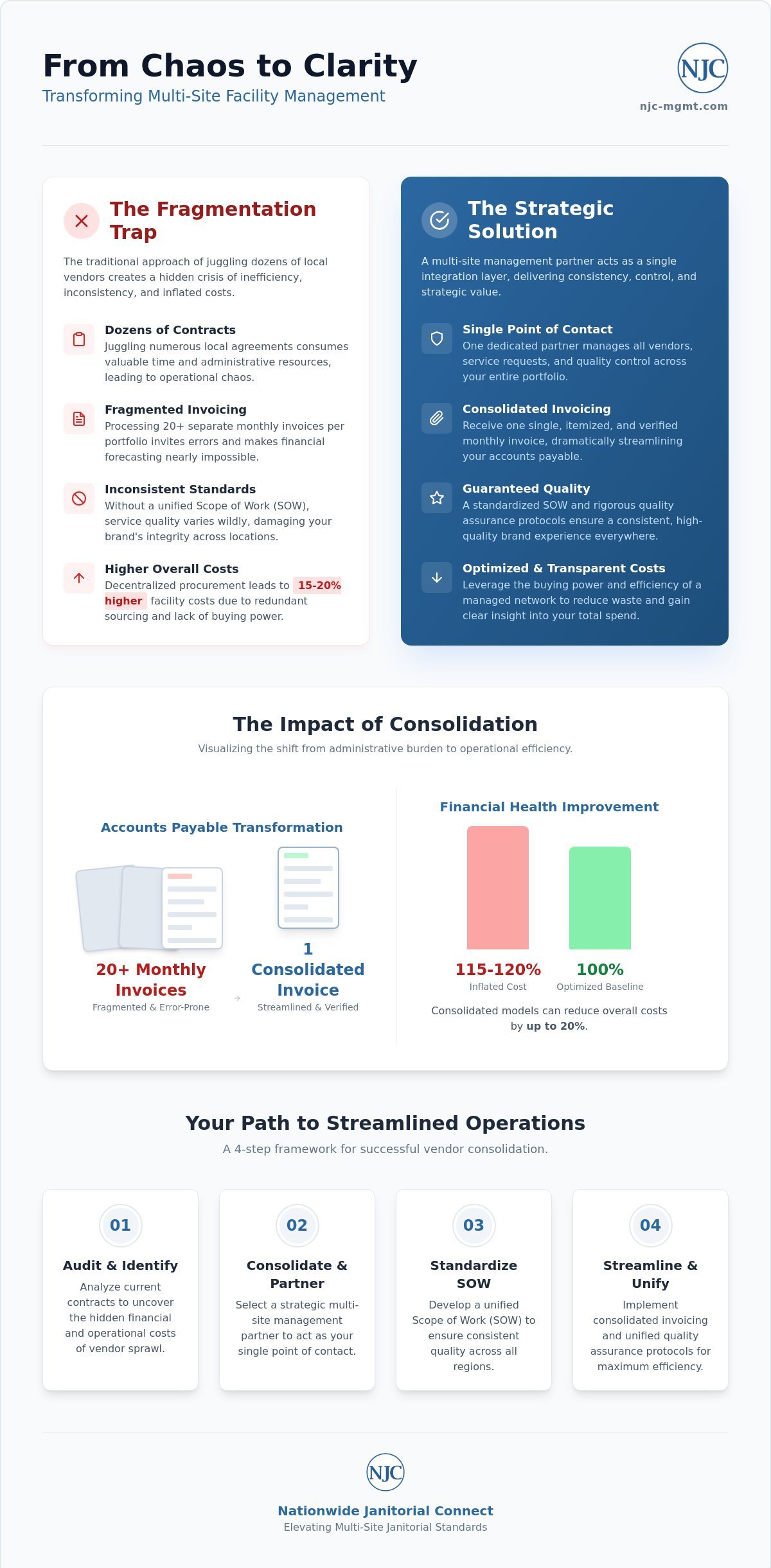
Managing a growing portfolio across multiple regions often leads to a phenomenon known as vendor sprawl. This happens when individual site managers hire local cleaners independently to solve immediate needs. While this feels efficient in the short term, it creates a fragmented ecosystem that lacks corporate oversight. Traditional sourcing methods fail because they prioritize local convenience over portfolio-wide strategy. You end up with dozens of different contracts, varying service levels, and a complete lack of transparency into your actual spend.
The administrative burden of this approach is staggering. Processing 20 or more separate monthly janitorial invoices doesn’t just waste time; it invites human error and prevents accurate financial forecasting. Relying on specialized multi-site facility management companies is no longer a luxury for large-scale operations; this is a principle that also applies to technology, where organizations like JP Technical consolidate IT support into a single, managed solution. It’s a requirement for those who want to reclaim their time and focus on high-level asset management rather than chasing down local contractors for basic proof of service.
The Fragmentation Trap for Multi-Location Businesses
Decentralized purchasing is a silent profit killer. Industry data indicates that decentralized facility procurement leads to 15-20% higher overall costs compared to consolidated models. This isn’t just about the price of chemicals or labor. It’s the cost of redundant sourcing, vetting, and contract management. Effective Facility management requires a unified vision that local-only vendors simply cannot provide. They don’t have the infrastructure to scale with your business or the systems to report data across a national footprint.
The risks extend beyond the balance sheet. In specialized environments like laboratories or clean rooms, the stakes are exceptionally high. A local vendor without specific expertise in these high-compliance zones puts your entire operation at risk of regulatory failure. When facility managers spend their days putting out fires caused by substandard local vendors, they lose the ability to engage in strategic planning. Your facilities become a liability rather than an asset.
Inconsistent Brand Integrity Across Regions
Your physical locations are the most tangible expression of your brand. If your Chicago branch is pristine but your Dallas site has neglected floor care and dirty windows, your brand promise is broken. Customers don’t see different vendors; they see one company that can’t maintain its own standards. Standardizing the Scope of Work (SOW) across diverse geographic footprints is the only way to ensure a uniform experience. Brand-consistent facility maintenance is the systematic application of uniform hygiene and aesthetic standards that protect a company’s reputation across every physical touchpoint. Without a single-source management layer, achieving this level of uniformity is nearly impossible.
Defining the Managed Facility Solution: More Than Just a Cleaning Contract
A managed facility solution is far more than a simple service agreement. It represents a strategic integration layer that synchronizes all maintenance and janitorial operations under one command structure. Unlike traditional models where you manage separate contracts for floor care, window cleaning, and daily porter services—or niche maintenance experts like Best Chimney Services—this model positions specialized multi-site facility management companies as the primary engine of your operational health. They don’t just oversee labor; they manage the entire lifecycle of facility care across your entire portfolio.
One of the most significant shifts involves the transformation of your accounts payable workflow. Consolidated billing replaces the exhaustion of processing dozens of individual invoices with a single, verified statement. This isn’t just an administrative convenience. It’s a strategic move that aligns with emerging trends in facilities management where data transparency and financial control are paramount. An unbiased management layer ensures that you only pay for work that meets your specific quality benchmarks. It removes the conflict of interest that occurs when a service provider is left to grade their own performance.
The Single Point of Contact (SPOC) Advantage
Communication breakdowns are the primary cause of service failure in multi-location portfolios. A Single Point of Contact (SPOC) eliminates the friction of the “he-said, she-said” dynamic between on-site staff and multiple vendors. Instead of your site managers spending hours on the phone, they interact with a centralized management hub. This hub operates 24/7 to handle emergency requests and routine maintenance with equal precision. By implementing facility vendor management solutions, you create a buffer that protects your internal team from the daily noise of vendor coordination.
Strategic Vendor Sourcing and Vetting
There’s a fundamental difference between a local cleaner and a vetted facility partner. High-performance multi-site facility management companies leverage extensive networks to find local expertise that meets national standards. This means a site in Houston receives the same Tier-1 service level as a site in New York. The vetting process is rigorous; it covers insurance, safety records, and specialized training for environments like laboratories or financial institutions. This ensures that every technician on your property is qualified and compliant. If you’re ready to move beyond the chaos of fragmented sourcing, exploring a structured vendor management approach is the next logical step for your portfolio.
Comparing National Conglomerates to Strategic Management Partners
When selecting a partner for a national portfolio, the default choice is often a multi-billion dollar conglomerate. These giants offer undeniable scale, but that scale frequently comes at the expense of agility and personalized oversight. Conglomerates represent the traditional path for national coverage, yet their massive internal structures often lead to a rigid, one-size-fits-all service model. If your portfolio requires specialized attention or rapid adjustments, you may find that these firms lack the responsiveness necessary to maintain your standards.
The direct labor model used by many large-scale multi-site facility management companies creates an environment where site-specific needs are secondary to corporate quotas. In this scenario, your facility is just one of thousands, and your account manager is likely handling a volume that prevents deep engagement. This “lost in the shuffle” risk is a significant concern for firms that operate in high-stakes sectors. A strategic management partner offers a viable alternative by prioritizing a managed vendor network over a massive, unspecialized workforce.
Conglomerate Pros and Cons
Conglomerates possess vast resources and standardized software, but their service packages are often inflexible. Getting personalized support for a specific location, such as a Houston-based headquarters, often requires navigating multiple layers of bureaucracy. These firms also carry high overhead costs, which are invariably passed down to the client through inflated service fees. While they provide a sense of security through their size, the lack of a high-touch management layer often results in a disconnect between corporate expectations and on-site reality.
The Strategic Partner Model (The Nationwide Janitorial Connect Approach)
Strategic multi-site facility management companies, like Nationwide Janitorial Connect, operate with a different philosophy. This model focuses on high-touch management and deep expertise in specialized environments. Instead of simply filling shifts with any available laborer, strategic partners curate a network of vetted professionals who understand the nuances of your specific industry. This approach allows for the flexibility to adapt to unique site requirements, whether you need standard janitorial care or highly specialized industrial cleaning services.
This model excels in high-compliance zones where general office cleaning isn’t enough. Financial institutions, laboratories, and clean rooms require a level of precision that generic conglomerate contracts rarely cover. By focusing on vendor performance rather than just headcount, a strategic partner ensures that quality assurance remains the top priority. You gain the benefits of national reach without sacrificing the specialized care that protects your assets and your brand integrity.
A Strategic Framework for Multi-Location Vendor Consolidation
Consolidating a fragmented vendor list requires more than just a new contract. It demands a phased transition that protects your operations while stripping away administrative waste. Most organizations struggle because they attempt to change everything at once without a clear baseline. By following a structured framework, you can transition from “putting out fires” to a proactive management model that scales with your growth. This process moves beyond simple cost-cutting; it’s about building a resilient infrastructure for your entire portfolio.
The Facility Audit: Identifying Gaps and Overlaps
The first phase involves a deep dive into your current spend. You must identify “rogue” local contracts where site managers have bypassed corporate procurement. These off-book agreements often lead to redundant services or non-compliant practices, especially in high-compliance areas like clean rooms or laboratories. A comprehensive facility audit exposes the financial leakage caused by overlapping service schedules and unverified invoices from rogue local vendors. This data becomes your leverage during the consolidation process, allowing you to reclaim lost budget and reinvest it into higher service standards.
Standardizing Standards and KPIs
Once you understand your current state, you must define what success looks like across the entire portfolio. This means creating a universal “definition of clean” that applies to every site, regardless of its location. You can’t manage what you don’t measure. Implementing Quality Assurance (QA) inspections as a mandatory metric ensures that every vendor is held to the same high standard. Establishing clear reporting protocols for facility health allows you to spot performance dips before they become brand-damaging issues. This level of standardization ensures that your facility in New York meets the same rigorous hygiene requirements as your site in Houston.
Selecting the right partner is the most critical decision in this framework. Many multi-site facility management companies claim national reach, but few possess the specialized expertise required for laboratories or financial institutions. You must prioritize partners who offer an unbiased management layer. This means they focus on vendor performance and compliance rather than just filling labor shifts. Their value lies in their ability to vet local talent against your standardized SOW and provide real-time reporting that proves the work was done correctly.
The final phase is the transition itself. This must be a “zero-downtime” event. Strategic partners use a phased rollout, starting with a pilot region to refine the new reporting and communication protocols. This approach ensures that your on-site staff is trained on the new system and that there’s no gap in service quality during the handoff. By the time the final site is onboarded, the system should be a well-oiled machine that delivers consistent results and a single, consolidated invoice. If you’re ready to eliminate the complexity of managing multiple local vendors, you can contact Nationwide Janitorial Connect for a strategic facility audit to begin your consolidation journey.
Nationwide Janitorial Connect: Elevating Multi-Site Janitorial Standards
Nationwide Janitorial Connect represents the practical application of the strategic partner model. We provide a single-source management layer for over 20 facility solutions, effectively ending the cycle of vendor sprawl that drains corporate resources. While many multi-site facility management companies offer generic labor, we prioritize a performance-driven approach that integrates seamlessly into your corporate structure. Our infrastructure is built to handle the complexities of large-scale portfolios while maintaining the agility and personalized oversight of a specialized partner. This ensures that your facility standards remain high, regardless of geographic expansion.
Our roots in Houston provide a unique advantage. We understand the demands of high-growth, high-stakes markets and have scaled that expertise into a national infrastructure. This allows us to offer the reach of a conglomerate with the high-touch service of a boutique firm. We don’t just fill shifts; we manage the entire lifecycle of your facility needs through rigorous quality assurance and a commitment to transparent, consolidated invoicing. You gain a partner that’s as invested in your brand’s physical integrity as you are.
Specialized Cleaning for High-Standard Environments
High-standard environments don’t allow for a margin of error. Managing the complexities of ISO class clean room protocols requires technical precision and a deep understanding of contamination control. We apply this same level of rigor to financial institutions and banks, where security-first cleaning is a non-negotiable prerequisite. Our teams are specifically trained to operate within the strict compliance frameworks of medical and daycare facilities. This specialized expertise ensures that your most sensitive sites meet every regulatory requirement without the need for constant corporate intervention.
Simplifying Your Facility Management Lifecycle
Nationwide Janitorial Connect acts as a strategic extension of your management team rather than just another name on your vendor list. This partnership simplifies your entire facility management lifecycle by providing a single monthly invoice for all janitorial and maintenance needs. You no longer have to reconcile dozens of local statements or manually verify individual service reports. We handle the quality assurance, vendor vetting, and performance tracking, delivering the data you need to make informed decisions about your property assets. This shift from reactive cleaning to proactive management protects your bottom line and your brand reputation.
Consolidating your vendors is a strategic move toward operational excellence. If you’re ready to eliminate the friction of fragmented facility care, simplify your multi-site operations with a custom Nationwide Janitorial Connect management plan. We provide the stability, expertise, and consolidated reporting necessary to manage your portfolio with confidence in 2026 and beyond.
Future-Proofing Your Portfolio Through Strategic Consolidation
Transitioning from a fragmented vendor list to a unified management layer is no longer just a cost-saving tactic; it’s a strategic necessity for 2026. By standardizing your scope of work and implementing a single point of contact, you eliminate the administrative paralysis that halts corporate growth. Specialized multi-site facility management companies provide the necessary oversight to ensure that high-compliance zones, such as laboratories and clean rooms, receive the technical precision they require without constant internal supervision.
NJC Management delivers this stability by acting as a single point of contact for over 20 facility solutions. We combine consolidated billing with rigorous quality assurance inspections to protect your brand’s integrity across every region. This approach transforms your facility operations from a source of friction into a reliable asset that supports your long-term business goals. If you’re ready to reclaim your time and elevate your portfolio standards, it’s time to move toward a more disciplined management model. Request a Multi-Site Management Consultation from NJC today and secure a streamlined future for your organization.
Frequently Asked Questions
What are the benefits of using a multi-site facility management company?
Using multi-site facility management companies centralizes your operational oversight and ensures a uniform brand experience across all locations. This model replaces the chaos of managing dozens of local contracts with a single, high-performance management layer. It allows your internal team to focus on strategic asset management rather than daily vendor coordination. You gain a partner that manages the entire lifecycle of your facility needs through a disciplined, singular command structure.
How does vendor consolidation reduce facility management costs?
Consolidation reduces costs by eliminating redundant administrative tasks and identifying financial leakage in “rogue” local contracts. By standardizing procurement and invoicing, businesses often uncover significant maintenance waste that was previously hidden in fragmented billing. A single-source integrator leverages portfolio-wide data to optimize service schedules and reduce overall operational overhead. This strategic shift transforms facility maintenance from a variable expense into a predictable, managed asset.
Can a management company handle specialized cleaning for clean rooms and labs?
Strategic management partners with specialized expertise can indeed handle high-compliance environments like ISO-rated clean rooms and laboratories. These facilities require strict adherence to contamination control protocols and specialized technician training. NJC Management provides these specialized services, ensuring that your most sensitive sites remain compliant and operational. This eliminates the need for you to source separate, niche vendors for your technical spaces.
Is it better to use one national company or multiple local cleaning vendors?
A strategic management partner is generally superior to managing multiple local vendors or a single, rigid national conglomerate. This model provides the agility of local expertise combined with the stability of a national infrastructure. It ensures you don’t get lost in the shuffle of a multi-billion dollar firm while maintaining the high standards necessary for your brand’s integrity. You receive personalized attention without the administrative burden of managing local crews yourself.
How do multi-site companies ensure consistent quality across different states?
Consistency is maintained through the implementation of a universal Scope of Work (SOW) and mandatory Quality Assurance inspections. By establishing clear KPIs and reporting protocols, multi-site facility management companies can monitor performance in real-time across different states. This data-driven approach ensures that every location, regardless of its distance from headquarters, meets the same rigorous corporate standards. It provides an unbiased layer of accountability for every vendor in the network.
What industries benefit most from consolidated facility management?
Industries with geographically diverse footprints, such as retail, financial institutions, and medical facilities, benefit most from consolidation. These sectors require a uniform customer experience and high hygiene standards across every touchpoint. Consolidated management ensures that brand integrity is preserved whether a customer visits a branch in Houston or a satellite office in another state. It provides the stability required for sectors that operate under strict regulatory oversight.
How does NJC Management handle quality assurance for remote locations?
NJC Management utilizes a centralized management hub and standardized on-site inspection protocols to ensure quality in remote locations. We grade every service provider against your specific KPIs, providing unbiased reporting that proves compliance. This system allows us to detect and correct performance dips immediately, ensuring that remote sites receive the same level of care as your primary headquarters. Our commitment to quality assurance protects your assets and your reputation.
What is the typical transition period when consolidating facility vendors?
The typical transition involves a phased rollout that usually spans several months to ensure zero service interruptions. We begin with a pilot region to refine reporting and communication protocols before scaling to the rest of the portfolio. This structured approach allows for thorough staff training and ensures a seamless handoff from previous vendors to our integrated management layer. It’s a zero-downtime event designed to protect your ongoing operations.