Commercial Snow Removal in Houston: Strategic Ice & Winter Management for 2026
In Houston, the cost of being unprepared for a freeze isn’t just a minor delay; it’s a documented $200 billion economic impact as seen during the February 2021 winter storm. You understand that while snow is rare, the liability of a single slip-and-fall accident on an untreated walkway can devastate your annual budget. Reliability is the only currency that matters when the temperature drops, yet securing a professional snow removal partner during a city-wide emergency often feels impossible.
This guide provides the strategic framework you need to master ice management protocols for the 2026 winter season. We’ll examine how to vet high-performance vendors, implement rapid response triggers, and leverage consolidated billing to ensure your operations remain uninterrupted. You’ll gain a clear roadmap for maintaining local safety compliance and protecting your assets against unpredictable Gulf Coast weather with absolute confidence.
Key Takeaways
- Understand why “ice management” is the critical priority for Houston facilities and how to differentiate it from traditional snow removal protocols.
- Learn the technical distinction between anti-icing and de-icing to protect your facility’s infrastructure and ensure safe passage before the storm hits.
- Discover the strategic advantage of a single-managed solution over fragmented vendor hiring to eliminate logistical failures during weather emergencies.
- Master the essential winter preparedness checklist, including high-risk zone identification and the necessity of securing priority contracts by November 1st.
- Explore NJC Management’s rapid-response protocols and 24/7 monitoring designed specifically for high-compliance environments like banks, labs, and schools.
The Reality of Snow Removal and Ice Management in Houston, TX
Commercial snow removal in Houston differs fundamentally from northern operations. In our subtropical climate, the focus shifts from volume-based plowing to precision ice mitigation. While heavy snowfall remains rare, the February 2021 winter storm proved that even 2 inches of accumulation can paralyze local infrastructure for days. For Houston facilities, “ice management” is the technically accurate term. It describes the strategic application of chemical treatments to prevent bonding between frozen precipitation and pavement. Effective snow removal and ice management strategies focus on pre-treatment rather than reactive clearing. This approach ensures that business operations remain uninterrupted during volatile weather shifts.
The 2021 freeze resulted in over $200 billion in economic losses across Texas, highlighting the high cost of being unprepared. The January 2024 freeze, where temperatures in the Energy Corridor plummeted to 18°F, reinforced this necessity. Unprepared facilities face structural damage and prolonged closures that impact the bottom line. Different industries face unique challenges during these events:
- Medical: The Texas Medical Center requires 24/7 clear access for emergency vehicles and staff to ensure patient safety.
- Financial: Banking hubs must maintain secure, accessible teller lanes and ATM access to prevent service disruptions.
- Industrial: Logistics centers near the Port of Houston lose approximately $100 million in daily productivity when surface ice halts trucking operations.
The Houston ‘Flash Freeze’ Phenomenon
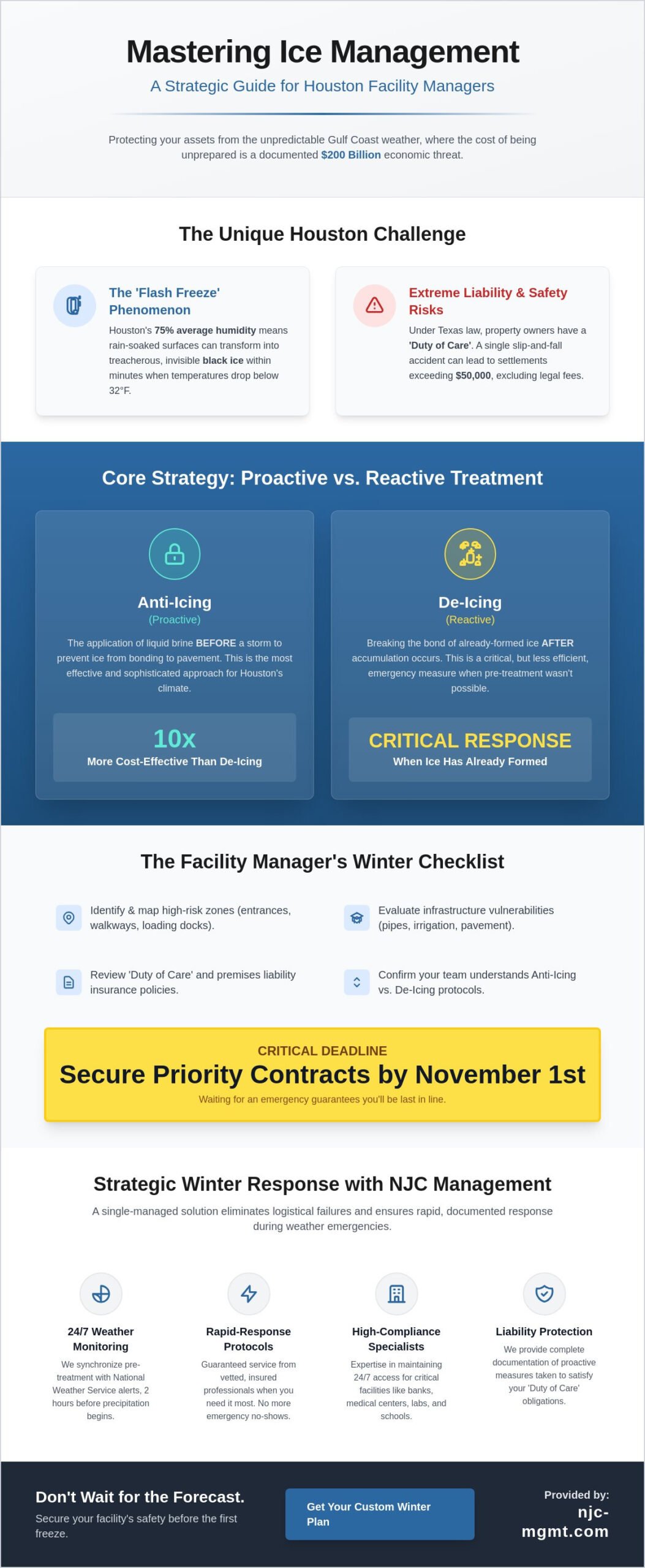
Houston’s 75% average humidity creates a unique hazard during rapid temperature drops. When temperatures fall below 32°F after a rain event, moisture on surfaces transforms into invisible black ice within minutes. Standard northern plowing techniques don’t work on Houston overpasses because the ice layer is often too thin for heavy blades but too slick for standard tires. While TxDOT manages municipal highways and major thoroughfares, private property owners bear total responsibility for their sidewalks, loading docks, and parking structures.
Liability and Safety Risks for Commercial Properties
Texas premises liability laws require property owners to maintain safe environments for invitees at all times. A single slip-and-fall accident on a commercial lot can result in settlements exceeding $50,000, not including associated legal fees. Property managers must document their proactive measures to mitigate these risks effectively. Duty of care represents the legal obligation of a Houston property manager to take reasonable, proactive steps to identify and eliminate ice hazards before they cause injury to tenants or visitors. This proactive stance is the only way to protect a commercial portfolio from the financial fallout of a winter event. Using professional snow removal services provides the documentation and execution needed to meet these strict legal standards.
Technical Strategies: Anti-Icing vs. De-Icing for Houston Facilities
Effective winter management in Southeast Texas requires a data-driven approach that balances chemical efficacy with infrastructure protection. Houston’s infrastructure isn’t built for sustained freezes, making the choice between anti-icing and de-icing a matter of financial and operational risk management. Strategic snow removal starts long before the first flake falls, focusing on the chemistry of adhesion prevention rather than just physical clearance.
Pre-Treatment: The Power of Anti-Icing
Anti-icing is the most sophisticated tool in a facility manager’s arsenal. By applying a liquid brine or magnesium chloride solution before a storm, we lower the freezing point of water on the pavement surface. This prevents ice from bonding to the substrate. Industry data confirms that anti-icing is 10 times more cost-effective than reactive de-icing because it requires significantly less material to achieve the same safety outcome. We synchronize these applications with National Weather Service Houston alerts, ensuring treatments are active at least 2 hours before precipitation begins. This methodology aligns with the best practices outlined in the Federal Highway Administration’s manual on Technical Strategies: Anti-Icing vs. De-Icing, which emphasizes the reduction of chemical runoff through precision liquid application.
Reactive De-Icing: Clearing the Way After Accumulation
When unexpected accumulation occurs, reactive de-icing becomes the priority. This phase involves breaking the bond of already-formed ice or packed snow. In Houston, we frequently face refreeze cycles. During the February 2021 freeze, daytime melting followed by rapid evening cooling created lethal black ice across commercial parking lots. To combat this, we use mechanical snow removal combined with high-traction grit and salt mixtures. We select chemical agents specifically for Houston’s unique concrete and asphalt compositions. Standard rock salt can cause spalling on newer concrete; we often pivot to calcium chloride or treated salt blends that work down to negative 25 degrees Fahrenheit. This ensures walkways remain clear during multi-day cold snaps without compromising the property’s structural integrity.
Protecting Houston’s drainage systems is a non-negotiable part of our technical strategy. Excessive salt runoff can damage local ecosystems and violate municipal codes. We utilize specialized liquid sprayers and calibrated salt spreaders to ensure 98 percent of the product stays on the target surface. A comprehensive winter management partner will always prioritize these environmental safeguards to protect your brand’s reputation and the city’s water quality.
Managed Facility Solutions vs. Direct Vendor Hiring
Managing winter weather in Houston is a high-stakes logistical puzzle that many property owners underestimate. Most facility managers juggle between five and twelve different service providers, creating a fragmented response when temperatures drop. During the 2021 freeze, businesses with decentralized contracts experienced a 35% increase in operational downtime because they couldn’t reach their individual vendors. Hiring direct often leads to a bidding war during an active storm. Vendors naturally prioritize the highest bidder or the largest contract, leaving smaller or mid-sized commercial properties at the back of the line. Consolidating your snow removal needs with your janitorial company transforms a reactive chore into a proactive business strategy.
The Single-Source Management Advantage
NJC Management eliminates the chaos of emergency vendor hunting. We vet partners for reliability 12 months in advance, ensuring they possess the specific equipment needed for 2026 weather patterns. This approach integrates Strategic Winter Response protocols into your existing infrastructure. By folding snow removal into a broader facility vendor management solution, you secure a priority position in the service queue. When the city shuts down, your facility doesn’t. Our model removes the uncertainty of whether a crew will show up. We replace that anxiety with a contractually guaranteed response time and a single point of contact who understands your site’s specific vulnerabilities.
Consolidated Billing and Reporting
Administrative efficiency is a core business value that we take seriously. Processing 20 or more individual invoices for a single winter event is an unnecessary burden on your accounting team. Managed solutions provide a single, transparent invoice that covers every aspect of site maintenance. This documentation is audit-ready. It simplifies insurance claims by providing timestamped proof of service and geolocation data from the crews on-site.
- Eliminate the 15-20 hours spent on manual invoice reconciliation after a storm.
- Access 100% transparent reporting that satisfies both internal stakeholders and insurance adjusters.
- Use historical data from the past five Houston winter events to build a precise 2026 budget.
We use data to predict and budget for future events rather than guessing. You gain visibility into your spending while reducing the time spent on manual data entry by 60%. This level of transparency ensures that every dollar spent contributes directly to site safety and operational continuity. A managed solution isn’t just about clearing ice. It’s about protecting your bottom line through superior administrative discipline.
The Houston Facility Manager’s Winter Preparedness Checklist
Operational continuity in Houston requires more than a reactive mindset. By 2026, the volatility of Gulf Coast winters has proven that waiting for a forecast is a high-risk gamble. A professional approach starts with a rigorous site audit. You must identify high-risk zones like loading ramps, north-facing stairs, and shaded walkways that retain moisture. These areas become liability traps the moment temperatures dip. Securing a priority service contract for snow removal before November 1st is the only way to ensure your facility isn’t at the bottom of a vendor’s list during a regional freeze.
Verifying vendor readiness is equally critical. Don’t assume your provider has the necessary equipment or current insurance. Demand proof of general liability and workers’ compensation coverage that specifically includes ice and snow operations. Once an event concludes, the focus shifts to asset preservation. Tracking salt and de-icing chemicals into your lobby can degrade expensive finishes within 48 hours. This makes commercial floor cleaning a non-negotiable step in your post-event recovery plan to prevent permanent floor damage.
Site Audits and Hazard Identification
Mapping your facility involves identifying “Must-Clear” zones to maintain strict ADA compliance. Slopes and ramps must remain friction-ready to prevent accidents. Drainage issues are often the primary cause of black ice in Southeast Texas. Houston’s drainage systems are engineered for volume discharge of rain rather than the gradual melt of ice, which often leads to rapid refreezing on surface pavements. Catch basins that are clogged with autumn debris will cause melt-water to pool and freeze, creating hazardous patches that persist long after the sun comes out.
Emergency Communication Protocols
Efficiency depends on clear trigger points. Establish a protocol where snow removal vendors are dispatched automatically when the temperature hits 34°F and precipitation is forecast. You need a centralized communication chain to update tenants and employees on facility status via SMS or email every 4 hours during an event. For large-scale facilities, industrial cleaning services play a vital role in clearing debris and chemical residues from warehouse floors and production zones to ensure safe operations immediately after the storm passes.
Protect your property and ensure business continuity by partnering with experts. Secure your 2026 winter management strategy with NJC Management.
Strategic Winter Response with NJC Management
NJC Management approaches winter weather with the same rigor required by global financial hubs and medical research facilities. We don’t wait for a storm to hit; we prepare for the 2026 season months in advance. Our strategy relies on a 24/7 monitoring system that tracks ground temperatures and precipitation levels in real-time. This proactive stance allows our rapid-response vendor network to initiate snow removal and de-icing protocols within a 60-minute window of a weather trigger. For Houston portfolios, this means business continuity remains uninterrupted, even during the rare but disruptive ice events predicted for the coming years.
We manage the total facility environment by looking beyond the pavement. Our approach integrates exterior safety with interior preservation. Winter conditions often lead to increased moisture and debris being tracked into buildings, which can damage flooring and compromise air quality. NJC Management synchronizes outdoor clearing with indoor maintenance schedules to ensure your entire asset remains protected. Our vendor network is vetted for high-compliance environments, ensuring that every technician on your site understands the specific operational requirements of your industry.
Specialized Cleaning in Harsh Weather
High-compliance environments require more than just a clear parking lot. Within sterile facilities, our clean room janitorial services are designed to prevent the tracking of corrosive ice-melt chemicals or winter contaminants into sensitive areas. We use specialized matting systems and increased cleaning frequencies to maintain ISO standards during weather emergencies.
Banks and financial institutions benefit from our vetted teams who understand that emergency clearing must occur within strict security protocols. We ensure that ATM access and secure entry points are cleared without compromising perimeter integrity. For schools and daycares, we prioritize safety standards that mandate zero-tolerance for ice on walkways before the first bell rings. Our teams focus on high-traffic zones, including bus drop-off points and playground entries, to minimize liability and keep students safe.
Your Strategic Partner in Houston
The NJC promise is built on professionalism, transparency, and measurable results. We don’t just provide a service; we act as a strategic partner that stabilizes your operations during chaotic weather events. Our facility managers receive real-time updates and digital documentation of all snow removal activities, providing a clear audit trail for compliance and insurance purposes.
Getting started is a straightforward process focused on value creation. We begin with a site-specific audit to identify high-risk areas and critical access points. From there, we build a comprehensive commercial cleaning and management plan that fits your 2026 budget and operational goals. This long-term perspective ensures you aren’t scrambling for vendors when a freeze is imminent.
Partner with NJC Management for total facility peace of mind. Contact us today to request a custom winter management quote for your Houston portfolio.
Strengthen Your Houston Portfolio for the 2026 Winter Season
Houston’s unpredictable climate demands a proactive stance rather than a reactive scramble. Effective snow removal and ice management depend on selecting the right technical strategies, such as anti-icing and de-icing, well before the first freeze hits. Transitioning from direct vendor hiring to a managed solution provides the stability needed for complex property portfolios. NJC Management offers a strategic advantage through an elite network of 50+ Houston contractors. We navigate the rigorous compliance requirements of medical and financial institutions, ensuring your facility meets every safety standard. You’ll gain efficiency through consolidated monthly invoicing for 20+ services, which eliminates administrative friction. This approach transforms winter maintenance from a seasonal burden into a managed business asset. Don’t wait for the next weather event to test your infrastructure’s limits. Secure Your Houston Facility Winter Response Plan Today and enjoy the confidence that comes with expert oversight. We’re ready to protect your investment and ensure your operations remain seamless.
Frequently Asked Questions
Is snow removal legally required for Houston commercial businesses?
Commercial property owners in Houston bear legal responsibility for maintaining safe premises under Texas premises liability law. While specific city ordinances for winter weather are rare, the 2021 Winter Storm Uri established a strong legal precedent for duty of care. Business owners must mitigate “unreasonably dangerous conditions” to avoid negligence claims. It’s vital to act quickly because failure to do so can result in costly personal injury lawsuits if a slip and fall occurs on your property.
What is the difference between anti-icing and de-icing for parking lots?
Anti-icing is a proactive strategy applied before a storm hits to prevent ice from bonding to the pavement. We use liquid brine solutions that lower the freezing point of water on surfaces. De-icing is a reactive method used after ice has already formed. This process uses granular salt or chemicals to break an existing bond. Combining both methods reduces total chemical usage by 30 percent compared to using reactive treatments alone.
How much does commercial snow removal management cost in Houston?
Commercial snow removal costs in Houston vary based on square footage and the specific service level required for your facility. According to industry data from the Snow and Ice Management Association (SIMA), pricing depends on parking lot acreage and the volume of chemicals applied. Factors like site complexity and specific response time triggers influence the final investment. We provide customized quotes following a 20-point site inspection to ensure your budget remains accurate.
Can my regular janitorial team handle ice removal?
Standard janitorial teams don’t have the specialized equipment or the high-limit liability insurance required for winter weather operations. Most general liability policies for janitorial services specifically exclude “snow and ice slip and fall” coverage. Professional crews use heavy-duty spreaders and commercial-grade liquids that janitorial staff can’t access. Risking your property’s safety with untrained personnel increases your legal exposure and operational risk during a freeze.
What chemicals are safest for Houston’s environment and infrastructure?
Calcium magnesium acetate (CMA) is the safest choice for Houston’s concrete infrastructure and the surrounding landscape. It’s significantly less corrosive than standard rock salt; it won’t damage the rebar within your parking structures. We also utilize liquid brine with organic additives to reduce sodium chloride runoff into local watersheds. These professional-grade solutions protect your 5-year pavement warranty while ensuring pedestrian safety throughout the winter season.
How quickly can a vendor respond to a Houston freeze warning?
Contracted partners receive a guaranteed response time, typically within 2 to 4 hours of a National Weather Service freeze warning. Our team monitors local meteorological data 24/7 to stage equipment before the first snowflake or ice pellet falls. Non-contracted businesses often wait 12 hours or more for service during peak demand periods. Priority scheduling ensures your facility remains operational and accessible to employees and customers without any delay.
Does NJC Management provide services for multi-location properties outside Houston?
We provide comprehensive snow removal management for multi-location portfolios across the Greater Houston area and neighboring Texas regions. Our strategic approach ensures consistent service levels whether you manage 10 or 100 different sites. You’ll have a single point of contact and unified reporting for every property in your portfolio. This centralized management model eliminates the administrative burden of coordinating with multiple local vendors during a crisis.
What happens if a vendor fails to show up during a storm?
Vendor failure during a storm leaves your business vulnerable to lawsuits and forced closures. Our contracts include a “Zero-Failure” guarantee backed by redundant equipment and backup crews stationed throughout the city. We provide real-time GPS tracking and digital logs to prove service completion for insurance purposes. If a provider misses a trigger point, they’re often liable for any resulting fines or safety incidents that occur on the site.